

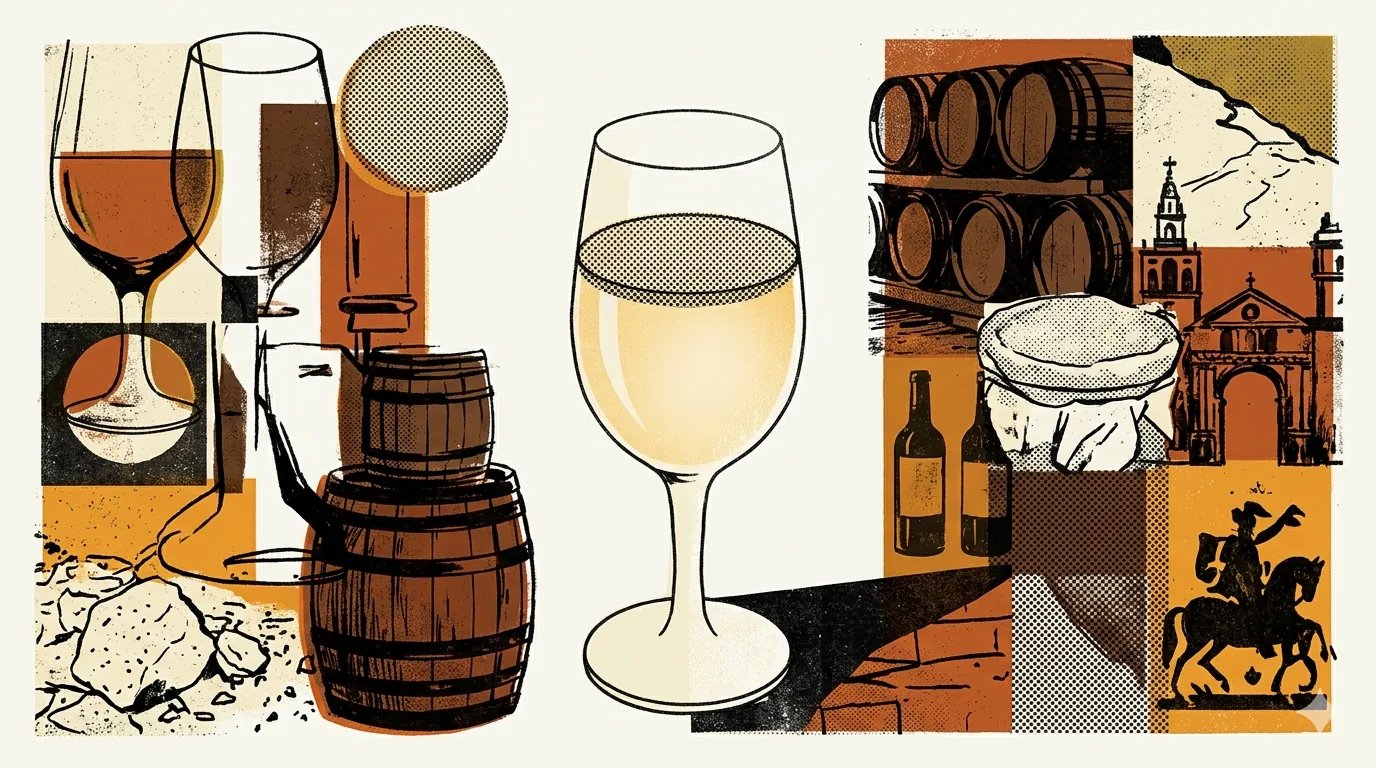
Eight degrees Celsius, a copita, a small bowl of green Manzanilla olives and a handful of toasted almonds. The first sip of fino sherry lands salty, faintly bitter, with a nose somewhere between fresh bread and bruised green apple. This is not a sweet old-aunt wine. It is one of the driest white wines in the world, made from Palomino, aged under a living film of yeast, and built to finish at the table before the main course begins.
Fino in specifications
| Feature | What applies to fino | Where you notice it |
|---|---|---|
| Grape | 100 percent Palomino Fino, a neutral variety with low acidity and little colour | That neutrality is what lets the flor, rather than the grape, shape the wine |
| Alcohol | Fortified to 15 to 15.5 percent, a window less than a percentage point wide | Above 15.5 percent the flor dies, below 14.5 percent it fails to establish |
| Residual sugar | Under 1 gram per litre, so no added sugar and no caramel note | Fino tastes drier and leaner than its 15 percent alcohol suggests |
| Where it may age | Jerez de la Frontera or El Puerto de Santa María, never Sanlúcar | Age the same wine in Sanlúcar and it is called manzanilla instead |
| Ageing | Two years minimum by law, four on average in practice, four to seven for premium bottlings | Beyond seven years is impossible: the flor dies and the wine shifts toward amontillado |
| Acetaldehyde | 30 to 80 milligrams per litre in a good fino | This is the compound behind green apple, bread dough and almond |
| Serving temperature | 6 to 9 degrees Celsius, in a copita or an ordinary white wine glass | Too warm and the alcohol takes over, too cold and the aromatics close down |
| Life after opening | One to two weeks in the fridge under a decent stopper | Champagne lasts one to two days, oloroso weeks to a month |
What is fino sherry?
Fino is the pale, dry, biologically aged style from Andalusia. Four things define it: 100% Palomino Fino as the grape, biological aging under a layer of flor yeast, fortification to roughly 15% alcohol, and a dry finish with less than 1 gram of residual sugar per litre. Colour runs from pale straw to light gold. Body is lean, mouthfeel dry, finish saline and gently bitter.
The gap with the sweet sherry that still haunts Dutch sideboards is fundamental. Fino contains no added sugar and no oxidative caramel notes. What you taste comes almost entirely from flor: a biofilm of Saccharomyces yeasts that lives on the surface of the wine and shields it from oxygen.
Where is fino made? Jerez and El Puerto
Fino comes from two of the three towns in the Marco de Jerez: Jerez de la Frontera and El Puerto de Santa María. The third town in the triangle, Sanlúcar de Barrameda, makes its own biologically aged style officially called manzanilla. Same grape, same method, different postcode.
The difference sits in microclimate. Jerez is inland, on hills up to about 87 metres above sea level. Warmer, drier, with summers in which the flor layer thins out temporarily. As a result Jerez fino tends to carry slightly more body and a hint of oxidative depth. El Puerto sits at the mouth of the Guadalete with moderate Atlantic influence and steadier humidity. Flor grows more evenly there, and the finos are typically fresher and more saline than their Jerez counterparts.
The whole production zone covers around 7,000 hectares of vineyard, governed by the Consejo Regulador, founded in 1935. Almost all of it is planted on albariza, the white chalky soil that retains water and forces roots deep.
How is fino made? Palomino, flor and 15% alcohol
Palomino Fino is a neutral grape. No striking aromatics, low acidity, little colour. That is exactly why it works. Flor would smother the perfume of an aromatic variety; Palomino is a blank canvas the yeast spends four to seven years painting on.
The base wine ferments to about 11 to 12% alcohol. Then comes the selection. Casks that look pale and lively get a light fortification with grape spirit to 15 to 15.5% alcohol. Above 15.5% flor dies; below 14.5% it does not establish reliably. That narrow window decides whether a wine becomes fino or heads toward oloroso.
The wine then enters the solera: the fractional aging system in which older casks (the solera) are drawn down and topped up from younger casks (criaderas) above. At each bottling rarely more than a third of any cask is drawn off. Legal minimum: 2 years of aging. In practice the average stock in Jerez bodegas sits around 4 years, and most premium finos reach the bottle after 4 to 7 years.
Under the flor the wine changes chemically. The yeast eats glycerol, eats oxygen, slowly eats alcohol too (about 0.1% ABV per year), and produces acetaldehyde, the compound that gives fino its signature: green apple, bread dough, almond. Acetaldehyde concentration in a quality fino sits between 30 and 80 mg/l.
Tasting profile: salt, almond, bread and freshness
A good fino smells of bitter almond, fresh bread dough, chamomile, bruised green apple and a saline edge that tasters invariably call “sea air”. On the palate it is lean, dry, gently bitter on the finish and tighter than you would expect from 15% alcohol. No glycerol sweetness, no roundness. Flor has eaten precisely those elements.
Compare it with manzanilla and the difference is subtle but real. Manzanilla from Sanlúcar is paler, saltier and lighter. El Puerto fino sits in the middle. Jerez fino often has a nuttier, slightly fuller side.
Serving temperature and glassware
Serve fino between 6 and 9 degrees Celsius, cooler than most white wines. Too warm and the alcohol takes over; too cold and the subtle aromatics close down. The ISO copita is the traditional glass: narrow, upright, with a slightly inward-curving rim that funnels the aromas. A standard white wine glass works fine. Avoid the wide schooner that fino still arrives in at some restaurants; it kills the aromatics.
Do not pour too much at once. Four to five centilitres, and refill as the glass warms.
Storage: why fino does not belong in the back of the cabinet
Fino is a living wine, and once the bottle is open the decline is fast. One to two weeks in the fridge with a good stopper, and the profile tips over. The green apple drops away, the salinity flattens, the bitterness sharpens.
That sounds short, but in practice it is comfortable. Champagne after opening lasts 1 to 2 days; oxidative sherries such as oloroso stay good for weeks or a month. Fino sits between the two, with a clear window.
Unopened bottles of fino are not eternally cellarable either. Unlike vintage Champagne or premier cru Burgundy, fino is meant to be drunk young. Buy what you will finish in a few months, not what should sit on the rack in five years’ time.
Producers worth knowing
Four names to start with, no posturing:
- Tío Pepe (González Byass, Jerez), the international reference. Widely available in the entry-level segment. The Tío Pepe en Rama version (see next section) is more than that.
- La Ina (Lustau, Jerez), formerly Domecq. Slightly nuttier and fuller than Tío Pepe.
- Hidalgo-La Gitana (Sanlúcar), best known for manzanilla, but the finos are classic and fairly priced.
- Lustau Puerto Fino (El Puerto de Santa María), textbook El Puerto fino, with the saline balance that sits between Jerez and Sanlúcar.
A step up sits Valdespino Inocente, a single-vineyard fino from the Macharnudo Alto pago, fermented in oak butts. And if you want to go really deep: the Equipo Navazos La Bota series. A collective around Jesús Barquín and Eduardo Ojeda which releases single-saca bottlings from soleras they hand-pick. La Bota finos sit in the premium segment and are usually limited.
En rama: the unfiltered new wave
En rama literally means “from the branch”, in practice unfiltered or minimally filtered. Over the past years this has become the most-discussed segment within sherry. The wine is bottled straight from cask, with flor remnants and cell walls still in suspension, instead of the heavy kieselguhr filtration that became standard in the late twentieth century.
The effect is dramatic. An en rama has more texture, fuller mouthfeel, more intense bread and yeast notes, and an aromatic profile much closer to what you taste from cask in the bodega. Bottlings are seasonal: spring and autumn, when the flor layer is at its thickest. Tío Pepe releases a yearly en rama, Lustau has its own en rama editions, and Equipo Navazos releases single sacas at each launch.
Important: VOS (Vinum Optimum Signatum, average 20 years old) and VORS (average 30 years) do not exist for pure fino. Flor dies around the seven-year mark, so any fino held longer in solera shifts naturally into amontillado territory. VOS and VORS are reserved for the oxidative styles: amontillado, oloroso, palo cortado and Pedro Ximénez.
Pairing: what fino does at the table
Fino is a table wine, not just an aperitif. It needs food, and it does things few other wines can.
- Ibérico ham, sliced from a good paleta. Salt on salt, fat on saline; the classic pairing.
- Pescaíto frito, the Andalusian fried fish. Fino’s bitterness cuts through fried-fish oil the way no white wine does.
- Oysters and mussels. Fino sits next to Chablis as the best oyster wine in the room.
- Sushi and sashimi. The umami from acetaldehyde matches the umami of dashi, soy and seaweed butter.
- Toasted almonds, Manzanilla olives, capers. Salt and bitter always work.
- Croquetas, grilled chicken, smoked sardines, gazpacho.
What does not work: sweet sauces, milk chocolate, creamy desserts. Fino is dry and bitter; sweetness hollows it out.
Frequently asked questions
What makes a sherry a fino?
Four things: 100% Palomino Fino, biological ageing under a layer of flor yeast, fortification to roughly 15% alcohol, and a dry result with less than 1 gram of residual sugar per litre. The flor shields the wine from oxygen and accounts for 90% of what you taste.
What does fino taste like?
Green apple, bread dough and almond, with a saline edge. That signature comes from acetaldehyde, the compound the flor produces; a good fino carries 30 to 80 mg/l. On the palate it is lean, dry and tighter than you expect at 15% alcohol.
How long can you keep fino?
Not long. Buy what you will finish within a few months, not what should still be on the shelf in five years. Once open it goes faster still: fino loses its freshness within days, where an oxidative oloroso stays good for weeks to a month.
What is fino en rama?
Fino bottled unfiltered and without cold stabilisation, as close as possible to what was in the cask. Bottlings are seasonal, in spring and autumn when the flor layer is at its thickest. Tío Pepe releases an en rama version every year and Equipo Navazos works with single sacas per release.
What is the difference between fino and manzanilla?
The place of ageing. Fino matures in Jerez de la Frontera or El Puerto de Santa María; manzanilla exclusively in Sanlúcar de Barrameda, at the mouth of the Guadalquivir. The coastal air makes the flor thicker there and the wine drier and more saline.
Sources
- Consejo Regulador of the Denominations of Origin “Jerez-Xérès-Sherry”, Manzanilla-Sanlúcar de Barrameda and Vinagre de Jerez. sherry.wine, official regulation and style definitions.
- SherryNotes, “Flor: the sherry yeast” and “VOS, VORS and the age of sherry”. sherrynotes.com, reference for flor microbiology and age certification.
- Peter Liem, Sherry, Manzanilla & Montilla (2014); and Julian Jeffs, Sherry (Classic Wine Library, 7th edition 2020). Standard works on the Marco de Jerez.
- Equipo Navazos / La Bota series. Background on en rama, single-saca and pago bottlings. equiponavazos.com
- Foods & Wines from Spain, “Biological aging and the world of fino and manzanilla”. foodswinesfromspain.com