

Someone pours cream sherry and the whole table grimaces: that is the sticky bottle from grandma’s drinks cabinet, right? Sometimes true. But also not, because the real cream is a blended oloroso with the depth of raisin, walnut and date, and the latest generation is far from sugar water. Forget the eighties and look again.
The Consejo’s sugar classes
| Category | Residual sugar per litre | Base wine and colour |
|---|---|---|
| Dry | 4 grams maximum, lowered from 5 in the 2023 modernisation | The dry generosos: fino, manzanilla, amontillado, palo cortado and oloroso |
| Medium Dry | 5 to 45 grams | Usually amontillado, reads as dry until a soft rounding shows up in the finish |
| Medium Sweet | 45 to 115 grams | Amontillado or light oloroso, with nut and dried fruit still recognisable |
| Pale Cream | 50 grams minimum by law since October 2022, in practice 115 to 140 | Fino or manzanilla, sweetened with colourless must to preserve the pale tint |
| Cream | 115 grams minimum, commercially usually 115 to 140 | Oloroso, dark amber to mahogany, with raisin, fig, date and walnut |
| Pedro Ximénez | 212 grams minimum | The sweet sherry of sun-dried grapes, which doubles as the sweetener for the others |
| Moscatel | 160 grams minimum | Lighter and more floral than PX, with peach and orange blossom |
Sugar measurement shifted in 2023 from total reducing substances to glucose and fructose only. Labels rarely state the figure, so rely on the bodega’s fact sheet.
What are Cream, Pale Cream and Medium?
Sherry has two axes: colour and sugar. The dry generosos are fino, manzanilla, amontillado, palo cortado and oloroso. Above them sit the sweet blends, made by marrying a dry base wine with a naturally sweet sherry or concentrated grape must. Cream, Pale Cream and Medium are those blends, and they differ mainly in how much sugar they contain and which base wine sets the tone.
Cream is the heaviest and darkest, built on oloroso. Pale Cream has the same sugar level but a light fino or manzanilla base, so it stays pale in colour. Medium sits in between, with less sugar and often an amontillado background. None of the three is a bodega accident. They are deliberately built wines that were once the export engine of Jerez and are now reclaiming their own place.
How do you make a Cream? Oloroso plus PX or Moscatel
A Cream sherry almost always starts as oloroso: palomino must dry-fermented, fortified to about 17 percent and then aged oxidatively without flor protection. That base delivers notes of walnut, coffee, leather and dried orange peel. After that the wine is sweetened.
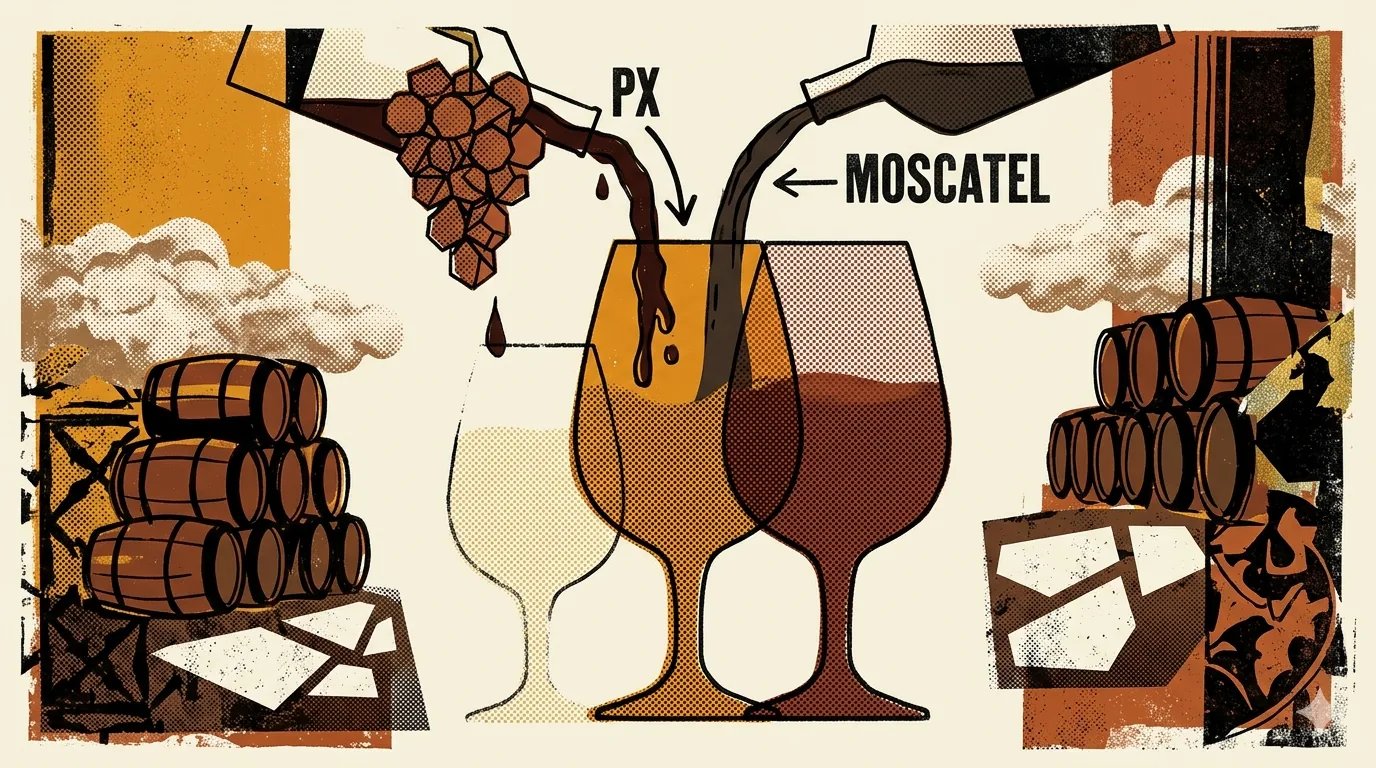
There are three routes. The classic method blends in Pedro Ximénez, the syrup-black sweet sherry from sun-dried grapes with sometimes 400 grams of residual sugar per liter. A second route uses Moscatel, lighter and more floral, with more peach and orange blossom. The third method works with mosto concentrado or vino dulce natural, concentrated grape must used purely as a sweetener.
The Consejo Regulador sets the minimum for Cream at 115 grams of residual sugar per liter, and most commercial Creams land between 115 and 140 g/L. That is around three times as sweet as an average dessert wine, but still far from a PX that can sit above 300 g/L. The alcohol stays between 15.5 and 22 percent, usually around 17 to 19.
The colour is dark amber to mahogany. In the glass you find raisin, fig, date, caramel, walnut and dried apricot, with a finish that can pull toward coffee and bitter chocolate in older examples.
Pale Cream: the lighter sibling
Pale Cream is the youngest official category within the sweet blends. Until the late eighties it did not exist, and it emerged when Croft Original opened a commercial niche in 1975: a sherry that tastes sweet but looks pale, for drinkers who found the heavy brown of Cream too imposing.
The production method flips Cream around. The base is not an oloroso but a biologically aged wine, fino or manzanilla, with the pale colour and the saline, almond-like nervousness of flor. That wine is sweetened with concentrated must or rectified concentrated grape must that is deliberately colourless, precisely to preserve the pale tint.
The legal minimum has been 50 grams of residual sugar per liter since October 2022, but in practice houses bottle Pale Cream between 115 and 140 g/L. Commercially the sugar range sits close to Cream. But the flavour is different: pale gold instead of amber, fresh citrus and peach instead of nut and caramel, and a much shorter finish. Pale Cream is the aperitif version of the sweet category, often served well chilled, with a target audience that prefers a fruity angle to a penetrating one.
Iconic in this category are Croft Original, Harveys Pale Cream and Lustau Papirusa-style experiments. The debate question among purists remains whether a sweetened fino can still be called “fino” in spirit. The Consejo says yes, provided the rules are met. The flavour says: it is its own thing, judge it on its own merits.
Medium: between dry and sweet
Medium is not an in-between category but an umbrella with two subclasses. Medium Dry sits between 5 and 45 grams of residual sugar per liter. Medium Sweet sits between 45 and 115 g/L. Both usually use an amontillado base, sometimes a light oloroso, with a dose of PX or concentrated must to dial in the sweetness level.
The Medium Dry is the hardest sherry to understand. It looks dry, smells of hazelnut and dried apple, and only on the finish do you notice a soft rounding you do not find in a real amontillado. For many this is the most accessible sherry, precisely because the sharp edges of the dry version are smoothed without losing the wine character.
The Medium Sweet sits closer to Cream, but lighter and with more acid colour. The amontillado notes of nut and dried fruit remain recognisable, and the added sweetness makes it suitable for pâté, foie gras or a sharp blue cheese without the dominance of a real Cream.
The sugar spectrum is broad enough to produce huge variation within one label. Two Medium Sweets from different houses can differ by 50 or 70 g/L and therefore taste radically different. Reading what the bodega lists for residual sugar, or testing the glass yourself, remains the only way.
The British heritage: Bristol Cream and the export boom
Cream sherry was invented for the British market, not for Spain. From the seventeenth century onward England was the largest sherry buyer, and nineteenth-century merchants in Bristol experimented with blends that were softer and sweeter than the dry generosos that Andalusia drank at home.
Bristol Cream was launched in the early twentieth century by Harveys of Bristol and grew into a worldwide symbol of sherry.
In the sixties and seventies Cream sherry was a dominant export. Harveys Bristol Cream became a major global brand, and houses like González Byass, Williams & Humbert and Domecq built their own Cream portfolios. British pub culture drank Cream as aperitif, as Christmas drink, as after-dinner. For two generations “a glass of sherry” automatically meant a glass of Cream.
When taste shifted toward drier wines in the eighties and nineties the figures declined. Cream became stigmatised as the drink of older ladies, and younger drinkers moved en masse to white wine and beer. The prestige position was gone for decades.
The image problem and the quality renaissance
The image of Cream as sticky or boring is largely due to the mass-market products of the sixties and seventies, where cheap base olorosos were propped up with industrial sweetener. The wine tasted flat, the finish was short, and the label ended up at the back of the cupboard.
That image no longer holds for the premium segments. Lustau built with Capataz Andrés Deluxe Cream a Cream based on selected palomino butts with pronounced notes of raisin, date and fig, positioned as a serious dessert wine. Williams & Humbert lifted Canasta Cream toward a more balanced style, and houses like Valdespino and Hidalgo brought Creams to market that are older and more complex than ever previously available at this scale.
The top of the pyramid is Lustau’s VORS Cream. VORS stands for Vinum Optimum Rare Signatum, the highest Consejo category for sherries with a certified average age of more than thirty years. A Cream from this category is no longer an aperitif but a meditation wine: black coffee, walnut oil, date paste, old leather book, and a finish that goes on for minutes.
What that new wave proves is that Cream is not a synonym for trivial. The style stands or falls with the quality of the base oloroso and the finesse of the sweetener. A Cream from a thirty-year-old solera with a dose of VOS-PX is a totally different product than a cheap supermarket bottling.
Sugar classes according to the Consejo
The Consejo Regulador sets the sugar classes in the DOP statutes and modernised them in 2023. Sugar measurement shifted from total reducing substances to glucose and fructose only. For the dry generosos the maximum was lowered from 5 to 4 grams per liter.
For the blends these limits apply today:
- Dry: max 4 g/L residual sugar
- Medium Dry: 5 to 45 g/L
- Medium Sweet: 45 to 115 g/L
- Pale Cream: minimum 50 g/L (since the October 2022 Pliego update; in practice 115 to 140)
- Cream: minimum 115 g/L
- Pedro Ximénez: minimum 212 g/L
- Moscatel: minimum 160 g/L
An important note: the legal floor for Pale Cream is technically 50 g/L, but in practice bodegas make it sweeter, comparable to Cream itself. The difference lies not in sugar level but in base wine and colour. Labels rarely state the sugar content explicitly, so rely on the bodega fact sheet or a good importer.
Pairing and serving temperature
Pairing is where the sweet blends make their comeback. Cream goes brilliantly with substantial desserts where sweet fortified wines are usually requested: nut tart, fruitcake, sticky toffee pudding, date pudding, fig tart. The raisin-walnut axis in the Cream picks up the identical ingredients in the dish and reinforces them rather than competing.
For savoury Cream also works, provided the counterpart has enough fat and bite. A wedge of old Stilton or Roquefort, a slice of rich chicken liver pâté, a piece of smoked duck breast. The sweetness neutralises the salt and mould pungency in a way that port sometimes makes too heavy.
Pale Cream is an aperitif wine. Well chilled at 7 to 9 degrees Celsius, optionally on ice in summer, with salted almonds, jamón or a dish of olives. It does not replace dry fino for sherry purists, but it convinces drinkers who would otherwise never order dry sherry.
Medium Dry pairs with the difficult dishes where many wines collapse: curries with coconut, tagines with dried fruit, smoked fish with fruity sauce, foie gras on brioche. The Medium Sweet shifts toward Cream applications but lets the dishes breathe more.
Serving temperature is crucial. Cream is often poured far too warm, at room temperature, and then becomes sticky indeed. Pour it at 12 to 14 degrees in a copita or small wine glass and the balance between sugar, alcohol and acidity comes forward. Older than VORS may go toward 14 to 16. Pale Cream goes to 7 to 9. Medium follows Cream.
A final experiment: Cream on the rocks with an orange peel. In Andalusia that is called a rebujito de Cream, and it is no blasphemy but an accepted summer way to rediscover the wine. Try it before you reject it.
Frequently asked questions
What is the difference between Cream, Pale Cream and Medium sherry?
The base wine and the colour. Cream is built on oloroso, sits at a minimum of 115 grams of residual sugar and runs dark amber to mahogany. Pale Cream starts from a biologically aged fino or manzanilla and is sweetened with colourless must, so it stays pale; its legal floor has been 50 grams since October 2022. Medium sits between them, with less sugar and often an amontillado background.
How much sugar is in Cream sherry?
At least 115 grams per litre under Consejo Regulador rules, with most commercial bottles between 115 and 140. That is about three times a typical dessert wine, yet far below a Pedro Ximénez, which can pass 300. Alcohol sits between 15.5 and 22 percent, usually 17 to 19.
What temperature should Cream sherry be served at?
At 12 to 14 degrees, in a copita or small wine glass. Cream is routinely poured at room temperature and does turn sticky that way, which accounts for most of its poor reputation. Pale Cream goes colder, 7 to 9 degrees, and Medium follows Cream.
Sources
- Consejo Regulador de las Denominaciones de Origen “Jerez-Xérès-Sherry”, “Manzanilla-Sanlúcar de Barrameda” and “Vinagre de Jerez. Pliego de Condiciones de la DOP (updated 2023). sherry.wine
- Boletín Oficial de la Junta de Andalucía, modificación del pliego de condiciones DOP Jerez-Xérès-Sherry (2023). Sugar measurement revisions, glucose/fructose-only methodology.
- Bodegas Lustau, product information Capataz Andrés Deluxe Cream and VORS Cream. lustau.es
- Williams & Humbert, Canasta Cream Sherry technical sheet. williams-humbert.com
- Harveys of Bristol, history Bristol Cream. harveys.wine
- Jefford, A. (2018). Sherry: A Modern Guide to the Wine World’s Best-Kept Secret. Ten Speed Press.
- Liem, P. & Barquín, J. (2012). Sherry, Manzanilla & Montilla: A Guide to the Traditional Wines of Andalucía. Manutius Press.