

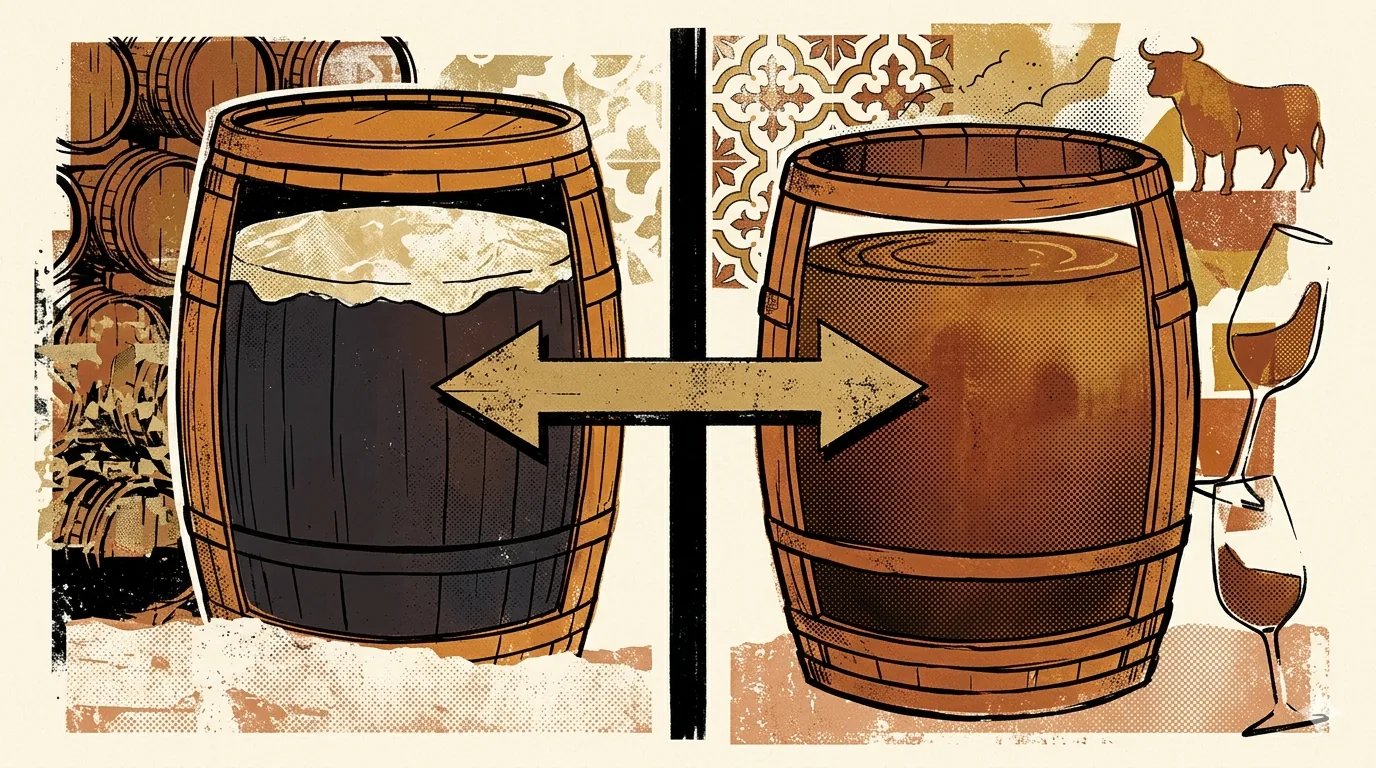
Two glasses on the table. On the left, pale straw, a nose of green apple and fresh-baked bread. On the right, deep mahogany, a nose of walnut and candied date. Both are sherry, both come from the same Palomino grape grown around Jerez. The difference comes down to one decision the capataz makes after the first harvest: does this wine spend years under a white yeast veil through biological aging sherry, or do we let it oxidise in open contact with air.
That single choice decides everything. Colour, aroma, mouthfeel, ageability, and ultimately whether the label reads Fino or Oloroso. In this guide we dissect both aging paths, the chemistry beneath them, the in-between styles Amontillado and Palo Cortado, and how a capataz with a piece of chalk in hand decides which butt goes which way.
The two paths in one table
| What you’re comparing | Biological aging | Oxidative aging |
|---|---|---|
| Fortification after fermentation | 15 to 15.5% ABV, low enough for flor to grow | 17 to 18% ABV, high enough to kill every yeast cell |
| What happens in the butt | A living veil of yeast seals the wine off from the air | The wine sits unprotected and reacts with oxygen seeping through the oak |
| Colour in the glass | Pale straw, even after years on the solera | Amber to mahogany to deep brown, darker with age |
| Aroma | Green apple, fresh-baked bread, almond | Walnut, candied date, caramel |
| What the label says | Fino, or Manzanilla if it comes from Sanlúcar de Barrameda | Oloroso |
| Alcohol after long aging | Stays around 15% ABV, the flor protects the wine | Climbs to 20% ABV and beyond, as water evaporates faster than alcohol |
That fortification call is final. Flor is alcohol-intolerant: above 16% ABV it starts to fade, above 17% ABV it dies outright. One degree too many and the biological route is closed.
Two paths, one region
Sherry comes almost entirely from Palomino Fino. After fermentation the dry base wine sits at around 11.5% ABV. Then comes the pivot: fortification with grape spirit.
Stop at 15 to 15.5% ABV and flor (the yeast veil) can develop. The wine takes the biological route and becomes a Fino, or in Sanlúcar de Barrameda a Manzanilla. Push fortification up to 17 to 18% ABV and every yeast cell dies. The wine sits unprotected in the butt and slowly oxidises into an Oloroso.
A bota is the standard 600-litre American oak butt. Crucially, it is never filled beyond five sixths, around 500 litres. That deliberate headspace is functional in both styles. With Fino the air gap gives flor oxygen to breathe. With Oloroso the same gap is the engine of slow oxidation.
Biological aging: life under the flor
Flor is not a mould but a biofilm of four Saccharomyces strains: S. beticus, cheresiensis, montuliensis and rouxii. They float on top of the wine, build a white veil several millimetres thick and metabolise actively.
What does the flor do? It consumes glycerol, residual alcohol, dissolved oxygen and acetic acid. In return it produces acetaldehyde, the molecule responsible for the typical Fino aroma: green apple, green almond, fresh dough, the baker’s flour. Light esters and 1,1-diethoxyethane build alongside. What the flor does not do is almost more important: it shields the wine from oxygen. The wine stays pale straw, sits at one to two colour units, and keeps its freshness and salinity.
That salinity is not marketing fluff. In Sanlúcar de Barrameda, where humid Atlantic air rolls in cool, flor grows noticeably denser and more continuous than in the more continental Jerez. Manzanilla therefore has a tingling, sea-breeze tone you hear less in Fino from Jerez. Same grape juice, different bodega temperature, different result.
Flor is alcohol-intolerant. Above 16% ABV it weakens, above 17% it dies outright. That is what makes the fortification call so final: one degree too high and the path is sealed shut.
Oxidative aging: contact with air
For oxidative aging the bodega fortifies higher on purpose, to 17 or 18% ABV, ruling out flor entirely. The wine then sits bare in the butt and does business with the oxygen seeping slowly through the oak.
The chemistry shifts completely. Polyphenols polymerise and the colour drifts from yellow through amber to mahogany and deep brown. Maillard reactions between residual sugars and amino acids produce furfural and 5-hydroxymethylfurfural, giving caramel, coffee and toasted notes. The key molecule is sotolon, a sulfur-containing lactone smelling of walnut, fenugreek, curry and old port. Oxidatively aged sherries carry sotolon at concentrations ten to fifty times higher than Fino.
Meanwhile water and alcohol slowly evaporate through the oak, around 3 to 4% per year. That is the angels’ share. Because water evaporates faster than alcohol, ABV in old Olorosos often climbs to 20 to 22%. The wine concentrates. Glycerol, no longer eaten by flor, stays put and gives a fuller, fatter mouthfeel. Volatile acidity creeps up slightly but stays inside DO limits.
A fifteen-year-old Oloroso therefore tastes structurally different from a fifteen-year-old Fino, rooted in a different chemical reality.
In-between paths: Amontillado and Palo Cortado
Between the two extremes lies the most fascinating part of the Jerez dance.
Amontillado starts as a Fino. Three to eight years under flor, then the capataz (or chance) decides the veil is dying. Sometimes he actively refortifies to 17%, sometimes the flor weakens by itself because the wine sits too deep in a solera. From that moment the wine oxidises further. The result carries both signatures: the sharp acetaldehyde tone of its Fino youth plus the nutty, sotolon-driven notes of its oxidative maturity. Colour: amber to toasted hazelnut.
Palo Cortado is the myth. Butts where the capataz, during the first classification, smelled a Fino nose, but where the flor died unexpectedly without obvious reason. No human intervention, no explainable cause. The wine then develops the body and structure of an Oloroso while keeping some of the elegance and sharper aromatics of a Fino. True Palo Cortado is rare, not designable, and still tracked in every bodega’s books with serial numbers.
Within that umbrella sit micro-categories: Palo Cortado leaning more Fino, leaning more Oloroso, vintage-dated versions. The system is empirical, not schematic.
The flavour chemistry: acetaldehyde versus oxidation
Reduce both paths to one molecule and you get this picture.
Biological: acetaldehyde dominates at 300 to 500 mg per litre. For comparison, a normal still wine sits at 30 to 50 mg/l. Ten times more. That is the Fino signature of green apple and almond. Sotolon stays low, below 5 µg/l. Flor consumes the glycerol away, so the wine feels drier and leaner.
Oxidative: acetaldehyde stays modest because no flor produces it in those quantities. Maillard products (furfural, 5-HMF) climb instead, and especially sotolon, which reaches 100 to 500 µg/l in old Olorosos. Polyphenols polymerise into brown pigments. Glycerol stays at 8 to 10 g/l and gives the tactile roundness Fino lacks.
Research by Moreno-García, Peinado and Mauricio (Universidad de Córdoba) has mapped the proteomics of flor in detail and shown that sotolon formation runs through several routes: oxidative breakdown of methionine, Maillard reactions between reducing sugars and amino acids, and non-enzymatic cyclisation of α-ketobutyric acid and threonine. Under oxidative conditions multiple routes run in parallel. Under flor protection they all get blocked.
How a capataz selects: the chalk marks on the butt
After six to nine months of sobretablas (the first rest after fortification) comes the moment of decision. The capataz takes a venencia, a long flexible rod with a small metal cup, dips it through the flor without breaking the veil and pulls a sample. He smells, sometimes tastes, and writes a mark in chalk on the butt’s head.
Five marks decide the wine’s future:
| Chalk mark | Symbol on the butt | What the capataz tasted | Where the butt goes |
|---|---|---|---|
| Una raya | One diagonal stroke | Clean and fine, with a light body | To the Fino criadera, the biological route |
| Palma | A palm leaf | Elegant, top quality, a Fino worth protecting | To the bodega’s best Fino solera |
| Palma cortada | A palm leaf with a stroke through it | Was a Fino, now drifting toward Amontillado | To a separate Amontillado criadera |
| Dos rayas | Two diagonal strokes | Fuller and heavier, with little finesse | To the Oloroso path, with higher fortification |
| Tres rayas or gridiron | Three strokes or a grid | Defective: volatile acidity, heading for vinegar | To vinazo, and on to the distillery |
The system dates from the nineteenth century and is still applied at Lustau, González Byass, Hidalgo-La Gitana and Valdespino. It is not schematic but empirical: the same capataz can mark two identical butts differently based on what his nose tells him that morning. That is why bodegas vary even when the base wine comes from the same albariza soils.
After the first mark the wine enters its assigned criadera. From there the path is locked, although a Fino can later be promoted to Amontillado if the flor dies.
What you see in the glass: colour as a compass
Pour three sherries side by side and the colour tells the entire story.
- Fino and Manzanilla: pale straw, on the Consejo Regulador colour scale 1 to 2 units. Clear, almost colourless at the meniscus. No oxidation, because the flor blocked every contact with air.
- Amontillado: topaz to amber, 4 to 7 units. Biological youth kept it light, the oxidative phase pulled in copper and gold. Still transparent.
- Oloroso: mahogany to deep brown with green-walnut reflections at the meniscus, 8 to 14 units. The older it gets, the darker, almost opaque in a thirty-year VORS.
- Palo Cortado: colour-wise it sits at Amontillado level (5 to 8) but with more depth and a subtler rim tone. Visually not always distinguishable.
Pour a Fino and an Oloroso of the same bodega, same age, into two identical glasses. The colour difference is direct evidence of fundamentally different chemistry. That is what the chalk mark on the butt predicted twenty years earlier.
Frequently asked questions
What is the difference between biological and oxidative ageing?
Whether a living yeast veil sits on the wine. Under biological ageing, flor shields the wine from oxygen, so it stays pale and fresh and smells of green apple and raw dough. Under oxidative ageing the wine lies bare in the butt, its polyphenols polymerise, and it turns amber then mahogany, with walnut and caramel.
Why does one percent of alcohol decide which sherry you get?
Because flor cannot tolerate alcohol. Above 16 percent the veil starts to fade and above 17 it dies outright. Fortify to 15 or 15.5 percent and you get a Fino or Manzanilla; carry on to 17 or 18 and the road to Oloroso is settled for good.
Why does an old butt of sherry get stronger rather than weaker?
The angels’ share. Roughly 3 to 4 percent evaporates through the oak each year, and water leaves faster than alcohol. An old Oloroso therefore climbs to 20 or 22 percent, while the glycerol that flor never ate stays behind and fills out the palate.
Sources
- Consejo Regulador de las Denominaciones de Origen Jerez-Xérès-Sherry y Manzanilla de Sanlúcar de Barrameda. Pliego de Condiciones DO. https://www.sherry.wine/sherry-wine/elaboration
- Moreno-García J, García-Martínez T, Mauricio JC, Moreno J. Proteomic analysis of flor yeasts during sherry wine biological aging. Food Chemistry, 2015. https://www.sciencedirect.com/science/article/pii/S0308814615007852
- Peinado RA, Mauricio JC. Biologically aged wines. In: Wine Chemistry and Biochemistry. Springer, 2009. https://link.springer.com/chapter/10.1007/978-0-387-74118-5_5
- Cortés-Diéguez S, Rodríguez-Solana R, Domínguez JM, Díaz E. Impact odorants and sensory profile of young red wines (sotolon pathway reference). Journal of the Institute of Brewing, 2015. https://onlinelibrary.wiley.com/journal/20500416
- Zea L, Moyano L, Moreno J, Cortes B, Medina M. Discrimination of the aroma fraction of sherry wines obtained by oxidative and biological ageing. Food Chemistry, 2001. https://www.sciencedirect.com/science/article/pii/S0308814600002590
- Pozo-Bayón MA, Moreno-Arribas MV. Sherry wines. Advances in Food and Nutrition Research, 2011. https://www.sciencedirect.com/science/article/pii/B9780123848628000028
- Jeffs J. Sherry. 5th ed., Mitchell Beazley, 2004 (classic reference on chalk-mark system and capataz practice).
- Liem P, Barquín J. Sherry, Manzanilla & Montilla. Manutius, 2012 (reference for regional flor variation Sanlúcar vs Jerez).