

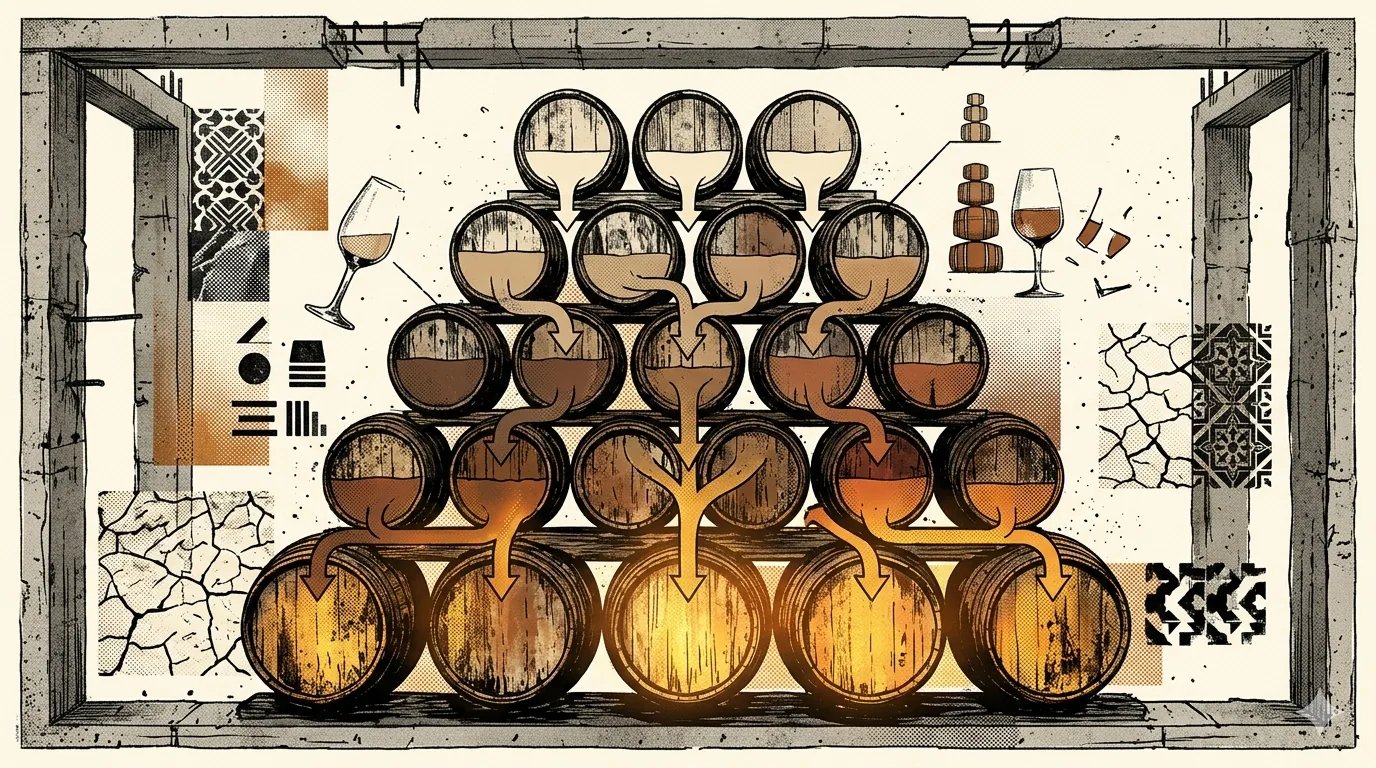
In a bodega on the edge of Jerez de la Frontera a row of oak casks rests on the stone floor. Above them, sometimes four or five tiers high, smaller casks sit in wooden racks. This stacked architecture is no accident. It is the heart of the solera system, the fractional aging method that has given sherry its unmistakable consistency and complexity since the late eighteenth century.
The system emerged around 1760 in Sanlúcar de Barrameda and spread through Jerez and El Puerto de Santa María. It breaks radically with conventional wine logic: instead of bottling each vintage separately, young and old wines are continuously blended. The result is a house style that stays recognisable year after year, despite the volatility of the Andalusian climate.
The terms in one place
| Term | What it is | The figure or rule attached to it |
|---|---|---|
| Solera | The bottom row of casks, on the bodega floor, holding the oldest blend in the system | Bottling happens from this row only; no bottle of sherry leaves the bodega without passing through it |
| Criadera | A row of casks of equal age above the solera, numbered from the bottom up | Most systems run three to seven criaderas; the higher up the stack, the younger the wine |
| Sobretabla | Young fortified wine from the most recent harvest, sitting above the highest criadera | This is the intake that feeds the whole system and sets the speed of the cycle |
| Saca | The draw from the solera for bottling | One third of the volume per year at most, as laid down by the Consejo Regulador |
| Rocío | The refill of each row from the row above, spread across every cask at once | Never in a single pour, so that no individual cask takes a shock |
| Angels’ share | The wine that evaporates each year through the pores of the oak | Three to five percent a year in Jerez, against two to three percent for Scotch whisky |
| Espacio de cabezada | The headspace deliberately left empty in a bota of 500 to 600 litres | Roughly one fifth of the cask; for Fino it is where flor grows, for Oloroso it admits oxygen |
| VOS and VORS | Certified average age, approved per saca by a tasting panel and a laboratory | Twenty years minimum for VOS, thirty for VORS; below those sit the 12 Años and 15 Años categories |
What is a solera? The oldest row of casks on the floor
The word solera comes from the Spanish suelo, “floor”. It is the bottom row of casks in the system, placed on the bodega floor. Only this row is drawn from for bottling. Not a drop of sherry leaves the bodega without first passing through the solera.
The casks are usually botas of American oak, holding around 500 to 600 litres. They are never fully filled. A deliberate headspace is left, the espacio de cabezada, roughly one fifth of the volume. For Fino and Manzanilla that headspace is essential: it is where flor grows, the yeast film that shields the wine from oxygen. For Oloroso the space is left empty precisely to allow oxidation.
The solera holds the oldest blend in the entire system. But it is not a static reserve. Constant replenishment from above keeps changing its chemistry, while the average profile remains stable.
Criaderas: the nursery rows above the solera
Above the solera lie the criaderas, literally “nurseries”. They are counted from the bottom: the first criadera (1ª criadera) sits directly above the solera, then the second, then the third, and so on. The higher the tier, the younger the wine.
Most sherry systems run three to seven criaderas plus the solera. At the largest bodegas, Fino systems can run substantially deeper. The more rungs, the finer the blending and the slower the average age climbs.
Above the highest criadera sits the sobretabla: young, fortified wine from the most recent harvest. This inflow feeds the entire system and sets the pace of the cycle.
Saca and rocío: how the cycle works
The mechanism turns on two coupled actions.
The saca is the drawing off from the solera. The Consejo Regulador del Vino de Jerez stipulates that no more than one third of the solera’s volume may be drawn per year. In practice this happens in several smaller sacas, especially for Fino and Manzanilla.
The rocío is the replenishment that follows. The Spanish word literally means “dew” or “to spray”. When a third has been drawn from the solera, the same volume is taken from the first criadera and poured into the solera. The first criadera is then topped up from the second, the second from the third, and the cascade moves upward until the highest criadera receives sobretabla.
A crucial detail: refilling the solera from the first criadera never happens in a single pour. The cellar master spreads the young wine across all the casks of the solera, so no single cask receives a shock. This gradualism is what makes fractional blending so gentle.
Why fractional blending? Consistency and complexity
The mathematical principle behind the solera is both simple and profound. Suppose you replace one third of the solera each year with wine from the criadera above it. After one year the solera holds two thirds “old” wine and one third new. After two years there is still wine from the original year present, but diluted. After ten years a vanishingly small fraction of the very first fill remains in every cask.
Jancis Robinson describes this in her Oxford Companion to Wine as fractional blending: an asymptotic curve in which old molecules never fully disappear but are constantly refreshed by young ones. The system is a biological memory.
For the drinker this means two things at once. One: an established Fino tastes almost identical year after year despite variable harvests. Two: every bottle contains traces of wine pressed decades earlier, blended with the youngest input.
The house style is therefore not defined by a single winemaker, but by generations of choices crystallised in the system.
Angels’ share: what the Andalusian sun costs
Each year part of the wine evaporates through the pores of the oak. This angels’ share runs significantly higher in Jerez than in cooler climates. Scottish whisky distilleries lose around two to three percent annually. In Jerez current sources put the loss between three and five percent per year, and in extreme summers or in dry bodegas it can climb higher.
The typical Jerez bodega is therefore a kind of cathedral: ceilings of at least ten metres, whitewashed walls, small windows facing north, and often a sand floor sprayed with water to keep humidity high. The famed bodegas catedral are architecturally tuned to temper evaporation without blocking the natural breathing of the wood.
The loss is not just volume. Because water evaporates slightly faster than alcohol, ABV rises during aging. In Oloroso, which has no flor consuming alcohol, a wine that started at 17% can climb above 20% after thirty years, concentrated and rich in glycerol.
VOS, VORS and certified ages
For a long time age in sherry was a rhetorical claim, not a measured fact. In the year 2000 the Consejo Regulador introduced a system whose first accreditations were issued in July 2001: VOS and VORS.
VOS stands for Vinum Optimum Signatum, sometimes loosely translated as Very Old Sherry. It guarantees a minimum proven average age of twenty years. VORS stands for Vinum Optimum Rare Signatum, with a minimum of thirty years average age.
Certification is granted per saca. Bodegas submit an application, the Consejo takes samples, and both a tasting panel and an independent laboratory verify age through carbon-isotope analysis and sensory evaluation. If the saca passes, that specific bottling earns the label.
Two intermediate categories also exist: 12 Años and 15 Años, introduced to formally mark younger but still substantially aged sherries.
Per style: Fino solera vs Oloroso solera
Biological logic sets the rhythm of the system. Fino and Manzanilla run on flor. That yeast layer needs regular feeding: young wine brings sugars, glycerol and nitrogen that keep the flor alive. Hence a Fino solera is often drawn from two to six times per year, with relatively small volumes each time. The casks are continually refreshed, the flor stays optimally fed and the wine retains its hallmark pale colour, freshness and bitter almond note.
Oloroso works differently. The wine is fortified to at least 17% alcohol, high enough to make any flor impossible. Without flor there is no biological clock forcing frequent sacas. Oloroso soleras are therefore often refreshed only once a year, with larger volumes. The wine sits in direct contact with oxygen for longer, oxidises freely and develops the nutty, caramel, sometimes balsamic notes that define the style.
Amontillado and Palo Cortado sit in between: they begin biologically under flor and finish oxidatively, often in separate criadera systems that are “cut” at a given moment to mark the transition. In Amontillado the flor eventually dies off, usually after a further fortification to around 17%, after which the wine continues to mature oxidatively for years in a dedicated subsolera. Palo Cortado often emerges by accident: a cask that began aging as Fino develops differently than expected and is set aside by the cellar master.
Pedro Ximénez and sweet Moscatel also operate their own soleras, sometimes with extremely slow cycles and intense concentration of sugars and colour through years of evaporation. A fifty-year-old PX solera is not unusual in bodegas such as Toro Albalá or Pérez Barquero in Montilla-Moriles.
The solera system is therefore not a single uniform protocol but a family of variants. Each style has its own cask architecture, its own saca frequency and its own balance between biology and chemistry. What they share is the fractional logic, and the conviction that time in sherry is not linear but stacked in layers. Whoever opens a glass of Fino, Amontillado or Oloroso is not drinking a vintage. They are drinking a continuous movement that began generations earlier and is carried forward with every new saca.
Frequently asked questions
What is a solera?
The bottom row of casks in a bodega, holding the oldest wine, with the criaderas of progressively younger wine stacked above it. The system emerged around 1760 in Sanlúcar de Barrameda and breaks with normal wine logic: instead of bottling each harvest separately, young and old wines are continuously blended.
What is a criadera?
A criadera is a row of casks of the same age within the solera system. They are stacked by maturity: the youngest wine sits in the top criadera and drops down one row at each draw, until it reaches the bottom row (the solera) that gets bottled. Criadera literally means nursery, which is exactly its job: the wine is raised there before it is allowed into the solera.
How much wine can leave a solera per year?
A third of the volume at most, per the rules of the Consejo Regulador. What is drawn off (the saca) is replaced with wine from the criadera above (the rocío). Each tier moves one step down, and after ten years every cask still holds a tiny fraction of the very first filling.
Why blend years instead of bottling vintages?
Consistency. An established Fino tastes virtually identical year after year, despite the swings of the Andalusian climate. Fractional blending also builds complexity: every bottle carries traces of dozens of harvests.
What is the angels’ share?
The wine that evaporates each year through the pores of the oak casks. In Jerez the loss runs between three and five percent a year, more than the two to three percent at Scottish whisky distilleries. An Oloroso that started at 17% can climb past 20% after thirty years.
What do VOS and VORS guarantee?
A certified average age: at least twenty years for VOS, at least thirty for VORS. The Consejo Regulador introduced the system in 2000 and issued the first accreditations in July 2001. The 12 Años and 15 Años categories mark younger but still substantially aged sherries.
Sources
- Consejo Regulador del Vino de Jerez. Sherry Region: Consejo Regulador. https://www.sherry.wine/sherry-region/consejo-regulador
- Sherrynotes. The Sherry Solera System. https://www.sherrynotes.com/2013/background/sherry-solera-system/
- Sherrynotes. VOS and VORS: Sherry Age Certification. https://www.sherrynotes.com/2015/background/vos-vors-sherry-age/
- Jancis Robinson. Fractional Blending. Oxford Companion to Wine. https://www.jancisrobinson.com/ocw/detail/fractional-blending
- Wine Anorak. How Sherry Is Transferred from Cask to Cask. https://www.wineanorak.com/wineblog/spain/how-sherry-is-transferred-from-cask-to-cask
- Spanish Wine Lover. Peter Liem on Sherry. https://spanishwinelover.com/peter-liem-sherry-is-not-a-wine-for-everybody-and-we-just-have-to-accept-that
- Around the World in 80 Harvests. Lifetime Sherry: Julian Jeffs Interview. https://aroundtheworldin80harvests.com/2017/07/25/lifetime-sherry-jerez-changed-julian-jeffs-interview/