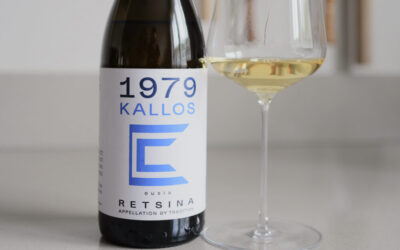
There’s a question that comes up whenever you’re tasting an unconventional wine style: Does it age? The answer, more often than not, determines whether you’re looking at something genuinely serious or a curiosity that’s interesting once and forgotten. With Retsina, that question has rarely been asked at all, partly because most Retsina was never made to be asked it.
The 1979 Kalos 2020 is Eleni Kechri’s answer. It’s the vintage that launched the 1979 Wines project, a blend of three different resin sources, Halkidiki, Megara, and Corinthia, assembled before Eleni had confirmed that the forest terroir differences were consistent enough to bottle separately. And at three years old, it’s already demonstrating something important: Retsina, made with care, ages very well indeed.
De wijn
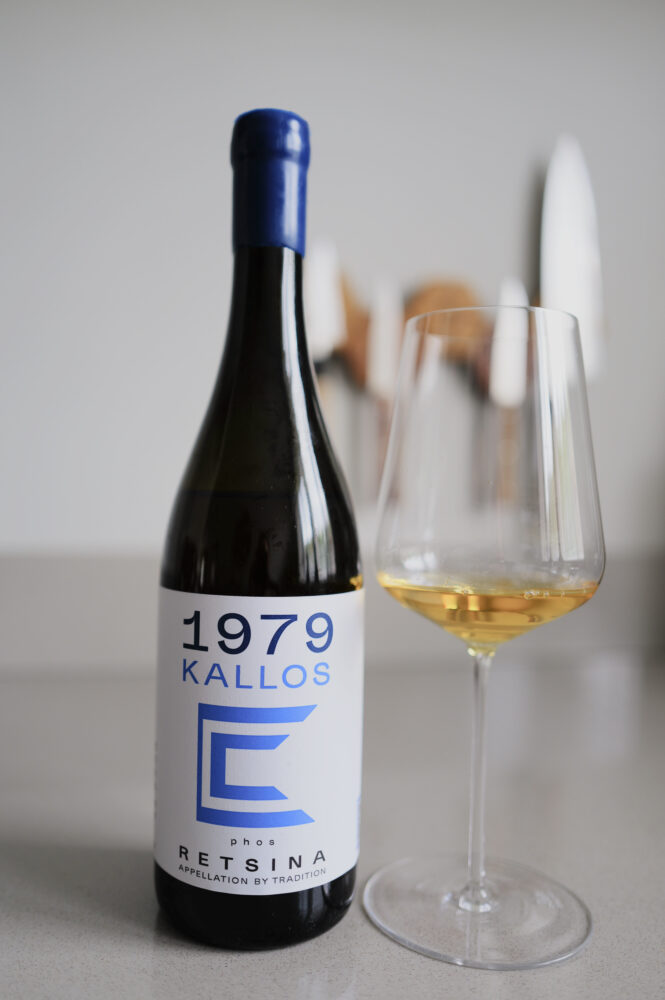
Producer: 1979 Wines Wine: Kalos Vintage: 2020 Region: Emathia, Northern Greece Grape Variety: Assyrtiko Vineyard: Gerakona, Kilkis, 350m altitude Resin Sources: Pinus halepensis from three forests Halkidiki (coastal), Megara/Attica (plateau), Corinthia/Peloponnese (inland) Harvesting Method: Sustainable no sulphuric acid Alcohol: ~13% Retail Price (Greece): approx. €25 Availability: Germany, Belgium, UK, Canada; Netherlands distribution coming soon Website: 1979.gr/nl
Proefnotitie
Appearance: Deeper gold than either 2022, with a warmer, more amber-tinged core and a clean, golden rim. The colour alone tells you this wine has been doing something.
Nose: The Assyrtiko is immediately recognisable but has moved from its primary citrus phase into something more developed. Lemon has become citrus marmalade preserved, slightly candied, with real depth behind it. Hazelnuts and a gentle toast character sit alongside it, and then, unmistakably, a thread of petrol: the signature secondary aroma of aged Assyrtiko that signals genuine ageing potential fulfilled. The resin is woven into the fabric of the wine rather than sitting on top of it, less a flavour than a structural quality, a spiced warmth that gives the marmalade and nut notes a particular richness.
Palate: Fuller-bodied than the 2022s, with a rounder, more textured attack. The acidity remains very much present. Assyrtiko doesn’t lose its structural backbone easily, but it’s now framed by more weight and glycerol from the extra time in the bottle. The mid-palate is the most complex moment: marmalade, fresh grapefruit peel (still there, still vital), dried herbs, a faint smokiness, and a mineral spine that never quite goes away. The finish is long, warm, and resinous in the best sense, a dry, spiced quality that lingers well beyond the last sip. The empty glass smells extraordinary.
Quality Assessment: This is the wine that settles the question of Retsina’s ageing potential. The Assyrtiko has evolved beautifully: the primary freshness has deepened into complexity without losing its essential character. The resin integration is complete after three years. You would not describe this as a resinous wine; you would describe it as a complex, layered, distinctly Greek white wine. Which is exactly what it is.
The Starting Point of a Project
The 2020 occupies a particular place in the story of 1979 Wines. It was the first vintage Eleni released commercially after years of research and experimentation, the first time she put her work into a bottle with a label and sent it out into the world. It was also the vintage in which she hadn’t yet confirmed, with full certainty, that the forest terroir differences were stable and reproducible enough to justify single-forest bottlings.
That’s why it’s a blend. Halkidiki, Megara, and Corinthia resins, assembled, each contributing a different dimension: the coastal freshness of the first, the herbal structure of the second, the deeper warmth of the Corinthian pines. It was, as Eleni describes it, the way Retsina has always been made, resins from different sources combined, the forest character averaged out rather than expressed distinctly.
What the 2020 shows, three years on, is that the assemblage approach has its own merit. The blend is more food-versatile than either single-forest wine, more complex at this stage of development, and more immediately accessible to someone trying serious Retsina for the first time. If you’re building a wine list or choosing a single bottle to introduce this project, this is the one.
The Research That Followed
The 2020’s blend format was also the last of its kind. By 2022, Eleni had confirmed, through multiple vintages of controlled trials, that the forest terroir differences were consistent year after year. The coastal pines of Halkidiki always gave iodine and sea spray. The Megara plateau always gave herbs and dry mineral warmth. So she separated them, creating the Thalassino and Stergianos as distinct expressions.
The 2020 Kalos is therefore not just a wine. It’s a document of a research process. A before-photograph, taken at the moment when the hypothesis was being tested but hadn’t yet been confirmed. Tasting it alongside the 2022 single-forest wines makes the whole story legible in a way no amount of description can quite replicate.
Eten en drinken
The most food-versatile of the three wines, and the most suitable for the dinner table rather than the aperitif glass. Eleni’s own suggestion: yellow cheese with marmalade, ripe Camembert, a French Alpine cheese with a washed rind. I’d add: slow-roasted pork with a citrus glaze, duck breast with cherry or orange sauce, aged cheddar with quince paste, and a rich chicken liver pâté. The wine’s combination of acidity, body, and complex aromatics means it can handle rich dishes, something most white wines at this price struggle with.
It would also be genuinely interesting at a cheese course: its evolved, complex character would hold its own against strong-flavoured cheeses where a younger white would be overwhelmed.
Serve at: 10–12°C. If anything, slightly warmer than the 2022s, the extra body and complexity deserve a touch more room to breathe. Decant for 15 minutes or let it sit in the glass for an extended time.
Cellaring: The wine is already showing beautiful development at three years. Given how Assyrtiko typically ages, there’s no reason this couldn’t comfortably age another three to five years, developing further complexity. Buy two bottles: drink one now, hold one.
De uitspraak
The 1979 Kalos 2020 is the most complete wine in the 1979 portfolio at the moment, simply because it’s had the most time. It shows where single-forest wines are going, it demonstrates Assyrtiko’s ageing potential in the Retsina context, and it’s genuinely delicious in a way that needs no qualification or explanation for someone sceptical about the category.
At approximately €25 in Greece, it’s the most expensive of the three and the easiest to justify.
Deel van een proeverij van drie flessen met Eleni Kechri van 1979 Wines op Sparks by VinoVonk.
This article is based on a press sample received from 1979 Wines / Eleni Kechri. My assessment is entirely independent.