

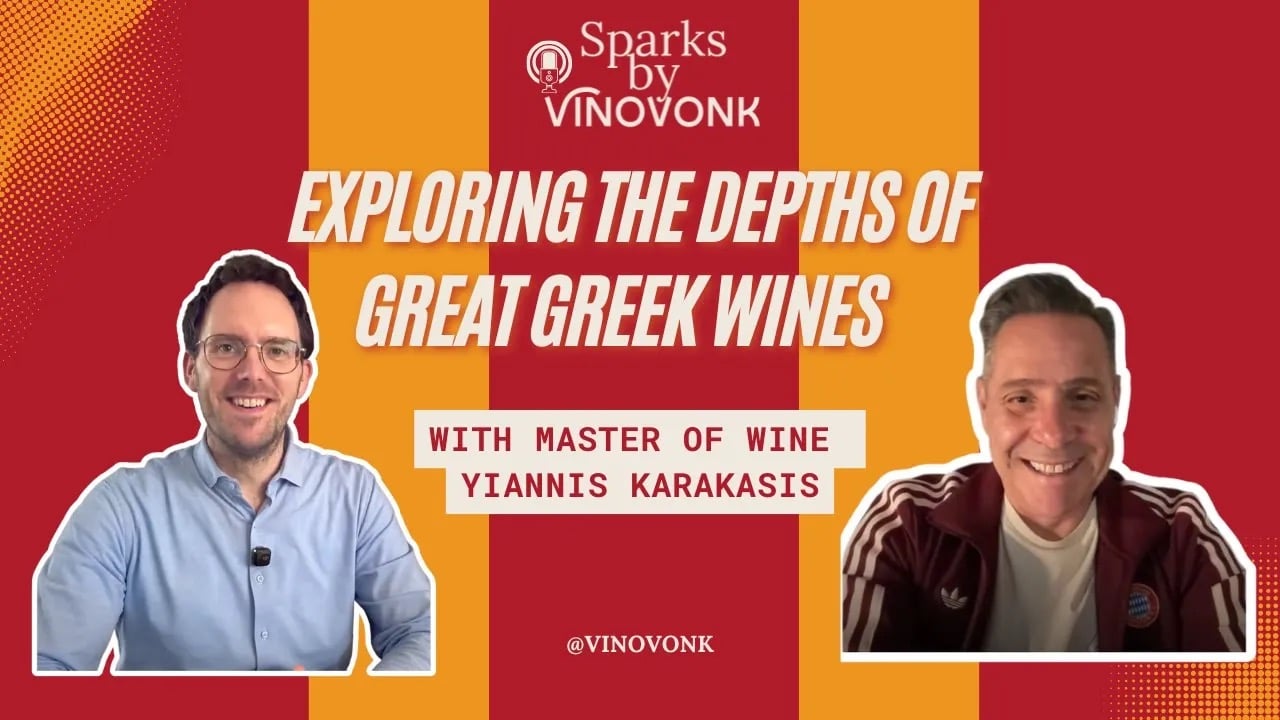
Yiannis Karakasis joined the Greek Navy as an officer in the 1990s and later retrained as a helicopter pilot. After two decades he resigned to pursue the Master of Wine, and earned the title in 2015. Today he runs Great Greek Wines with his partner Grigoris Michailos: a competition that grew into a promotional platform for Greek wine.
In Sparks episode 20 Yiannis explained why he pays for the bottles most wine competitions receive for free, and why he thinks this is a good moment to look at Greece.
Who is Yiannis Karakasis MW
In the 1990s Yiannis became an officer in the Greek Navy and served on several warships. Wanting a new challenge, he trained as a helicopter pilot. He had promised his mother he would not ride a bicycle; helicopters were never part of the deal. Navy pilots mostly flew over the Aegean, and he still remembers his first flight over Santorini, with its white and blue houses and a few vineyards.
After 20 or 21 years in the Navy, and with some WSET courses already behind him, he quit to start the MW programme. He had no mentor and had to find his own way. He became a Master of Wine in 2015. From day one he kept one rule: no work for Greek importers. That keeps him off any company’s payroll and free to talk about every wine he loves.
What is Great Greek Wines
Great Greek Wines started life as 50 Great Greek Wines. Yiannis and Grigoris Michailos award just 50 wines per edition. Many competitions give a medal to 85 or 90 percent of entries; theirs came in at around 8.5 percent. The fourth edition is now complete, and Yiannis says the top Greek wineries take part whether they win or not. Some have entered four times without an award.
The project reaches beyond the ceremony. There have been masterclasses in Amsterdam (twice), Antwerp, Warsaw, Paris, London, Girona, Italy and Belgrade, often led by jurors. There is a free 140-page digital report and a podcast in Greek. An English version of the podcast is still only an idea.
Three things that set it apart
The wines are bought. Great Greek Wines does not accept samples. Grigoris buys the bottles from importers and wine shops, so only wines a consumer can actually find get judged. Elsewhere they had seen unreleased wines entered into competitions. Buying gets harder every year: in 2025 many wineries bottled late, after a slow market and a cool vintage in which fermentation dragged on.
No stickers. Yiannis does not sell stickers to award-winning producers. “Maybe I’m losing money, but I don’t care,” he says.
An international jury. From the start Yiannis wanted no judges from inside the Greek wine trade, to keep the panel impartial. It is made up of Masters of Wine, Master Sommeliers and group wine directors. In 2025 there were seven: Marc Andrew (Noble Green), Lenka Sedivakova, Christoph Heylen, Wojciech Bońkowski, Stefan Newman MS, Paz Levinson and Peter Richards MW. A core of four or five returns each year, joined by two or three newcomers. Julia Harding MW presented this year’s awards to the winemakers.
Sub-categories
Beyond the 50 main awards there are three sub-categories:
- Hall of Fame: wines awarded in three consecutive editions. Two made it in 2023, the first year; six in 2025
- Great Value Wines: new in 2025, for wines under 17 euros on the Greek market that still deliver high quality. Five of them were new entries
- Sustainability Award: also new, with three criteria. Grapes from certified organic vineyards, a bottle under 420 grams, and a winery that covers a large share of its energy needs from renewables. There was one winner: the Santameriana Skin Contact 2024 from Sant’Or Winery, made from a rare Peloponnese grape
The award list on greatgreekwines.com now shows the bottle weight next to each wine.
Yiannis on Assyrtico: “RoboCop”
Years ago Yiannis compared Assyrtico to RoboCop, and he still stands by it. He knows of no other white grape that can reach 15 percent alcohol with 7 grams of tartaric acid and a pH below 3, though he adds that he does not claim to hold the absolute truth. Put a very good Assyrtico next to a sub-par Chardonnay and, in his words, it destroys everything.
The grape needs time to reveal its layers of complexity and sometimes behaves like a red wine. He recognises it by its salty character, its very long finish and its extract, which comes from high phenolic content.
He also wants the conversation to move beyond Assyrtico. This year’s edition of his report Greek Wine Explained has no Assyrtico or Santorini chapter; it covers Nemea, Attica, Limniona and the wines of Macedonia instead.
The business model
Nobody buys a couple of hundred bottles out of pocket, so I asked how it is funded. Yiannis kept it simple:
- Every participating winery pays a fee to enter
- Because the project is large, they look for sponsors; without them, he says, it would be very difficult
- No sticker income
- Yiannis also consults for large hotel and restaurant groups, which takes up a lot of his time
Passion comes first for him, though the business has to be healthy too. A great awards ceremony matters more to him than a few extra euros in his pocket.
Why Greek wine, now
At the end of the conversation Yiannis argued that this is a good time for drinkers willing to look past the classics. He loves Bordeaux and Burgundy, but often finds more excitement and better prices elsewhere. What Greece offers, in his view:
- Indigenous grapes, from the most obscure to Assyrtico
- Terroirs above 1,000 metres and exciting soils
- Plenty of island wines
- Many growers have farmed without herbicides or pesticides for generations, so what now gets called organic or biodynamic is long-standing practice for them
- Lots of spontaneous fermentation, less oak on reds, and elegant reds catching up with the whites
- A new era for Retsina, with four or five on the list. Julia Harding MW tasted every wine and, according to Yiannis, gave her highest Retsina score, 18.5, to the Thalassitis from 1979 Wines
Caveats
- This is the founder’s account. Everything about the selection, the jury and the money comes from Yiannis himself. I did not taste any of the wines for this episode.
- Wineries still pay to take part. The bottles are bought, but entrants pay a fee and the platform relies on sponsors, so the selection only covers wineries that sign up.
- The ceremony is in Greek. I watched the livestream on YouTube and could not follow it. Julia Harding, Yiannis recalls, sat through two and a half hours without understanding a word. He would like more English in future but has not settled on how.
- Buying at retail has limits. Late bottling made collecting the wines difficult this year; a wine that is not on sale cannot take part. Yiannis admits collecting everything gets harder every year.
Frequently asked questions
How do you become a Master of Wine? Yiannis describes it as a series of steps: getting into the Institute, moving on to stage 2, passing the theory exam, then the practical, and finally the research paper. He became an MW in 2015.
Why does Great Greek Wines buy its own bottles? So that only commercially available wines are judged. At other competitions they had seen samples of wines not yet released. At Great Greek Wines the bottle has to be on sale in a shop or at an importer.
What is the Greek Wine Explained report? A free digital report, available via greatgreekwines.com. The first edition ran to 130 pages, this one to 140. Yiannis writes it with winemaker Evmofia Kostaki, a stage 2 MW student. Each year covers different regions and chapters.
What are the criteria for the Sustainability Award? Three: certified organic grapes, a bottle under 420 grams, and a winery that draws a large share of its energy from renewables.
More about Great Greek Wines
greatgreekwines.com has the full list of awarded wines, including bottle weights, and the Greek Wine Explained report.
For more Greek wine, see Sparks episode 22 with Lodewijk of Daily Creta and Sparks episode 23 with Drakos Garakis.
Transcript
The full conversation transcript.
Show full transcript
This transcript is generated automatically from the audio and has not been edited. Speech recognition makes mistakes, so treat wording as an approximation rather than a verbatim quote. It is here for accessibility and search.
How did you become a Master of Wine? We need to go back many years. So it came to my mind to establish a competition. This is what we call Great Greek Wines now. Initially, it was 50 Great Greek Wines and the competition was part of it, but we didn’t want to stop at the awards.
What I found very interesting about your competition, the Great Greek Wines, is that you buy the bottles yourself. The wine should be commercially available because we’ve seen wines sent to competitions that were not released yet. Hi and welcome to a new episode of Sparks by VinoVonk. My name is Jeroen and today we’re going to talk about Greek wines with Master of Wine, Yiannis Karakasis. Yiannis, thank you very much for your time.
Thank you for the invitation and well done with the pronunciation of my name. Yes, was it correct? I was practicing all week. But Yiannis, you are a Master of Wine. I know what it is.
But for people who don’t know what it is and don’t know who you are, could you tell me something about yourself, who you are and how did you become a Master of Wine? Yeah, we need to go back many years. I’m not going to say exactly how many though, because my previous professional career was in the Hellenic Navy. So in the ’90s, I became an officer of the Hellenic Navy and I started my career on various warships, very irrelevant to wine. Then I went to…
I wanted to accept another challenge and I said, okay, let’s become a helicopter pilot. Yep. Why not? I promised my mom not to ride a bicycle, but I didn’t promise not to ride a helicopter. So I became a co-pilot, pilot, et cetera.
And after 20 or 21 years in the Hellenic Navy and already involved with WSET courses, I thought it was a good moment to try something big, to test your limits. So I quit my job and that was risky, obviously in a way. As I was a career officer and I said, okay, let’s try and slowly, slowly first entering the institute. Then proceeding to stage 2, then passing theory, then passing practical and then the research paper and obviously at the end of this journey you become a Master of Wine. It’s a great journey and as you know the journey is more important sometimes than the destination because you learn so many things.
So yes, I became a Master of Wine in 2015. I’m really happy that I’m in this team and I’m really happy that I have the chance to spread the word about good wine and also about Greek wine particularly. And that’s a very interesting story because you started with a good helicopter view. You could overview everything and then you thought, okay, let’s go into wine. Was it because you flew over a lot of vineyards that you thought, okay, that is very interesting?
Actually, as Navy helicopter pilot, we usually flew over the Aegean Sea. So I’m not sure if I got the chance to see it. I saw vineyards in Santorini. I still remember my first flight over Santorini when I saw the buildings, the white and blue houses and some vineyards. That was a memorable moment.
Seeing this beautiful island from a different view. I believe that becoming a Master of Wine when you have a different view is like climbing a mountain. You can see a lot of things, more things than if you are in a regular building, etc. And then you became a Master of Wine, but then you entered a new world. What was the biggest eye-opener for you as becoming a Master of Wine and opening this new world for you?
What was, can you repeat the question? Because I’m not sure I understood that. When you study a lot of wine, you also lose a lot of romantic views about wine. You know a lot about the technical details. But then when you become a Master of Wine, a new world opens up for you because everybody thinks, okay, you know everything.
Yeah, and this is a challenge because, yes, you became a Master of Wine. So what did you do after that? So as I didn’t have like a mentor guiding me through what to do, I had to find my own way. And I think this is always better. But sometimes, you know, some nice advice helps.
So one of the things that I followed from day one was not to be involved with importing companies in Greece. So I’m not on the payroll of any company and I feel independent speaking about all wines I love. This is the most important thing. I said, this is number one, Yiannis, you want to speak about Greek wine, stay away from being a part of importing companies. So…
And then I had to find my own way, because as a consultant in a way, you needed to find your own way. Initially, I spent a lot of my time on my blog. I started some digital reports. At the same time, I did various tastings. And I opened a wine school, a WSET APP in Cyprus, as I wanted to explore also the vineyards of Cyprus.
And I wanted to… Absolutely, I promoted Greek wine every time that I had a chance through Wines of Greece or other prefectures or even through specific winery promotional activities. And I was looking for an idea. To create something unique, something outside the box. Actually, I’m a person that wants to be outside the box.
So it came to my mind to establish a competition, actually a platform. This is what we call Great Greek Wines now. Initially, it was 50 Great Greek Wines and the competition was part of it, but we didn’t want to stop at the awards. We wanted to do activities, promotional activities all over the world. That was the first thing that we thought together with my partner, Grigoris Michailos.
And, you know, we thought we would award only 50 wines, 50 wines only. So usually in competitions, 85% or 90% of the wines are awarded. We awarded 50 wines, which was around 8.5%. Crazy. Then…
We decided to buy the wines from the market. So we still don’t accept samples. And don’t ask me why, but for various reasons. And then we said, OK, let’s travel the world. Let’s do things.
And after three editions, now we finished the fourth, but we haven’t started the activities of the last edition. We have visited various places, two times Amsterdam. We did a masterclass in Antwerp, Warsaw, Paris, London, Girona, Italy, Belgrade. So I travel a lot and I have also other people sometimes doing the masterclasses, usually judges of Great Greek Wines. So it’s not that we want to be different, to be different, but we see…
We see the promotion of Greek wine and this different competition in another way. For example, we’re not selling stickers. We will never put stickers on a very good bottle of Greek wine. It is, I think, no, sorry. Maybe we lose, maybe, maybe, maybe I’m losing money, but I don’t care.
No, but of course you’re losing money because in a lot of competitions, winemakers send the sample bottles to the competition and they have to pay a little fee to get promoted. What I found very interesting about your competition, the Great Greek Wines, is that you buy the bottles yourself. So you’re not saying, okay, now it’s 2024, or well, it’s now 2025, let’s buy the bottles of 2024, and let’s compare them with each other. Now you’re buying the bottles that are available now, so it could be a bottle of year 2020, and it has to be on a large market, not only in a small part of Greece, like… The wine should be commercially available because we’ve seen wines sent to competitions that were not released yet.
Yeah, but you’re buying a lot of wine. Yes, and this is a very complicated procedure. Grigoris is in charge of that. We buy from various importers, wine shops, and trust me, every year it’s becoming more difficult. Because, for example, this year the timing was early May that we did the new edition, and a lot of wineries bottled very late.
Because the market was slow, because it was a cool vintage and fermentation took more time. So it was really, really difficult for us to collect all of the wines. The good thing was that this year we did the competition part in Athens and not Santorini. If we did that in Santorini like the two previous times, it would be really challenging. So every time we need, it’s not a smooth road.
It’s not a road with rose petals. Believe me, this is what we like because we see Great Greek Wines as a communication platform. We’re growing not only in terms of participation because this is very difficult, especially if you have wineries that have participated for four times and never been awarded. So for them to trust us, this means a lot for me. And Grigoris.
It means a lot because they see something and usually this is a sign of the market’s maturity saying Yiannis, we are with Great Greek Wines, whether we are awarded or not. Because we see what you do with Greek wine, not only in terms of promotional activities, but also in terms of communication, in terms of podcasts, in terms of social media, in terms of new things. In terms of our digital book, which is free to download and you have all the information in terms of an updated website that we will put more information. This is one of the new things that we want to pursue. So, yes, it is a great journey, a difficult one, but yeah, sometimes we are invited to things that have a challenge.
Otherwise, it is kind of boring. And believe me, Great Greek Wines is not boring. No, what I found very interesting also is that the full list is for free downloadable, but you can also look it up and it doesn’t say, okay, we found this a platinum medal or a gold medal or silver. No, you just say, this is a great Greek wine. Gold or a double platinum or a ruby.
Yeah, you’re not doing that. It’s just this is a great Greek wine. You put it on the list. It’s in alphabetical order. But sometimes some wines again deserve the Hall of Fame.
Yes, which means we said that for wines, obviously from different vintages that have been awarded for three consecutive times, we created the Hall of Fame selection. So the first year we had, that was the third edition, the first year for Hall of Fame was in 2023. We had two wines. And this year we had six wines. We had the honor of having with us Julia Harding and she presented the awards to the winemakers, who were really happy to see her there.
Yes, Hall of Fame is one subcategory. We created this year the Great Value Wines. These are wines that combine retail price less than 17 euros in domestic market. With high quality. Some of them are obviously part of Great Greek Wines and some of them are new entries.
So five of them were new entries and we created, we want to encourage the producers to embrace more sustainability. So we created a sustainability award for those wines that fulfill three criteria. Number one, the wine The awarded wine, has grapes originating from certified organic vineyards, minimum. Number one. Number two, the weight of the bottle should be less than 420 grams.
And number three, a big part of the needs of the winery are covered by renewable sources. And we have one wine this year. One wine this year, which is Santos Santa Meriana Skin Contact, a rare Greek variety from the Peloponnese that got this award. I’m really excited. We also put in the list the weight of the wine, the bottle and the liquid.
So if you go to our website www.greatgreekwines.com, you can see the list. And next to the wines, you see the weight. Yeah, we did that as well. I think also it’s a brave thing. Obviously, we’re not the first ones who did that.
But I believe that sustainability should be part of every brand. And we are already late into addressing the issues that have arisen from the high CO2 footprint and all the rest that is on our minds. So, I’m waiting for the reaction from the wineries. I know that it takes a little bit of time to react there, but I’m pretty much sure that it’s important. Absolutely.
Yeah. Every year now we have started talking about the next Great Greek Wines and what kind of awards we want to, you know, to introduce, but not awards like, for example, lifetime achievement award. No, we want something else. Again, something else outside the box. Something that creates a…
A new situation, something that rewards an effort outside the box. So yes, this is who we are. And I think that Greek wine is wonderful. And from our side, we’re doing whatever we can, promoting this image and inviting more people to discover these wonderful wines. I’m really excited because I see also a lot of publicity from abroad, which is the first time that we see so much interest from UK, from Belgium, from the Netherlands, from Poland.
In a few weeks, we have various articles and various ideas proposed to do things. With magazines, with various… So I’m really excited. I’m trying to, you know, to prioritize what is needed, but the interest and the interaction is very encouraging. Now, you also mentioned Julia Harding, also a Master of Wine.
But who is tasting all these wines? Because I know, but it’s a great story to tell because I saw the picture and I saw last year’s. I forgot to say that. So, in the start, when I said, let’s do the competition, I said, we’re going to have only top tasters. No one involved with the Greek wine from Greece for obvious reasons, because we want the judges to be impartial.
Hmm My dream was to have fantastic judges, Masters of Wine, Master Sommeliers, wine directors from big groups. And we did that every year. Every year we followed this road. So this year we had seven judges. We had Marc Andrew from Noble Green.
We had Lenka Sedivakova. We had Christoph Heylen. Wojciech Bońkowski, Stefan Newman, Master Sommelier, we had Paz Levinson, the Group Wine Director, and we had Peter Richards, Master of Wine again. So it is a dream team. Every year, every edition, we have a core of, let’s say, four or five repeating judges and two new judges, or three.
This year, we had Paz and Peter joining. And Stefan was not present last time, he was. So this is a kind of family that we are together. Of course, we cannot have the same people every year. So, yeah, this is a nice blending.
And for me, the judges are evangelists of Greek wine. So I want judges to be really involved with Greek wine and being at least passionate or open to Greek wine because a lot of times we do things together. We did with Lenka a Great Greek Wines masterclass, I think it was in Austria, two or three years ago. Christoph did the masterclass in Antwerp. Yes, this is the way that this thing works and I’m pretty much sure that there is no competition in the world that has this this team of judges.
And what I like also is about learning new grape varieties because I never heard of Vidiano or Savatiano. You know, I knew Assyrtiko, but other indigenous grape varieties I didn’t know before. And in this way, I’m learning also, but a lot of people also learning. Absolutely. I’m thrilled that we see the best wineries in Greece participating in Great Greek Wines.
Wineries that traditionally do not do that in other competitions. They have selected only Great Greek Wines and they’re part of it no matter if they’re awarded or not awarded. It’s very important for me because as you know it’s very difficult to attract the top wineries but we did that and I’m really really happy. But you told me that you buy the wines yourself, but there must be a business model because you can’t buy like 200 bottles of wine yourself. Yes, we do that.
Of course there is a business model and I know that people are wondering what is the business model but it’s very easy, it’s very simple. The business model is the participation from the wineries, because every winery pays a fee to participate. Then, because it’s a big thing, we try to get sponsorships. So this is how we work. Obviously without sponsorships it’s very difficult because you get nothing.
You know, as I see it, we are driven by our passion first and then everything else. Of course, everyone wants to have a healthy business and it is healthy, but for me it’s more important to do an amazing award ceremony than getting in my pocket a few more extra euros. Yeah, the award ceremony was live streamed on YouTube, but my Greek is very bad. So I thought, well, I couldn’t follow it, but that’s with a lot of competitions. Do you have any plans to do these kinds of ceremonies in English?
Look, I flirted with this idea. I think that possibly in a few, after a few other editions, if we build the brand and it’s becoming more and more important, maybe we’ll do that in the UK or maybe we’ll do that in Amsterdam. I don’t know. I flirted with the idea of inviting Peter Richards and Susie Barrie this year and do that, but that would be awkward for the Greek people. It’s always with the selection of the language, it’s challenging.
You don’t know what is right or what is wrong. For example, Julia came and she said, guys, I’m sitting here for two and a half hours, I got nothing. But also we connected with Marc Andrew via live stream. I think we can find a balance in terms of language in the future. But yes, I agree.
I agree. As more people from international markets show more interest, I think we need to move to this tactic, to this option. And one last question because I did some research and I found an article that you said, okay, the Assyrtiko grape, you compared it with RoboCop. Yes, I did that many years ago. Why?
And are you still of that opinion? I think that Assyrtiko is a very powerful variety. It is possibly the only white variety that I know that can go to 15% of alcohol with 7 grams of tartaric acid and a pH of less than 3. Maybe I’m missing something, I’m not saying that I have the absolute truth, but in my mind it is like this. When I taste a very good Assyrtiko.
Next to a sub-par Chardonnay and the Assyrtiko is RoboCop, I mean, destroys everything. And because it takes some more time, you know, RoboCop was kind of like this, Assyrtiko takes time to develop, to reveal the layers of complexity. It behaves sometimes like a, like a red wine. And it is very easy to, to define it, to understand it, to taste it because of the salty character and the very, very long finish. You know, the extract, the extract is there.
As there is a high phenolic content. But if I’m allowed, beyond the Assyrtiko, there are so many great varieties. And this is what I’m trying to do, open the discussion for other varieties, for the other regions. This is what I do with my digital report, which is called Greek Wine Explained. And people can see it through the website of Great Greek Wines.
Hmm I do that in collaboration with a very talented lady winemaker, Evmofia Kostaki. She’s a stage two MW student, very talented. And the first time was last year, 130 pages, this year 140 pages. It is like a book. And I’m happy when I see people like Julia say, this is amazing.
We have all the Greek varieties. We have different chapters every year, different regions. This year you’re not going to find Assyrtiko there, you’re not going to find Santorini. You’ll find all the new things, you’ll find Nemea, you’ll find Attica, you’ll find Limniona, you’ll find new things, you’ll find the Macedonian wines. I’m really proud about this thing that also is kind of crazy, and possibly I’m crazy myself, but anyway, Greek wine has this concept.
And to fully understand it, you need to look beyond the obvious. So in a way, this is crazy and not very logical. Yeah, but I don’t think it’s crazy. I think it would be crazy when you do a lot of research, you want to give people a lot of knowledge and you say, okay, we have a great list of great Greek wines, but first, if you want to know it, you have to pay for it. I think who wants to do that?
If you’re just a consumer, you want to know more about wine? Yeah. You’re not going to buy a book or a guide for 20 euros to find out, this is a great wine. Oh, where can I buy it? Yes, yes.
We’ll see how we can evolve in the future. We try to find ways to expand, to give more information, to create more products. For example, we have already a podcast in Greece, which is called Great Greek Wine, usually in Greek. But of course, we thought about, and maybe we will do a podcast also in English. Hmm Yes, this is something that together with Grigoris we like very much.
So we enjoy all this. This is something that keeps us busy every day and we have other businesses as well. For example, myself, I’m consulting very large hotel groups and groups of restaurants that take a lot of my time. But every day I’m thinking of how we can go to the next level, not only for Great Greek Wines, but for Greek wine in general. Yeah, it’s a very nice mission and I’m very glad to I hope it’s not a Mission Impossible Tom Cruise situation, but it’s possible.
It’s possible because you’re doing it and you have the results already and you have them. They’re open, they’re transparent. I’m a huge fan of this approach and also I’m a huge fan of Greek wines and also the Greek grapes. Yiannis, thank you very much for your time. Do you want to share a last thing or is it okay like this?
No, of course. Let’s have another thought. I think it’s a wonderful time for international wine consumers looking beyond the obvious and the classics. I like the classics, but sometimes when I want to explore different things, I get bored very easily. So yes, I love the classic regions, Bordeaux, Burgundy, etc.
But sometimes I find excitement and better prices in other regions. So in Greece, we combine top indigenous varieties from the most crazy to Assyrtiko. Terroirs that go up to more than 1000 meters of elevation. Exciting soils, a lot of wines from the islands. So everything is there, a lot of history, a lot of new ideas.
I think it’s a wonderful time. Yeah, it’s a wonderful time indeed. Also because a lot of winemakers in Greece work traditionally. And when you ask, okay, how is traditionally? Well, we don’t use herbicides, pesticides.
We work, okay, when you hear it, okay, so you work organically and even you work biodynamically. Yeah, but we do it for years and years and years for generations long. Absolutely. And then lots of natural fermentations, decrease of use of oak for red wines, very elegant red wines catching up with the top quality of white wines and you know, new era of Retsina, which is amazing. People, when they see the list, they will find, I think, four or five new age Retsinas, which are amazing.
One of them that… Julia tasted because Julia tasted all the wines and she scored them. I think she gave the highest score to the Thalassitis from 1979 Wines which was an 18.5. Okay so we’re talking about this kind of score. Yeah.
Amazing. I’m really happy and I’m always looking forward to the new, to the evolution of Greek wines. And thank you very much for everything and thank you for your interest and thanks again. Thank you very much for your time, Yiannis. Ευχαριστώ πολύ!
(Thank you very much!) Thank you very much. This was a new episode of Sparks by VinoVonk. See you on the next episode. Bye.
Listen
Watch