

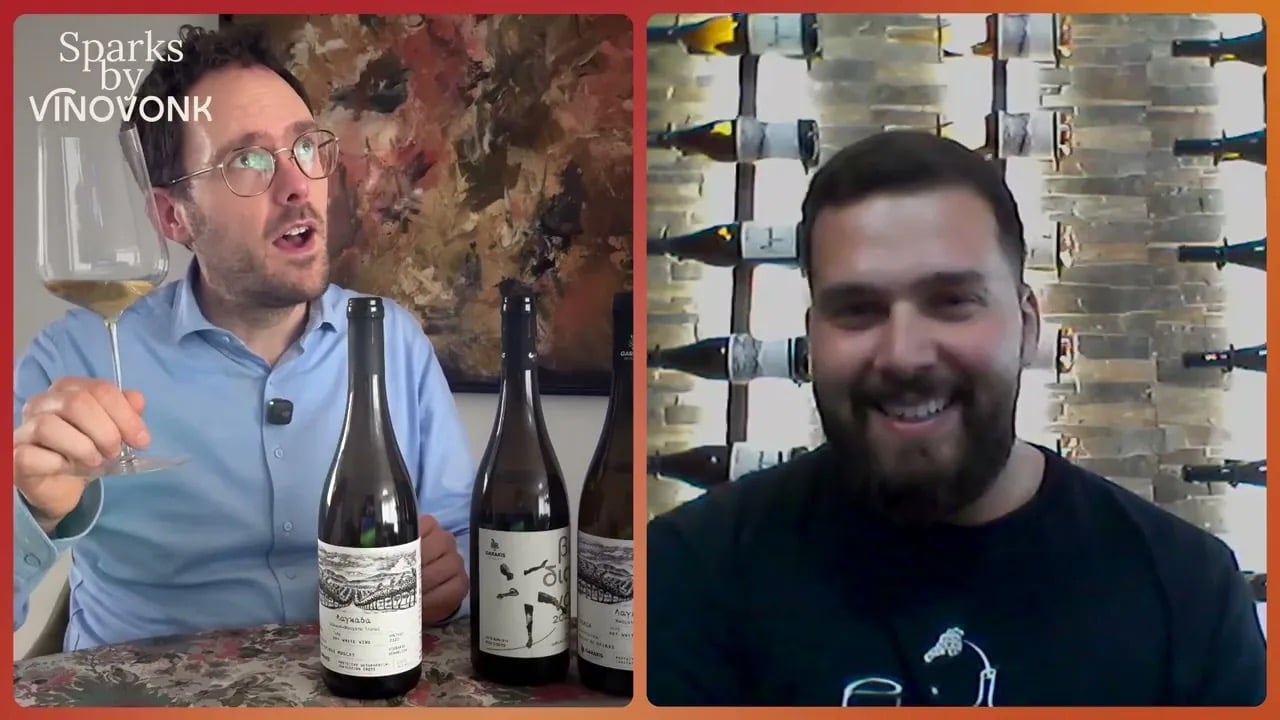
A 12.5 percent Syrah from Crete struck me as a contradiction. On an island with that much sun I expected a jammy red (Drakos: most Syrahs sit at 14 percent or higher). What I found in the glass was young red fruit, ripe but not overripe: strawberry, raspberry, blackberry, a little plum, and above all freshness. Drakos Garakis picks his Syrah early to keep the alcohol down and the aromas fresh.
For Sparks episode 23 I spoke to Drakos right after my tasting with Lodewijk of Dutch importer DeliKreta. Lodewijk didn’t know how the wines are made, so he texted the winemaker, and Drakos found time for me straight away. Four bottles on the table: a Lagada blend of Vidiano and Muscat of Spinas, an Acrobat Vidiano from almost 600 metres, a Lagada Muscat of Spinas and that Syrah.
Lodewijk of DeliKreta sent me the bottles; I received no payment and the opinions are my own.
Who is Drakos Garakis
Garakis is a family business in Kounavoi, a village less than 20 kilometres from Heraklion. His father started a distillery there 25 years ago, and it still makes raki. Three years ago Drakos and his brother set up the winery, with 2022 as their first vintage.
Both brothers studied Greek philosophy. The family has worked these vineyards for generations, and their love of the land pulled them back. They farm around 40 hectares, mostly local varieties. The first vintage came to 3,000 bottles, the 2024 to around 13,000. The vineyards could yield 50,000 to 70,000 bottles, but Drakos would rather grow step by step and be known for quality first.
The vineyards: Lagada and Acrobat
Most of the vineyards lie around Kounavoi at close to 400 metres, in the Lagada area, less than a kilometre from the winery. Lagada, Drakos says, means something like “a place with many vineyards”. Those wines carry the Lagada name.
Further away, about 40 kilometres from Heraklion, there is a vineyard at almost 600 metres. That is where the Mandilari grows, and where the Acrobat Vidiano comes from. The plot is hard to reach and you have to climb like an acrobat, hence the acrobats on that label.
The soil throughout is white limestone. Every wine I tasted was salty and mineral, each in its own way. I asked Drakos whether that comes from the soil or the sea. He thinks it is a mix of the two: the island and the soil.
The grapes: Cretan
Garakis works mainly with grapes that belong to Crete itself rather than to mainland Greece.
- Vidiano: white grape from the Rethymno area, in Drakos’s view one of the best Cretan varieties. Round, but not buttery.
- Muscat of Spinas: aromatic white grape with a thin skin that burns easily in the sun.
- Mandilari: red grape, also found on Paros and sometimes Santorini, and common on Crete. Drakos calls it a difficult variety to make wine from.
- Rozaki: a hard-to-find white Cretan grape Drakos is experimenting with. Whether it ever gets its own label is still open.
There is also Syrah, the French grape behind this episode’s title.
Tasting four wines
That morning I had tasted the wines with Lodewijk using a Coravin. On Drakos’s advice I then decanted two of the bottles for about two hours and poured them back into the bottle to chill them.
Lagada blend 2023 (around 90 percent Vidiano, with Muscat of Spinas), 13.9 percent
After decanting the wine was rounder and fresher. The aromas were still there, just less direct. On the nose a salty sea breeze, tropical fruit, blossom, acacia and vanilla. I found it clear and pure, with plenty of layers that stay approachable, and a long, warm finish.
Drakos makes it as a classic white in stainless steel, with 24 hours of cryo-vinification to hold on to aroma and freshness. After two years in bottle, he says, the blend tastes like straight Vidiano because the Muscat fades. He finds the 13.9 percent a little high himself, and the next vintage comes in at 13 percent.
Acrobat Vidiano (600 metres), 30 percent in oak
The colour is deeper, from two days of skin contact at low temperature. Two days on the skins would normally push a white towards orange wine with tannin, but not here. Again salty, fresh and mineral, with blossom, tropical fruit, peach, apple, lime, lemon and lemon zest, plus herbs such as Greek thyme. Drakos names honey as a hallmark of their wines. Once he said it I picked it up too: the roundness and floral side of honey rather than its sweetness.
Around 30 percent of the wine spent about two months in second-use French oak, for body and structure rather than oak flavour. He admits the alcohol is a little high here too, but he deliberately makes wines for the table. Besides Greek food, a salad with anchovies and grilled courgette came up.
Lagada Muscat of Spinas (100 percent)
Paler than the blend. Very aromatic, with red and green apple, lots of blossom and vanilla again, like vanilla biscuits. Fresh, elegant and cleanly made. Classic white vinification in stainless steel, fermented at a lower temperature, with no malolactic. Muscat can also be made with carbonic maceration or skin contact, but Drakos goes for the tank because it keeps the wine fresh.
On Crete, Muscat usually goes with a salad or something light. Drakos wants a wine that can stand up to a main course, with more structure and body. This is their oldest vineyard, which he says helps. He expects to push that line further over the next few vintages.
Lagada Syrah, 12.5 percent
Classic red vinification: four days on the skins at a slightly lower temperature, then time in second-use oak for body rather than oak flavour. As with most of his wines, Drakos keeps the wine on its fine lees and uses bâtonnage, again for body and structure.
Young red fruit, plus herbs and spice. Drakos recommends serving it cooler in summer. Red wine is hard going in Cretan heat, which is also why he keeps the alcohol lower. He suggests 12 to 13 degrees, and never above 15. I could also see it working on its own in the sun at around 15 degrees.
Style and approach
According to Drakos the family has farmed organically for 25 years, among the first to do so. They grow their own vegetables too. There is no certification on the bottle yet, which is hard to obtain in Greece. Drakos expects it in about a year.
Against the sun he uses two training systems, pergola and VSP. In both, the bunches hang beneath the leaves, which give shade. The Muscat of Spinas is on pergola because its thin skin burns easily. Crete doesn’t have enough water to irrigate. When I asked about the changing climate, Drakos said that leaf shade may be the only thing they can do. So far it works, he says, but time will tell.
New wines start in two experimental vineyards, one with white and one with red local varieties. Drakos runs micro-vinifications and repeats a successful trial the following year. Only if it convinces again can it become a label. The fixed range will be Muscat, Vidiano and Mandilari, plus the Mandilari pét-nat and, from this vintage, a rosé of 100 percent Mandilari.
Caveats
I tasted one bottle of each wine, and the technical details come from my conversation with Drakos rather than from a tech sheet. Prices didn’t come up in the episode. The organic farming isn’t certified yet, so until then it is the family’s account. Drakos himself finds the alcohol of the blend and the Acrobat on the high side, and the Muscat doesn’t yet have the body he is after. Production is small, and the pét-nat was sold out at the time of recording.
Frequently asked questions
Which Cretan grapes does Garakis use? Vidiano, Muscat of Spinas and the red Mandilari, which also grows on Paros and sometimes Santorini. There is Syrah as well, and Drakos is experimenting with the rare white Rozaki.
Why is the Garakis Syrah only 12.5 percent? Drakos picks early, which keeps the alcohol low and the aromas fresh. He wants a red you can drink chilled in a Cretan summer.
Is Garakis organic? According to Drakos the family has farmed organically for 25 years. There is no certificate yet; he expects one in about a year.
What does “Acrobat” mean on the label? The label belongs to a vineyard at almost 600 metres, outside the Lagada area. It is hard to reach, and you have to climb up like an acrobat.
The bottles in this episode
Lagada blend 2023. Around 90 percent Vidiano with Muscat of Spinas, stainless steel, 13.9 percent.
Acrobat Vidiano (600 m). Vidiano from the high vineyard, two days of skin contact, 30 percent for two months in second-use French oak.
Lagada Muscat of Spinas. 100 percent Muscat of Spinas, tank-fermented at low temperature, no malolactic.
Lagada Syrah. 12.5 percent, picked early, four days on the skins, second-use oak.
Garakis also makes a Mandilari pét-nat (sold out), and a Mandilari rosé joins the range this vintage.
Buying in the Netherlands
Outside Crete the wines are so far only sold in the Netherlands, through DeliKreta. Drakos and Lodewijk met two years ago and, Drakos says, have become friends. If you are on Crete, you can also visit the winery.
Transcript
The full conversation transcript.
Show full transcript
This transcript is generated automatically from the audio and has not been edited. Speech recognition makes mistakes, so treat wording as an approximation rather than a verbatim quote. It is here for accessibility and search.
Hi and welcome everyone to a new episode of Sparks by VinoVonk. The video podcast where I show you different kinds of wine, spirits and other innovative drinks. As you just saw, I had an interview with Lodewijk from Delikreta and we tasted some beautiful wines from Garakis. And I asked him, okay, but how do you make the wine? How are the plants planted, the vines?
How do you vinify them? And he said, I don’t know. I said, maybe I can ask the winemaker. And he texted the winemaker. Look who’s here.
He found some time directly for me. It’s Drakos Garakis from Garakis Winery from Crete. Drakos, thank you very much for having some time for me and welcoming the show. Can you tell me something about what you do? So, we are a family business.
The whole family works here. We started 25 years ago as a distillery. My father started the business. And three years ago, me and my brother started the winery. We studied something different.
We studied Greek philosophy. But our love for nature and vineyards pushed us to go back to the future, to nature and cultivate the vineyards. It’s something that we used to do our whole life. Also my grandparents and my grandparents’ grandparents. So it goes back.
It’s a history for us. So we love the nature, love the vineyards, the wine. And that’s why we decided to produce wine. Three years ago, the first vintage was the 2022. We started with Vidiano and Muscat of Spina.
And we started with only 3000 bottles, the whole production. But today, the 2024 vintage will be out. It could be about 13,000 bottles. So you’re growing. Step by step.
Our goal is to create high quality wines. We have our own vineyards and we cultivate about 100 acres of vineyards. Most of them are local varieties. You know, those vineyards can produce over 50,000 bottles. But our goal is to do step by step.
To have good quality and we will see in the future. Yeah, and you are making a lot of different kinds of wines because I have four of them here, but Lodewijk told me that there’s one more coming and you work with… One more Greek variety, Cretan variety. And we really believe in that variety. So stay tuned.
It could be out in about two months. Okay, now we’ll stay tuned. But you work with indigenous grapes, but it’s indigenous for Crete, not for Greece. Most of them like Muscat of Spina, it’s a Cretan variety, Vidiano is a Cretan variety. I think all of them, all of them are Cretan varieties.
Mandilari, it’s also Cretan but you can find it in a little bit different way at other Greek islands like Paros and sometimes in Santorini and other islands. But here in Crete it’s a common variety. It’s a difficult variety to make wine, but that’s the good thing. Can you tell me before we go to taste the wines something about your vineyards and about the altitude and about the soil that you have? Yes, of course.
Most of our vineyards are at our village, the Kounavoi village. It’s close to Heraklion city, less than 20 kilometers away. So the altitude is close to 400 meters altitude. We have also one vineyard, the Mandilari vineyard. It’s a little bit far away from here, 40 kilometers from Heraklion, from the center, let’s say, the bigger town here in Crete.
And the altitude there is close to 600 meters higher. And that’s good for that variety. The land, the terroir, it’s… White soil, let’s say. And the white soil is that like chalk or…
Limestone. And I’m sorry, let’s say, limestone. Limestone. Limestone. Yes.
And so all of them, all of them, all of them are limestone. Okay. And because all the wines have a lot of saltiness, minerality, but different kinds of minerality, is that because of the soil or the exposition or because you’re surrounded by the sea, you’re on an island? Yes, I think it’s maybe because we are on an island and of course the soil. It’s a combination of that result.
I think maybe because of the island. Yeah, and we’re going to taste some wines. Lodewijk sent it to me from Delikreta and he told me this morning, or Lodewijk told me, Lagada is the name of the vineyard. Yeah, and that is your vineyard in your hometown. It’s an area close to our winery, less than one kilometer away from here, from our winery.
And most of our vineyards are in that area, the Lagada area. And Lagada, let’s say, it’s a place with many vineyards. That’s the meaning of the word. So, Lagada. And one question I also had was these labels are quite similar, but this label is quite different.
It’s something different. It’s two series of labels, the Lagada series and the other one with the acrobats. It’s something like an acrobat. Oh, in my imagination that’s because it’s another vineyard 600 meters high and it’s difficult to reach because you have to climb and be like an acrobat. Yeah.
Yeah, I love that approach. And you gave me the tip to decant these two. So I decanted them, but I… I also wanted to chill them, so I put them back in the bottle. So I decanted them like two hours.
With which one of the wines would you like to start? I prefer it’s better with the Muscat, Muscat of Spina. The Lagada, from Lagada, yes. This one. Yes?
Okay. And I have to tell you that the Muscat variety is a variety with high aromatic profile. But our goal is to make wines with structure and to make wines to be a good pairing with food, gastronomic wines. So also here… Of course you can find the aromas of Muscat and imagine that that vintage was the 2023.
So if you drink it fresher, for example… The new vintage, the 2024, you will find of course more aromas, more fresh aromas, but after time inside the bottle you will find different herbs and other characteristics after the time inside the bottle. You will find, you will try now to… Yeah, because I already tasted them with Coravin and now I decanted the wines. And what immediately struck me was that now after decanting the wine, it’s more round and more fresh.
The aromas are still there, but they’re more round and not so direct in your nose. And it’s very aromatic. Now you have a little bit like a sea breeze in your nose. The salty sea breeze with some tropical fruits, blossom, acacia, vanilla. But it’s very lovely.
Can you tell me something about how you Yeah, that’s good. Yamas, maybe. Yeah, Lodewijk told me, yamas. Everywhere, everywhere. Cheers.
So it’s a classic white vinification inside stainless steel tank. We use 24 hours cryo-vinification to keep the aromas, to have freshness. One other thing I have to say is that that vineyard, Muscat vineyard, it’s in a style like a pergola style, you know. So here in Crete maybe it’s the future of the vineyards because we have the sun maybe the whole year. So sometimes it’s a problem for the grapes and this way we have a natural protection.
Because we have the leaves and the shape like this one, like the VSP style sometimes and also the pergola style we have the leaves up there and the grapes down from the leaves so this way we have a natural protection and I think it’s better this way you can keep the aromas And here in Crete sometimes it’s a problem the sun and the high temperatures. Because then it’s too hot and the grapes will burn. That’s true, that’s true. And some varieties like the Muscat of Spina, it’s easier to destroy. Because the skin is very thin.
Yes, yes. I love it very much, but it’s also very clear, very pure and a lot of layers. It’s not too complex, but it’s… It’s an accessible complexity. It’s a serious wine, not, okay, a lot of layers.
What is it? No, it’s very straightforward, too, true, but it’s very warm and cozy. And the aftertaste is also very long. Very nice. And one of the questions I also had to Lodewijk and he didn’t know, but do you work organic or sustainable?
Yes, yes of course, we cultivate organically. 25 years ago we started. We were among the first people that are doing this approach. And for us it’s a way of living, the organic life, you know, the sustainability. And also we cultivate our vegetables.
Our goal is to… To have everything, to know what we eat, what we drink, what we are. Yeah. That’s a good lifestyle because there wasn’t any certification on the bottle. But I know that it could be very difficult in Greece to…
To have it, to have the certification soon. I think in about a year we will have it. Ah, perfect. Is there anything more you want to tell me about this wine? You can see the alcohol is a little bit high.
It’s 13.9%. And this year we did something different. It’s a little bit lower. It’s 13%. I think it’s a little bit better.
You know… We are here in Crete, we have the sun. I think it’s better to try fresher styles of wines. And also with the red wines, we prefer lower alcohols. For example, we will try after the Syrah, the French variety.
You know, most of the Syrahs are 14% and higher. This one is only 12.5%. But how do you manage to keep the alcohol so low? Is it just harvest soon, early? Yes, yes, this way, this way.
And this way you can keep the aromas fresher. Yeah, good approach. Shall we go to the next one? Yes. And shall we do this one next or?
Okay. Because this way you will see the continuation of the variety. And it’s difficult to reach, so that’s why an acrobat is on the label. Up the rope! Yeah.
It’s again very salty, very fresh, lots of minerality, but also a lot of blossom fruitiness, tropical aromas with peach, apple, lime, a lot of lemon also, lemon zest. And what kind of variety is it? This is Vidiano. That’s an indigenous grape for Crete. Yes, it comes from the Rethymno area and I think it’s one of the best Cretan varieties.
It’s very round, but it’s not so buttery. It’s not creamy, but it’s a little bit. Because we used the oak there, but not the whole amount, about 30% of the wine stayed inside French oak barrels, not for so long, for about two months, and the barrels were second-use barrels. Because our goal is for all of our wines to have a… To feel the body, to have more structure but not to have an oaky result.
So yes, you can find the oak there but it’s not so much. Can you tell me something about the vinification? How do you vinify this wine? You can see also the color it’s a little bit darker because we have a two days skin contact so this way we extract more aromas and flavors and also we use the oak as I told you Also the alcohol there it’s a little bit high but you know as I told you we prefer gastronomic wines, this one of course It’s a gastronomic wine. Yeah, and so you do two days of skin contact.
That’s why it has a lot more color. But normally when you do two days of skin contact, you almost get an orange wine, like with a lot of tannins. But this is not the case. Do you do it at low temperature or? Yes, this one is at low temperature.
The previous vintage, the 2022 of Vidiano, but from Lagada series, you’ll see after the color is darker because the temperature levels were a little bit higher. Not too high, but a little bit higher. Yeah. It’s very gastronomic, but it’s not only gastronomic with Greek food. I also think like with a salad with some anchovies or with some grilled zucchini.
It also could be very nice because it’s very round and elegant and a lot of… Herbs, like Greek thyme. And also one of our characteristics is the honey. Now that you say it, yeah, the honey is there, but it’s the thickness of the honey, it’s like the roundness and the florality of the honey. That’s true.
Ah, love it. Hmm. So this is from another vineyard, 600 meters high. Outside of Lagada area and we will continue with that label, the label with the acrobats. In the future for all the labels.
Yes, yes, we have one more label. It’s a Pét-Nat from Mandilari, the red variety. It started as an experimental vinification. It’s this one I showed you. It’s a little bit funky.
It’s our cat Billy. We hope this vintage to have more bottles because it’s sold out. Yeah, it’s all sold out. Or maybe you drank it yourself too much. Oh, a lot of them.
It’s always the best part of being a winemaker. Shall we go to the next one? Yes, of course. And the next one is also from Lagada, it’s the Muscat of Spina. Yes, yes.
This one I didn’t taste this morning with Lodewijk. Very nice color. It’s a little bit lighter. Lighter in color. It’s also very aromatic, very nice apples, red and green apples, but also a lot of blossom, vanilla again, like vanilla cookies.
It’s very nice. But it’s not the same variety as the first one, but it’s in the blend. This one is 100% Muscat of Spina. The first one was with Vidiano and the Vidiano inside was about 90%. So after two years inside the bottle it’s like 100% Vidiano, the Muscat disappears.
Ah, that’s why. So there we have the 100% Muscat. It’s very aromatic, very fresh again. Again, very lovely, elegant, very purely made. And can you tell me something about how you made this wine, like the vinification?
Yes, this one is with a classic white vinification. We use tanks for Muscats. It’s easier when you would like to keep the aromas to use the tank, the tank fermentation at lower temperature. I think you don’t need something else if you want to have a fresh wine. Because the Muscat variety has also other kinds of vinification like carbonic maceration, like something different, like skin contact method, but this one is the fresher way.
So only in stainless steel tank, classic white vinification. Yeah, but in that way, in different kinds of vinification, you get different kinds of wines and you have different moments of drinking wine in others, but everybody has another preference also. That’s true. That’s true. Yeah, and what is your preference?
Like this style or more round? You know, the Muscat, what happened with us? I can tell you what we believe. We believe in Muscat because it’s a variety that it’s easier to drink and also when you don’t know a lot of things about wine you will like that variety. The only thing that we would like to change is to…
Have more structure and more body in our Muscat wine and this way we are trying to have a gastronomic wine because the Muscat here the common thing is to drink it with salads you know something fresher but our goal is to try it with food with the main dish so that’s the difference that’s why we have alcohol Are you going to work with that then? How does it work? We have a lot of work inside the vineyard. Also, that vineyard is the older vineyard that we have. So that’s an important thing to have more body.
Our goal is to have clear fruit. So maybe next year and the year after that we’re getting the same line but with more structure and more body, a different approach. Yes, why not, we will see. We make a lot of experimental vinifications, so year per year we change things. We’ll see.
And how do you test this different kind of vinification? Do you blind taste it with your family? Yes, and we have also two experimental vineyards. We have one vineyard with white varieties. All of them are local varieties.
And one other with red varieties. And also many, many different varieties. We do micro-vinification in smaller amounts and we test the results. If we like the result, we test again the next year to have the same result, close to the same result. And if we like the result, after that maybe it could be a label.
Yeah, and I love that approach. That’s the way how you innovate, start small, test it, learn, build again, learn, measure. We produce only 13,000 bottles, because our vineyards can produce around 50 to 70,000 bottles. But as I told you, our goal is year per year, step by step, to have good quality wines, for people to know us. And after that, the easier thing is to have a bigger amount, bigger production.
Yeah, because you still have the distillery. Yes, yes, we have also the distillery. It’s something also we love, the Raki. But I think that our bigger love is the wine. Yeah, but you still can do it both.
Yes, yes of course we do, we do. And all the wines are opening up in the bottle. And it’s so nice to… Notice that expression that when you first pour it in, it’s a totally different wine after a couple of minutes in your glass. And imagine when you are in the sun and the warmth kicks in, you pour in half glasses, chill it down, and then you have all the meal, totally different expressions.
You think, okay, it’s one bottle, but you’re drinking different kinds of wine. It’s very fascinating. I think that’s a good thing. Yeah. Shall we go to the Syrah?
Yes, let’s close because they’re red. Yeah. You know, in the summer season, I suggest to serve it at a little bit lower temperature. And we are trying to make red wines that can be drinkable the whole season. Because here in Greece in general, and specifically in Crete, we have high temperature the whole year.
So… We need to drink the red wines but the red wines are difficult to drink for example in summer if you chill a bit it’s easier and this one for sure it could be much better a little bit lower temperature that’s why also the alcohol is lower 12.5 percent yes 12.5%. And again, I thought, okay, Syrah from Crete, very warm, it could be a little bit too much like jammy, but it’s very fresh. It’s very young fruit, young red, and a little bit ripe, but not overripe red fruit, a lot of strawberries, but also raspberries, blackberries, a little bit of plum, but not too much. And how do you make this wine?
This one is a classic red vinification. We use the oak, but also here the oak barrels were second use. Not oaky result, just to add the body. We had four days skin contact there. It’s not too much for the red wines.
That’s why… We want to keep the freshness, the fresh fruit. Those things. Yeah, it’s classical to do it like this or also with a little short oak maturation. Yes, we had a little bit lower temperature and at all of our wines, I forget to tell you, we keep the fine lees, the fine lees and most of them we use also the bâtonnage method To have, that’s because we need to add the body to have more structure.
One question I have also for the white wines. Do you also do the malolactic fermentation on your white wines? Yes, at Vidiano for example, not at all of them, Vidiano had. And the other one, so it’s in the blend, but it’s not at the Muscat of Spina. Without malolactic.
Yes. Yeah, because then you want to have the freshness. Also here we haven’t. Also here we haven’t. At the Syrah we have, at the Mandilari.
Yeah, yeah, but we have to wait two months. Yeah, and in here is also a lot of herbs, spices. It’s very gastronomic, but I also could think, okay, chill it a little bit down, like 15 degrees, enjoy it standalone in the sun. It could also be very nice. Our visitors here, they love it chilled at lower temperature, at lower temperature.
So you chill it like 10 degrees or 12. Yes, 12 to 13 I think. It’s good. Not over 15. No.
I can imagine. Can you tell me something about what your plans are in the future? I saw a Pét-Nat, but are you also going to work like with amphoras or natural wines? We do a lot of things, a lot of experimental things. We have also one variety, it’s really difficult to find it, it’s called Rozaki.
It’s a white variety, a Cretan variety and maybe you will find things from us in the future with Rozaki. We do, we do a lot of things. We will see if we have labels in the future. Yeah, but the goal is okay, now you are at 13,000 bottles. To keep four labels for sure.
The Muscat, the Vidiano, the Mandilari, those three for sure. We will have this vintage one more from Mandilari with the rosé method. 100% Mandilari, rosé wine. And of course the Pét-Nat. Those five things, I think we will have them All the years and maybe we will add some others.
Yeah, but you also have to surprise people a little bit, okay? Something new is here, well what is it? Well, it’s an experiment and you will love it. Our goal is to keep a low profile and to leave our wines to speak for us. Are you also planning on, because the climate is changing, also on Crete of course, because the temperature is rising, the winds are getting more, a lot of rain will come more in A short amount of time, but are you also planning on planting more vineyards at higher places or different places?
The thing we do, for example here in Crete, we haven’t a lot of rain and also it’s a problem to water the plants. Sometimes it’s a problem if you water a lot, the result is not too good. But here we haven’t enough water just to water the plants. So the thing we do is to use a different style inside the vineyard. As I told you, it’s the pergola style and the other one is the VSP style.
And this way we have something like shade, a natural protection of leaves. And maybe it’s the only thing we can do to protect the grapes. That’s our goal. We’ll see if it works in the future. Till now it’s okay.
We will see. But you always have to be prepared for the future. Yes, yes that’s true. Well, thank you very much for your time, Dracos. And if you have the opportunity, go find your wines in Netherlands.
You can buy them at Delikreta. You have distributors in all of Europe or… Until now we are only in the Netherlands. Thanks to Delikreta for that. We are friends.
We met two years ago. And from the first time we told each other that we will have a collaboration. So we are lucky now we have it. And thank you, thank you. So if you want to buy them go to Delikreta.nl or go visit you on Crete yourself at the vineyard.
Send Dracos an email. Well thank you very much for your time. This was a new episode of Sparks by VinoVonk. Join us in the next episode. Leave a comment below what you want to see the next time.
If you have any questions just send me a message. If you have a message to Dracos from Garakis Winery, send me a message, follow them on Instagram, on other kinds of platforms. I will link all of them in the descriptions below and enjoy your day. Thank you.
Listen
Watch