

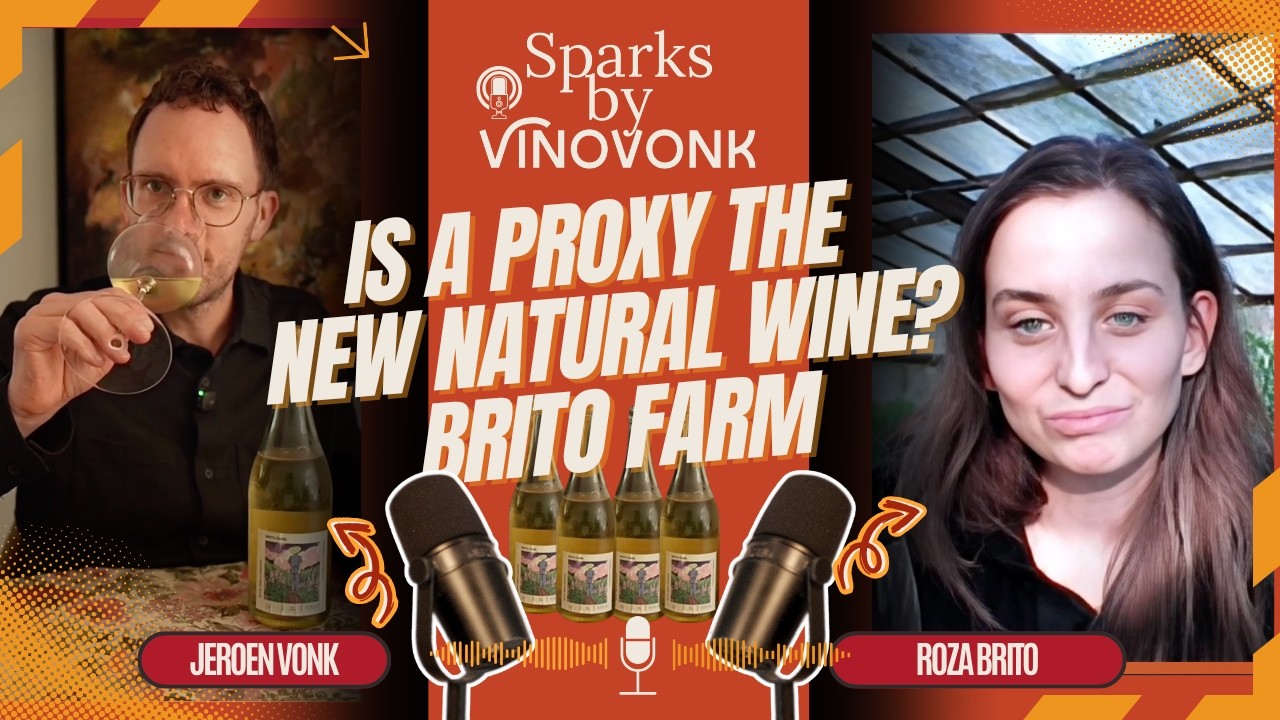
“Oh, what a smell,” I said as I poured the bottle from Brito’s Farm. Lots of herbs and lots of energy came off the glass, and I couldn’t put it any other way. It reminds you of tea, though it doesn’t taste much like it. Roza Brito makes it in Mazovia, Poland. Roza calls it a proxy.
For this Sparks episode we tasted two bottles: number 708 of 770, her largest batch so far, and a red prototype she is still working on. Most of the ingredients come from her parents’ farm and the countryside around it, from oregano and thyme to hyssop and a root she calls curly dock in English. She doesn’t use standardised extracts.
Roza sent me both bottles after I came across her on Instagram. No money was involved, and she didn’t see this piece before it went up.
Who is Roza Brito
Roza studied industrial design and found her way into fermentation as a student. “Our faculty taught us that the point isn’t to make another chair,” she told me. She has worked on fermentation in various parts of industry ever since, and still does. She sees herself as a future farm owner who wants to work with the land and with fermentation.
In her view the drink was made by a lot of people. She tested it for almost three years at a farmers’ market, the kind of place where you buy local eggs and vegetables and never see a wine bottle. Some shoppers were taken aback to hear it wasn’t wine, and others asked why anyone would make something without alcohol. A group of regulars also formed, and they come back every week.
“The same person comes every week and tells me about their mood for the week, and I decide which bottle to choose,” Roza said. If someone wants something sweeter or juicier, she points them to another stall.
When she talks to winemakers about why they do what they do, she recognises a similar motive. She thinks about fermentation and transformation the way winemakers think about grapes and wine.
What is a proxy?
I asked where it belongs: kefir, kombucha, or something else. Roza tries not to categorise it. Customers sometimes call it kombucha, others a botanical ferment or just a ferment. She calls it a proxy herself, a term she didn’t coin and which she finds the broadest.
She works with kefir cultures, kombucha cultures, other microorganisms and sometimes blends. She places her drinks somewhere between wine, kombucha and tea, and describes them as sparkling herbal fermented drinks. Kombucha is something she can drink on a run as a refresher; her own drinks are more intense. If people want to call them kombucha, sparkling tea or herbal tea, that’s fine by her. “I’m more listening at this point to what people say.”
Fermentation changes the taste, she explains. Most people know oregano and thyme from the kitchen or as a tea, and fermentation shows a different layer of the same herb. Her favourite for fermenting is hyssop, which is rarely used.
I see proxies more and more. A lot of people treat them as a new dimension of natural wine, because they are made naturally and are often organic or biodynamic. It’s a drink to sit down with, perhaps alongside some food.
From six bottles to a plan for a thousand
Bottle 708 of 770 sounds like a tiny run, but for Roza it was her largest batch yet. Sometimes she made only six bottles, as a single sample, and that lasted her a year. Then came sixty, and for two years she worked in batches of 60 to 100 bottles. She is now preparing a bigger batch, and the plan is to move to around a thousand bottles per batch.
I put a comparison with soup to her. Soup for two or four people is something you make by feel, and soup for 400 is a different job altogether. “Exactly how you’re saying,” Roza said. Benoît Gouez of Moët & Chandon also talked about what scale does to a drink in episode 36.
Roza believes the feeling in the drink can carry over to bigger batches, but she sees the danger of the easier path. She wants to keep using fresh and farmed ingredients rather than extracts, which are much easier to control, and to keep the same fermentation process. That means tighter control. She is a believer in technology to help her control and check more, so she can keep “the same romantic values in higher quantity”. “We should talk next year,” she added, “about whether that worked.”
Growing without extracts
Roza doesn’t grow everything herself. What matters to her is the limit she sets: no tea, and no free use of imported ingredients. “I like limitations, because limitations push us to think a little bit differently.” Most of the ingredients come from the farm or from the wild, such as the forests.
The first bottle contains a plant that grows beside lakes, looks like grass and has a black root. As a tea she found it unpleasant. Fermented, she says, you can taste something mineral, the wetness of the soil. Sometimes she buys in less usual ingredients, such as cinnamon, or the magnolia she once paired with basil in a seasonal batch. That bottle, with basil, magnolia and black pepper, had already gone to distributors and customers before she could send me one.
She doesn’t use mango. At the village shop near her, mango is easier to buy than local fruit, and she finds that a pity. She has travelled a lot and likes a wide range of flavours.
I asked whether there’s a ceiling if she does everything, or nearly everything, herself; I guessed 95 per cent. Roza pointed to bottling. Because it’s a food product, that happens at a neighbouring production space. She also sees a natural limit in the drink itself, which isn’t easy drinking. “It’s not a can that you can just run and drink.”
The first bottle: 708 of 770
Roza already had some in her glass. “Every time it tastes different to me,” she said. The bottle didn’t explode when I opened it, which pleased me.
I got lots of herbs and lots of energy. It’s complex and yet accessible. It isn’t the sparkling tea I’m used to, and it isn’t sweet. It’s a little bitter and has a touch of sweetness, but it stays dry. I wanted food with it straight away, and more of it.
By the fourth glass I was calling it a proxy of Red Bull, without the caffeine.
The red prototype
Roza had told me to mix the bottle before pouring. It looked very dark, and I had those Instagram videos in my head where a bottle sprays everywhere the moment it’s opened, so I opened it outside. Nothing happened. “Sometimes it’s happening with the test ones,” Roza said.
In the glass it’s very cloudy, like a very cloudy natural wine. It smelled like a handful of fresh and dried herbs rubbed in your face, with flowers and something of Christmas and pumpkin season. On the palate it’s different from the first bottle: round, closer to tea, with tannin that grips the gums. I also tasted strawberry and Sichuan pepper.
The finish is flat. The first bottle’s is more complex and fuller, whereas this one is gone as soon as you swallow. “I had the same feeling,” Roza said. The prototype is one of her attempts at a red colour, with warmth and depth. “That’s why it’s a test, because it doesn’t leave you with anything, as you said. And I don’t like that in proxies.”
The base is curly dock, kopylak in Polish, a root that grows almost everywhere and is rarely used in the kitchen. Brewed and fermented it gives a metallic taste, which is why she is looking for other ingredients to add layers. There’s also artichoke leaf, jalapeño from her parents’ farm and cinnamon. A third ingredient was meant to carry the finish, but that fermentation wasn’t handled well.
She has made two new batches since, with a little improvement. With the third batch she isn’t sure yet. I called it build, measure, learn, the lean startup cycle.
Disruption or addition
I asked whether she’s disrupting a market. Roza sees her drink as an add-on to the category. “If that happens as disruption, that will be by accident.” Her goals are personal ones: working with the land, working with these herbs.
She wants to show herbs that are little known abroad, in the way you drink wine from Italy or from a particular region. Scale in numbers isn’t really her aim. How many bottles she makes a year will follow from that. She wants people everywhere to be able to taste this region, for example in a restaurant.
This year she started selling beyond the farmers’ market, with a Christmas market as the first step. Restaurants followed, along with one distributor that works with restaurants, so she can concentrate on the farm and the fermentation. At the time of recording she hoped to go abroad by the end of the year. In Poland she sees interest growing, with the big cities leading. Sparkling tea is popular there, and proxies are on their way.
At wine festivals she usually ends up in a separate room, and she hopes one day to share the room with winemakers. When she doesn’t have time to say it’s non-alcoholic and not wine, visitors drink it as wine and talk about it as a natural wine. Only once she explains that it isn’t made from grapes do they see it differently.
Reservations
Roza can’t put “bio” on the label. Her parents farm without pesticides but have no certificate, because with so many small crops they don’t have time for the paperwork. She is working on getting it sorted.
The first bottle is a little bitter. Anyone after something sweet gets sent to another stall by Roza herself.
The prototype loses its finish. We both said so, which is why Roza calls it a test.
At festivals people take it for natural wine until Roza tells them it isn’t wine. Without that explanation, a visitor doesn’t know what they’re drinking.
Price and alcohol content didn’t come up in our conversation; Roza describes the drink as non-alcoholic. I couldn’t find it in the Netherlands, and at the time of recording it wasn’t on sale there.
Frequently asked questions
What is a proxy? Roza uses the word for a drink that sits between wine, kombucha and tea. Her proxies are sparkling herbal fermented drinks, non-alcoholic according to her. She didn’t coin the term, and she’s happy for people to call her drinks kombucha or sparkling tea.
How does Brito’s Farm ferment its drinks? With kefir cultures, kombucha cultures, other microorganisms and sometimes blends of these. Most of the ingredients come from her parents’ farm or from the wild. She doesn’t use tea or standardised extracts.
Can you buy Brito’s Farm in the Netherlands? Not at the time of recording; I looked. Roza was selling in Poland through a farmers’ market, restaurants and one distributor, and hoped to go abroad by the end of the year.
Which herbs does Roza use? She mentions oregano and thyme as examples of herbs people know from the kitchen. Her favourite for fermenting is hyssop, which is rarely used. The first bottle also contains a grass-like plant with a black root that grows beside lakes, and the red prototype is built on curly dock.
The bottle itself
Brito’s Farm, bottle 708 of 770. A sparkling herbal fermented drink from Mazovia, Poland, non-alcoholic according to Roza. I tasted lots of herbs and lots of energy. It’s complex and accessible, not sweet and a little bitter, and I wanted food with it.
Full transcript
Open the full transcript (English)
Taken from the episode’s English subtitles. Timestamps mark each minute of the recording; there are no speaker labels. It is here for accessibility and search.
[00:00] Hi and welcome to a new episode of Sparks by VinoVonk. My name is Jeroen and I’m going to talk to you about proxies. Normally we talk about wines, spirits, innovative drinks, but a proxy is a very innovative drink. I found this beverage from Brito’s Farm through Instagram, I sent a message, and now we are here with Roza Brito from Brito’s Farm. Roza, thank you very much for your time and thank you very much for sending me this bottle. Hi everyone, and cheers to you. Nice to meet you all and talk about the non-alcoholic space a bit. Yeah, it’s very nice to meet you. You already have it in your glass. Shall I pour it also? Yeah, let’s have a try! Every time it tastes different to me, so I always like to try. It didn’t explode, so I’m very happy.
[01:00] Oh, what a smell. It’s a lot of herbs, a lot of energy. I can’t describe it other than energy. It’s a kind of tea, but it’s not very much like tea. Roza, can you tell us what it is? This is also a fermentation — maybe not the one that you know from wine, but at Brito’s Farm we… moved every ingredient through the fermentation. That’s our way to make proxy. The point of it is that fermentation changes the taste. Although it’s herbs — some herbs you probably know, like oregano, thyme — the ones that you use in the kitchen. Sometimes you have tea from them, so you might know the taste. But when it’s touched by fermentation, I think it elevates it into a little bit of a different different perspective on this herb. That’s what proxy is for me. It’s just to give pleasure of drinking, but also like…
[02:00] show a bit of a different layer of the same ingredient. We also use ingredients that are maybe less used, like a hyssop herb — that’s really rarely used, but it’s personally my favourite for the fermentation. And most of the herbs and ingredients you find in this bottle are actually from the surroundings of me, which is my parents’ farm — our farm. So right now we are in the early stage of the farm, but we like to use the real ingredients, not the extracts that are standardised. I totally love it. It’s really amazing. It’s a lot of herbs, but it’s so complex, and it’s also very accessible at the same time. And it’s a totally new dimension for me, because it’s not a sparkling tea I’m used to, and it’s not sweet. It’s a little bit bitter. It has a kind of sweetness, but it’s very dry. And I think: okay,
[03:00] I want to pair this with food. I want more of this because it’s so complex. It’s so full of energy. I really love it. But we’re going straight into the depth, I would say. But for the people who don’t know you — who is Roza Brito? Yes, so right now I like to consider myself as a future — let’s say a farm owner. Let’s say I want to work with the land, and I want to work with fermentation. This drink was actually made, I would say, by many, many people, because it was tested for almost three years at the market. At the market — a food market — where you’re buying your local eggs, vegetables. A very different setting where you don’t see wine bottles, for example. So that was quite shocking for some people — hearing that it’s not wine.
[04:00] But honestly, the taste and the feelings you’d describe — it came from this repetition of showing and tasting by customers. Because sometimes it went really crazy, and I believe my customers remember some of them. Sometimes it went very sparkling, so it’s slightly dangerous, you know. Yeah, that’s natural fermentation. And now I believe this bottle you have is a really nice introduction to a wider market, outside of just the farmers’ market. Yeah, that’s it — that’s our first bottle. We also made one that’s from different sources of basil and magnolia — magnolia flower as an addition, and black pepper. Although I couldn’t even send you that one, because it just went away to distributors and customers.
[05:00] So I don’t even have one myself to try. No, you’re very popular — on this bottle it says bottle number 708 of 770 bottles. So it’s very small. And you’re from Poland. And where in Poland are you? Right now I’m in… the Mazovian area, which is — if you go towards Warsaw and then more south towards Ukraine — you’re going to pass the village. You say it’s small, but for me that was our biggest batch. Really, for two years we did really small batches — like 60 to 100 bottles — just to get to that point. And now I hope — we’re preparing for a bigger batch now. So it’s really fresh, but kind of old for me as well, because we’ve been at it for so long. It hasn’t been like, a month ago we had an idea, because a lot of proxies are out there so we wanted to do it.
[06:00] It was quite a long, long journey. So I’m really happy that I can share it with customers. Yeah, it’s like making a bowl of soup. When you make a bowl of soup for two or for four people, then you get a lot of feeling with it. And then somebody asks you: okay, let’s make soup for 400 people. Well, you have to put in 400 times the ingredients, and that’s a whole new dimension. And how did you do that? Was it in small steps, like — six bottles, 60 bottles, 600 bottles? How did it go? Exactly how you’re saying — maybe six bottles. Yes, sometimes we did even only six bottles — like one sample. As I sent you, but it was for let’s say one year, just like one taste. And then 60 bottles. Then another year we went crazy with the amount of
[07:00] rounds — also going small, like 60 to 100 bottles per batch. And now we’re moving to a stage where we want to do like a thousand bottles per batch. And I’m a huge — believer — we should talk in the next two years — but I’m a huge believer that these emotions can be transported in bigger batches. But there is a big danger to go the easier paths. So I’m really working on, you know, still using fresh ingredients if necessary, still using the farmed ingredients, and not using extracts that are much easier to control — still using fermentation with, let’s say, the same process. The control has to be higher. I’m also really a huge believer in technology. So we can control and check so much now that it can go in parallel and help us to have the same romantic values in higher quantity.
[08:00] So we should talk next year if we… if that will be a success. But that’s the point. I don’t want to do it differently. But you could also think: okay, let’s make small batches — like 600 bottles, 700 bottles. It isn’t very small, but you could work in batches like: we’re making 700 bottles, and doing the same for 700 bottles. And if you don’t have enough ingredients, or you think the quality of the herbs or something isn’t good enough, then you just wait. Yeah. It’s like making it small, making it very exclusive also. Yes, so that’s our — as you say… Our goal is not necessarily to go to scale, but we want to keep quality, want to have people that enjoy it — sometimes every week.
[09:00] There are people that enjoy it every week, and this is the biggest happiness for me. This is why I wanted to do it. The same person coming every week and telling me about their mood for the week, and I can decide which bottle to choose. This human part — it’s amazing. But how did you learn about fermentation, and where does your passion come from? It’s been a long time already, because I started with fermentation techniques during my studies. I was studying industrial design, and my biggest interest was not just to produce. The school — let’s say our faculty — taught us that it’s not the point to make another chair.
[10:00] We can think about it a bit differently. And at that time I really focused on fermentation, and since then I was working more on the fermentation in different industry parts, working there — which is amazing and gives me a lot of… I love it. And I still do it. But sometimes I’m asked how it’s similar to the wine industry. I feel that when I talk with some winemakers about why they do this, I think we have the same similarity — a similar why — because it’s beautiful in many aspects, from having a grape to having a wine. This process of fermentation and transformation. I think about it the same way as winemakers think about the grape and wine, et cetera. You talk a lot about fermentation, but I don’t know a lot about fermentation. But I know a little bit about kefir and a little bit about kombucha.
[11:00] In what kind of category do you have to place this? Is this a kefir, is this a kombucha, or is it something else? Yeah, that’s also very fluid. Let’s say, sometimes customers categorise it as kombucha. I try not to categorise. I think proxy is the term that was created — not by me. That is the most broad. Because sometimes I use kefir cultures, sometimes kombucha cultures, other types of microorganisms — and sometimes there are blends. I try different kombucha — I can run and drink it, for example. So with kombucha I can run and drink it. It’s a refreshment. With my drinks — I don’t know — I feel like that’s not the same category, because it’s more intensive. So it’s still kind of an open book. I call it proxy myself. Some people call it botanical ferment, or just ferment.
[12:00] But I think this space is not really yet so well defined. Because it’s in between different categories — it’s not a wine, it’s not a kombucha, it’s not a tea. It’s a sparkling herbal fermented drink. Well, it isn’t quite a juice. It’s a drink. Yeah, it doesn’t have so much fruit. This one has a little bit, but the fruitiness might come from the fermentation itself. So yeah, I keep it open. My focus at this point is to make it better and better in terms of taste, and get better layers. I think a lot can still be done. And that’s my focus right now. And I think if somebody wants to call it kombucha, I’m totally fine with that. If somebody wants to call it sparkling tea or herbal tea, I’m also fine. I’m more listening at this point to what people say. So what would you categorise it? Yeah.
[13:00] It’s a proxy, because it’s in between. And maybe the name of the category is proxy. And if you work in IT, you think proxy is something completely different, because you use it in connection with your computer. But I think this is really the standout of the proxy revolution. Because you see it a lot. I already talked about proxies in Sparks by VinoVonk. I see it around a lot, because a lot of people think it’s a new dimension of natural wine — because it’s naturally made, and it’s most of the time organic, biodynamic. It’s a new revolution. It’s a new kind of drink. And it’s not like a soda or refreshment you put in a can, drink it on the way home in the train or something.
[14:00] You have to sit, relax, maybe enjoy it with some food. Talking about food — do you also sell this in restaurants in Poland, or do you also sell it outside of Poland? So we started to show it outside of the farmers’ market this year. Actually, the Christmas market was the first market that was outside our small farmers’ market. Since then we’ve been seen in restaurants, and also we sold to a distributor that works with restaurants, because the reality is that we really want to focus on still bringing this fermentation to an even higher level. So we really cooperate with distributors that work with restaurants, and have this connection, to really focus on the farm and on bringing the… again, to a better level. So it’s still fresh. This year it happened, and I hope by the end of the year we’re going to go abroad as well.
[15:00] Very nice. Because I looked for it in the Netherlands and it isn’t available yet. When the batches grow and the audience grows, then maybe it will be available in the Netherlands also. But for the record — the ingredient sourcing: do you grow everything yourself and make everything yourself? Or how should I see it? Not everything. But the limitation of not using tea, and not going so freely to use imported ingredients, is really crucial. I like limitations, because limitations push us to think a little bit differently. But most of the ingredients are sourced from the farm, from the wild — like forests. Or — in this bottle you’re drinking — there is… I don’t know the English word for it, but it grows next to lakes, it looks like a grass, and it has a black — and there is the root
[16:00] itself. When you make tea from it, it’s… it’s horrible. It’s really, really — I don’t want to say bad taste because taste is very subjective. But it’s not really pleasurable. But when you put it in ferment, I think this kind of mineral feeling, the wetness of this soil — you can really feel it. It makes a big difference. So we like to look around at what is available, and sometimes we use ingredients that are less usual, not from the farm. We buy it. Or like magnolia — it’s not really something that grows easily in Poland, but we used it in a seasonal batch once, and it really blends well with the basil. I’m actually surrounded by basil. So we try to use everything that is accessible to us.
[17:00] And do you grow organically or biodynamically, or conventional? So my parents, for example, don’t have any certificate. The only reason for that is that they have so many different varieties — small-scale vegetables on a small scale — that they don’t have time for the paperwork part. I’m trying to work on the field I make, and we’re going to try to get the certification and the papers in place. It’s… I can’t say “bio” on the label, because we don’t have these papers, you know? But everything is without, you know, pesticides — in a very… in a way that it should be able to qualify. But that’s the thing we’re working on — to get the papers in place and actually put it on the label. And so this is something for the future. Still innovating and still making new prototypes.
[18:00] We’re going in a couple of minutes to a prototype you sent me. But you told me that you were selling at the farmers’ market. And how were the reactions from people, and what kind of people went there? Everyone goes to farmers’ markets, I feel. Older, younger, different views on the world, on politics, on food — traditional, non-traditional. So it’s really a good mixture of people, in my opinion. And opinions were… all the possible — like, from “No, why do something without alcohol?” to, you know, some people just don’t like it. And I say: that’s okay, not everyone should like everything. But there is a group of people that drink it every week — sometimes more than me — and that’s the point. I don’t want to standardise it to be good for everyone. And I recommend, for example, other brands or other stands if I see that the person would like something sweeter or more juicy. It’s quite dry, not sweet. So there was all
[19:00] kinds of possible opinions we had. Is making or drinking proxies a huge trend in Poland? I think so. I think it’s getting more and more accessible. Of course, bigger cities are leading in that, but… When I go to a restaurant, I start to see and order different ones myself. We really like sparkling tea, I think, as a nation now. It’s really popular. And the proxy is also coming. And Polish people — I see they’re really interested in that. Very open. So that’s really nice. Yeah, so it’s definitely here. Yeah. And what do you see for the future? Or shall we first go to the prototype you sent me? Whatever you think — whatever you feel better with. I’m very curious about the prototype.
[20:00] Go for it. I know already — you know — the bad stuff about it, like things that I’m missing there. Yeah, but you told me to mix it, so I mixed it. I was a little bit scared, so I opened it outside, because it looked very dark. And you know the videos on Instagram where people open the bottle and everything splashes? That was in my mind, but it didn’t happen. Sometimes it’s happening with the test ones, yeah. Wow, it’s very cloudy. It’s like a very cloudy natural wine — the association I have. But when you smell it, it’s… It’s a lot of herbs. It’s like when you have a lot of herbs in your hand — fresh and dried — and you rub it in your face and think: what’s happening? Like somebody’s smacking it in your face, waking
[21:00] you awake. And there are a lot of flowers also inside. Oh, and it’s a little bit like Christmas and pumpkin season. It’s very complex. A lot is happening in my mouth right now. I love it, I love it. I don’t want to tell too much — to give you ideas, you know. Yeah, I’ll taste it. And this is the only bottle that was left — you don’t have it anymore. I don’t have it anymore. The clients took it. We already did two new versions of it. It’s completely different from the other one. It’s very round. And it also has some tannins — like on my gums, it’s squeezing. It’s very intriguing. And I get goosebumps, because I think: okay, what is happening here? Hm. Mm, it’s very nice.
[22:00] Maybe I’m taking too long — it’s more of a tea vibe than the other one, but it’s very round. But what I think maybe is missing — it’s a little bit flat on the aftertaste. Maybe the aftertaste of this one is much more complex, much more… much more body. And this one — when you swallow it, it’s pretty much gone at the same I had the same feeling as you. Could you tell me what I’m drinking? Yeah, I had the same… This is one of our many attempts at a red colour. I don’t want to say “red wine,” but to a red. And the point here is to bring this warmth and the deepness. And yes, that’s why it’s a test, because it’s missing this… it doesn’t leave you with anything — as you said. And I don’t like that in proxies.
[23:00] I really don’t. So we already made two different batches. It’s better now. Let’s say the base, the aftertaste — we weren’t happy with this one. But yeah, I’m excited. I kind of wish I could transport you the newest one. Because we got a little bit of improvement. And the red is based actually on the root. Mostly in there. The juices don’t matter so much to me. They give a little bit of colour in the middle, but they’re not giving this wine-like taste. But the most interesting ingredient for me is called in English “curly dock.” In Polish it’s called kopylak. And this is the root that actually grows almost everywhere. During this time you can walk in a village and you see the stems of it coming out. So it’s very common in terms of growth, but it’s not used a lot in the kitchen. And it has this kind of metallic taste when you brew and ferment — which is why we really want to find other
[24:00] ingredients to give it stages. And as you can see — I totally agree with you — it doesn’t have that last stage for sure, but it could also be improved in other stages. Yeah, in restaurants you also have a lot of house wines. It’s a simple wine. You take a sip. It’s nice. You swallow it. It’s gone. And you have another sip. But yeah, that’s not what you are achieving. You want to achieve a very complex, high-quality, premium drink. Yes. But I also get some strawberry vibes, and like Chinese pepper — Sichuan pepper — it’s very aromatic. There was also… So I automatically start talking about ingredients, but in there you have artichoke leaf and you have jalapeño — which is maybe not a Polish ingredient, but my parents are growing it, so for me
[25:00] it’s kind of local. So we have jalapeño in this one, cinnamon — it’s not from the farm obviously — but now we’ve balanced it better, I think. Gave a little bit of better extraction on the fermentation of this jalapeño, the artichoke leaf — as they call it — and a third ingredient. It’s responsible for the aftertaste, but it wasn’t managed well on the fermentation part. So yeah, I’m going already to the technical side — sorry. Yeah, yeah, I love it. Because it’s about innovating, it’s about making different iterations, making it in a structured way — not just saying: let’s try it. And if it’s good, it’s good. Now you have to know what you do, because when it’s good, you want to repeat it and make it better — build, measure, learn. It’s like the lean startup cycle — you want to do it.
[26:00] Yeah, and it’s just… interesting. Yeah, definitely. When I’m sure I have it, I’m really curious about your opinion. I’m not sure yet with the third batch. It’s work in progress, it’s a prototype. If it wasn’t a prototype, it would be a finished product. And this process is infinite — yes. Yes, yes, it’s still in progress. And what is your future vision for proxies? My future vision is that I definitely want to show it abroad — kind of like how you have wine from Italy or certain regions. I want to make this — show these herbs that are not so common abroad — as, let’s say, it’s from this land. I don’t want to sound nationalistic, but I’m not really… My goal is not so much the scale in terms of numbers — let’s say in terms of reach. So let’s say, you can try it if you go to a restaurant. Like wines from a specific region, I want people from all over to try this region in terms
[27:00] of proxy. We’re not using mango — right now I go to the local store in a village, and it’s easier for me to buy mango than local fruits. And for me — I’ve travelled a lot — so for me it’s a pity, you know? There is so much more to taste. I like diversity of taste, I like to try different things. So I want to give this little piece — where people can try something different, more abroad as well. And what size it’s going to be — like how many bottles we’re going to do per year — I think that’s just the effect of this. It’s going to be the effect of this. Yeah, my goal is to spread it, but in this way. There will be a maximum, because you are growing everything yourself — or most of it, like 95% — and you’re doing everything yourself. So there will be a maximum.
[28:00] I mean, yeah. But in terms of, for example, bottling — because it’s a food — we do that at this point at a neighbouring production space. There is a limit. I think the limit is kind of natural also — this is not so… It’s not so easy. It’s not easy to drink — you know, it’s not a can that you can just run and drink. It gives people something they have to engage with. So I think that’s maybe why it’s hard to say it’ll be in every star’s hands — that’s not the goal. So I think we will manage somehow. And do you think that you are disrupting a market — in Poland and outside of Poland? I feel that with this drink? I don’t think that’s the goal. With this — let’s say — And Roza, thanks again for joining me — because we had a little hiccup.
[29:00] Do you think you are disrupting a market, or do you think you are adding something to a market that maybe disrupts another kind of category? Yeah, I think it’s an add-on to the category. My goal is not disruption. If that happens as disruption, that will be by accident, you know. That’s not the goal. There are so many personal goals for it — to work with the land, to have these herbs. Disruption of the market is really not the goal. But I hope it will be a really nice add-on. And I hope to be at more wine festivals, and I hope one day I’m going to be in the same room as winemakers — because right now I’m usually in a separate room. Yeah, that’s still a strange thing — because it’s a beverage to enjoy in a fine dining or just dining setting, in a restaurant, in gastronomy. And you don’t have to see it as something separate when you’re going to tastings. But you don’t have to think: okay, this is a wine.
[30:00] You don’t have to… make the same tasting notes as a wine. It’s another kind of thing. Yeah, and honestly, sometimes at these festivals I have situations where I don’t have — let’s say — time to tell somebody it’s non-alcoholic and it’s not wine. And sometimes, you know, there is no… when there is no information, people enjoy it as wine and comment on it as a natural wine, because usually it has some… it looks kind of natural, and the visuals about it. So when I don’t have — like… when I skip it, it’s really interesting how people perceive it. And when you add the information — “oh sorry, it’s not from grapes” — so yeah, I believe we really have space in the same room. Yeah. And you’re working on new kinds of fermentation, experimenting. Let’s say in five years — what do you expect you will be making in five years?
[31:00] New kinds of proxies, new categories — what do you think? If you ask me that, my first dream that comes to mind is more on the technical side — which is, I wish to bring a bit more fermentations that are not so available. And let’s say it needs a little bit more time. They’re more complicated — which I know is possible — but in order to do it at scale, I need to give it a bit more time. So I really want to improve on this technical part. I really want to have more aftertaste, more layers. And I have many dreams on the technical part. On the non-technical part, I would dream to be in the same room as winemakers at a festival — that’s one thing. And whatever happens, I hope people are going to enjoy it. I hope I’m going to have the same clients as well, coming to me every week.
[32:00] If they’re still there, I hope they’re going to keep coming — because that also gives a lot of happiness. And I hope to get new ones abroad. So yeah, this part — spreading it abroad — is really important as well. So many dreams. Yeah, dream big, start small. And you’ve already started, so the big things will come soon — I think — because you are full of energy. I poured a fourth glass, and I’m full of energy. It’s like a proxy of Red Bull, but without caffeine. I will still be able to sleep, but it’s very good. I’m really looking forward to the other drinks. Very nice to meet you also. Thank you very much for your time. I will enjoy this bottle further. And if you want to know more about Roza and her journey, her contact details are in the show notes.
[33:00] Roza, thank you very much. In the Netherlands we say: Proost. What do we say in Poland? Na zdrowie! Thank you very much, Roza. Thank you. This was a new episode of Sparks by VinoVonk. My name is Jeroen. If you want to know more about me, my website: vinovonk.com. Subscribe to your favourite podcast channel, YouTube, whatever. Send me a message about what you want to know more about — innovative beverages, drinks, proxies, wines, other kinds of things. And we will see you next week. That’s good, yeah. I already forgot how to say it in your language, but… Na zdrowie, na zdrowie. Cheers!
Listen on your own podcast platform
Prefer Apple Podcasts, Pocket Casts, Overcast or another app? The Spotify Creators page for Sparks links out to every major podcast platform.
More about Brito’s Farm
Follow Brito’s Farm on Instagram for new batches, prototypes, and where the bottles are being poured.
Listen
Watch