

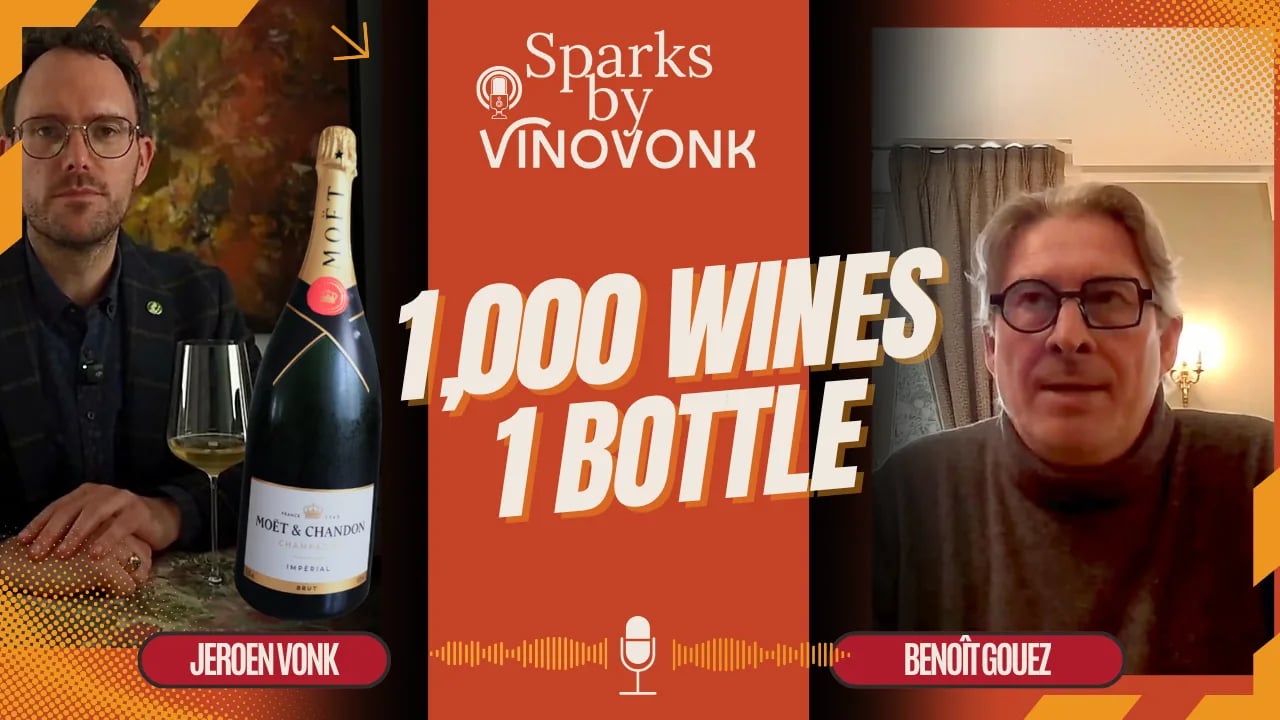
800 to 1,000 base wines. That’s what Benoît Gouez tastes every autumn before a single decision gets made about what becomes Brut Impérial. For about three weeks he tastes every morning and every afternoon, thirty to thirty-five wines per session, and each wine goes through three tastings before it is routed to a vintage blend, the reserves or a non-vintage blend.
For the new Sparks episode I spoke to Benoît Gouez and we tasted Brut Impérial together, remotely, each from our own magnum. He has been making those calls at Moët & Chandon for the past 20 years, and he calls Brut Impérial probably the best-known champagne in the world. We talked about scale, climate change and how you build the same style every year out of hundreds of base wines.
Who is Benoît Gouez
Benoît Gouez has been Chef de Cave at Moët & Chandon since 2005. 2025 was his 28th harvest with the house. He isn’t from Champagne. His roots are in Brittany and he grew up in Normandy, far from any vineyard. After his studies he worked harvests in California, Australia and New Zealand before joining Moët in 1998.
An engineer by training who blends by feel. He likes to say he doesn’t carry the weight of tradition on his shoulders. He sees his role as guarding the style and values of the house while guiding that style as the climate, technology and people’s taste change.
“Bigger is better”: why Champagne developed through houses
Champagne has 319 classified villages. At the last harvest Moët had access to grapes from 282 of them, plus an estate of 1,500 hectares of Grand Cru and Premier Cru vineyards.
“If Champagne has developed through houses rather than small growers,” Benoît told me, “it’s because the climate is uneven. The quality varies year to year. By having access to a certain diversity of supply, blending lets you reach the consistency Champagne is known for.”
I put a soup comparison to him. Cooking for four is one thing, cooking for 4,000 is a different problem. Benoît answered that in Champagne bigger is better, and that there are good reasons why the region grew through its houses.
Industrial or artisanal
In Benoît’s view, what makes a producer industrial is repeating the same recipe every year, whatever the volume.
“I know a lot of small growers who are industrial in the sense that they always do the same things. We don’t have recipes. I don’t want to have recipes. I want to adapt to the quality we get every single vintage.”
Out of those 800 to 1,000 base wines, the team builds 40 to 60 pre-blends. From those, the final blends are assembled, each pulling from 10 to 15 pre-blends. Brut Impérial typically integrates three different harvests. Collection Impériale, the project Benoît describes as “oenology of mutation” and compares to haute couture, adds a fourth layer with reserve wines aged in different ways.
A reservation
“Bigger is better” is the case the Chef de Cave of the largest house would make. The climate argument supports scale; whether scale also makes better wine is another question. Small growers deal with vintage variation too, and that didn’t come up in our conversation. Benoît also gives no figures for the lower dosage and the finer bead he talks about later on.
2003 was the turning point for Champagne
Asked about a memorable year, Benoît named 2003: for him the first year in which global warming was clearly visible. Harvest started in August, with very ripe grapes and very low acidity.
“Most people in Champagne decided to give up and not go for a vintage that year. We decided to go for it. It changed our mindset.”
Since then he has watched the maturity parameters of the grapes fall out of step. In 2025 Meunier needed at least 10 potential alcohol, Pinot Noir at least 10.5 and Chardonnay 11 to reach the right fruitiness. The year before, Benoît says, 9.5 was ripe enough.
Sugar, acids, aromas and tannins no longer ripen on the same schedule. Phenolic structure, tannins and aromatic precursors are things the lab can’t properly measure yet. Berry tasting is still needed.
Rebuilding Champagne’s genetic library
Five years ago, the team asked their growers to comb through every plot planted before the 1970s, before Champagne was uprooted and replanted with clones. Anything that looked different got flagged. Two years ago Moët inaugurated the conservatory where those vines now grow:
- 800 different individuals of Chardonnay
- 800 different individuals of Pinot Noir
- 800 different individuals of Meunier
- 300 others, including pink Chardonnay and smoky Meunier, plus old Champagne grape varieties
Benoît also wants to explore new varieties such as Voltis, a disease-resistant variety.
The same logic applies to yeast and bacteria. The selections in current use date from the 1970s, when soils, climate and farming practices were different. A new selection programme is underway.
Tasting Brut Impérial: three pillars
When I asked him what he looks for in a glass of Brut Impérial, the answer came in three parts.
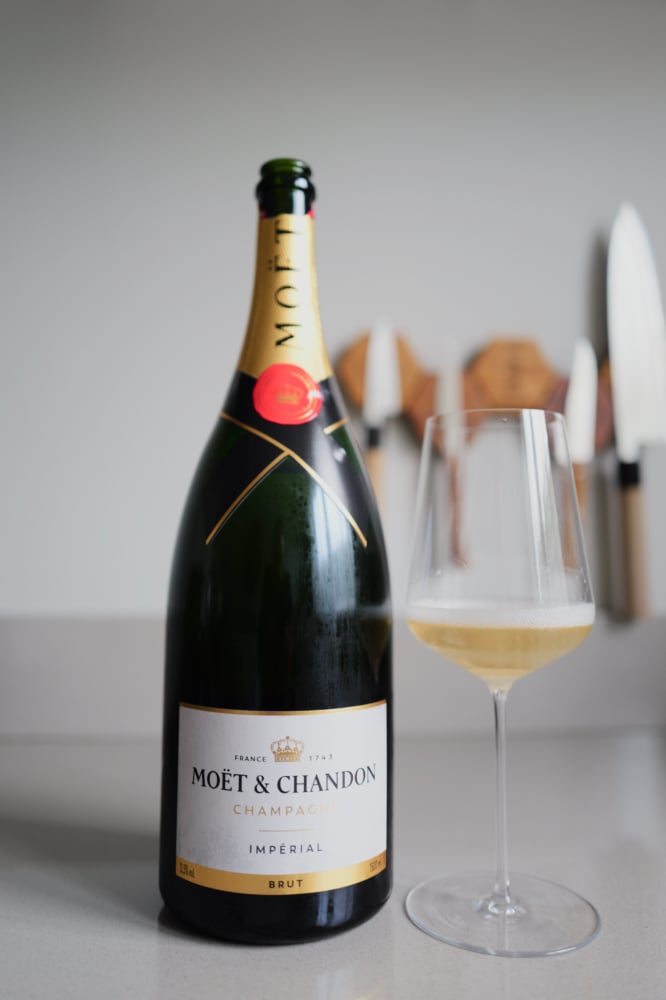
Joyful fruitiness. Moët’s house style is reductive and non-oxidative, with no oak, no oxidation and no aromatic yeasts. The goal is to taste the grapes as cleanly as possible. According to Benoît, in Brut Impérial that means white, yellow and green apple, fresh peach, hints of flowers and citrus, and a slightly vegetal, minty note for freshness.
Quiet maturity. No bottle of Brut Impérial leaves the cellar with less than 24 months on lees. Magnums get more than three years. Benoît says that maturity brings brioche, croissant, fresh bread and fresh nuts, which support the fruit without overpowering it.
Effortless pleasure. Brut Impérial is complex to make, Benoît says, but he has no wish to push that complexity onto the drinker. Benoît quotes Leonardo da Vinci: simplicity is the ultimate sophistication. In Brut Impérial he is after the taste of the grapes, with nothing to add and nothing to remove.
I find it accessible and very fruity, with a toasty brioche backbone that gives it structure. I’ve also noticed the mousse becoming more elegant over the years. Benoît puts that mainly down to the longer time on lees, with the finer bead as a consequence. The lower dosage adds to the sense of elegance; with more sugar the wine was a little stickier. He wants to keep the fruitiness and express it with more lightness and precision.
A 1872 Rosé in the cellars
The best story comes at the end.
While checking Moët’s vintage library, Benoît found bottles from 1872 listed as white in the records. Holding one up to the light, he saw colour. It could have been oxidised or maderised. Two bottles left, and no plan B. For the launch of the 2004 Rosé Vintage, he opened one with a small group of wine specialists.
It was a rosé, with a dosage of 100 grams per litre, classic for the period. Not perfect, Benoît says, but the wine was still telling something. The other bottle is still in the cellar and will never be opened.
FAQ
How many base wines does Moët blend each year? Between 800 and 1,000 individual base wines are tasted and evaluated each harvest. They are sorted into 40 to 60 pre-blends, which are then used to assemble the final blends.
How many villages does Moët source from? At the last harvest Moët had access to grapes from 282 of Champagne’s 319 classified villages, plus its own 1,500-hectare estate planted on Grand Cru and Premier Cru sites.
How long is Brut Impérial aged? A minimum of 24 months on lees before disgorgement. Magnums get more than three years.
When did climate change start affecting Moët’s blending decisions? Benoît Gouez identifies 2003 as the turning point: the first year in which global warming was clearly visible, with an August harvest and grapes that were very ripe and low in acidity. Most houses chose not to make a vintage that year; Moët did.
The bottle itself
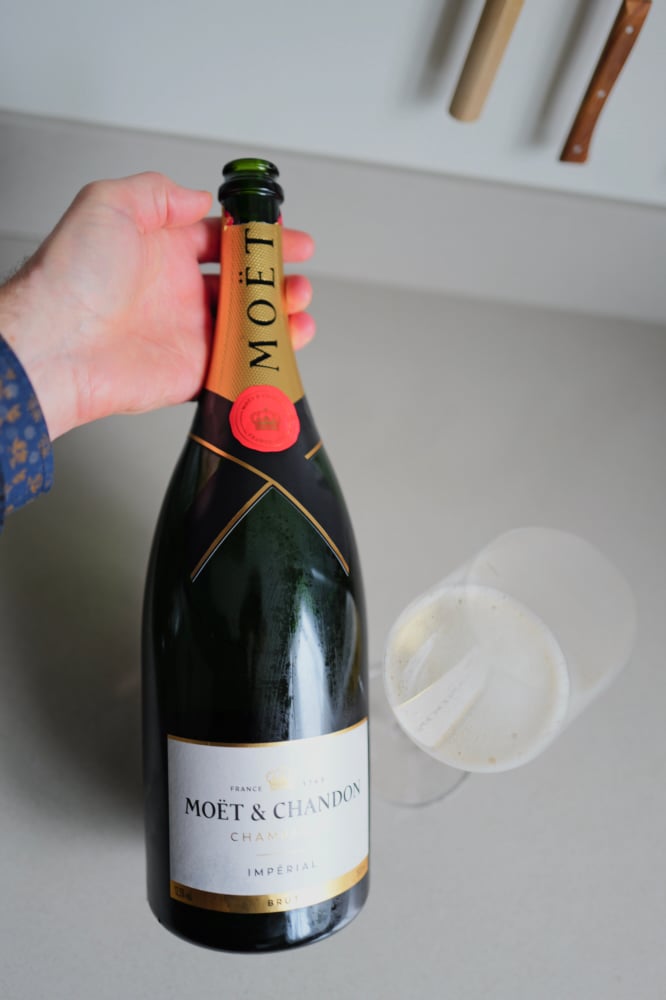
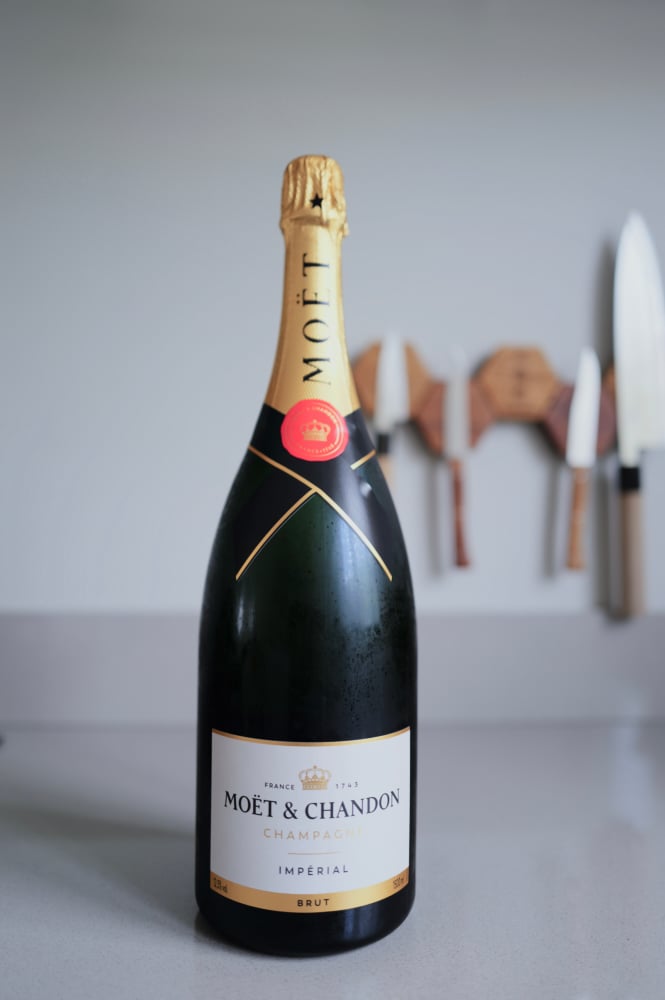
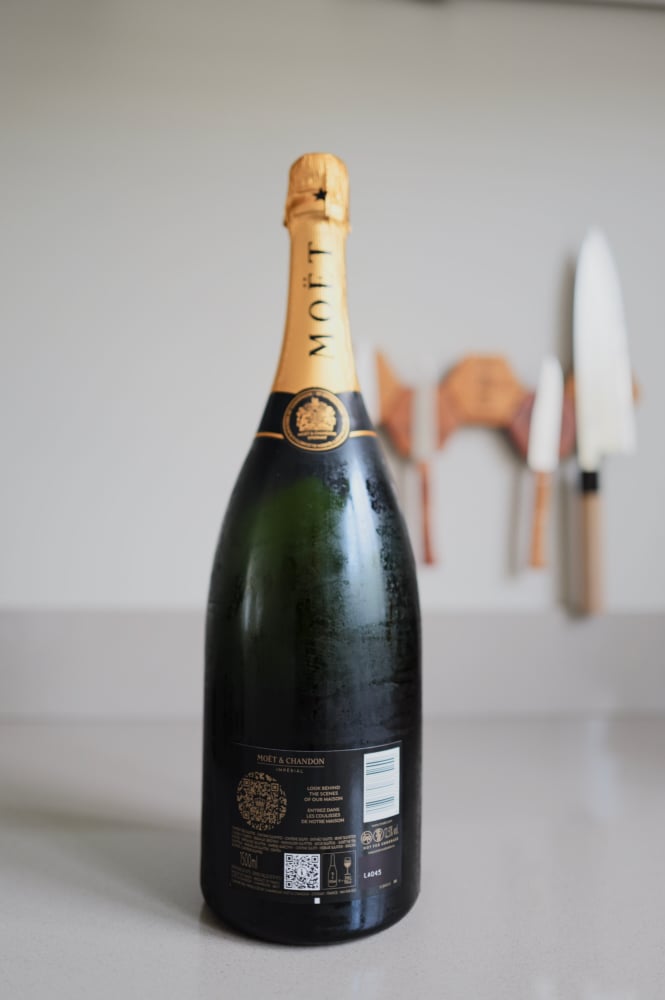
Moët & Chandon Brut Impérial NV. Usually three harvests, grapes from much of the Champagne region, at least 24 months on lees. In my glass it is fruity, with a toasty brioche layer underneath. Even if you have drunk this bottle for years, the current disgorgements are worth tasting again with attention. According to Benoît the bead is finer and the dosage lower. Around €45 to €55 for a 75 cl bottle in Dutch retail.
Moët & Chandon sent me the magnum of Brut Impérial, and the interview was arranged through the house. I wasn’t paid, and the opinions are my own.
More about Moët & Chandon
Visit moet.com for the full range and the history of the house.
Open the full transcript (English, ~6,600 words)
This transcript is generated automatically from the audio and has not been edited. Speech recognition makes mistakes, so treat wording as an approximation rather than a verbatim quote. It is here for accessibility and search.
[00:00:00] Hi, and welcome to a new episode of Sparks by VinoVonk. My name is Jeroen and I will guide you to the world of wine and storage behind the bottles. And today I have a very special guest. I’m very honored. His name is Benoît Gouez. He’s the Chef de Cave of the famous brand, Moët & Chandon. Benoît. Thank you very much for joining me and good afternoon.
Good afternoon. How are you doing? I’m doing great. You know it’s sunny in champagne today, so everything is fine. Yeah, that’s perfect. Before we open a open up this bottle, could you introduce yourself shortly? So I’m Benoît Gouez, as you said. I’m the Chef de Cave of Moët. It means that I’m ultimately the creator of the Moët Champagne, and I’ve been with, the house since 1998.
So this year has been my 28 harvest at Moët & Chandon. The cal, that’s the champagne way of calling Chef de Cave Chef de Cave since
[00:01:00] 2005. So I’ve been in that position for, the past 20 years. So the past 20 years, you are making these famous wines. Clearly, we have the chance to work with a large diversity of grape supply coming from our estate and our partners.
For me, quantity is not the main thing in champagne. If champagne has developed through houses rather than small growers, it’s because to reach consistency in style and quality, you need to reach a certain size. In fact, champagne is known for being a blend. A blend of different varieties from different villages and even from different vintages in case of Brut Impérial.
And if we blend. So largely it’s because by nature in champagne, the climate is uneven. The quality is quite versatile. So if we’re doing only single vineyards, single vintages, champagne, the quality would vary a lot by reaching a certain size. By having access to a certain diversity of supply, you get the opportunity
[00:02:00] through the blending to reach.
The consistency Champagne is known for. That’s the reason why Champagne has developed through big houses rather than small growers. And it’s still the case today. Yeah, perfect. Because everywhere around the world where you go to a wine shop, almost everywhere, there is a bottle of Moët, you know? And for a lot of people, this is the first experience with champagne because everybody knows it.
Shall we open up this bottle? Yes, of course. This is a very large bottle.
Oh, your bottle is already open.
It looks beautiful Brut Impérial.
It’s always very rich for me.
[00:03:00] Later on we’re gonna share some tasting notes, but how did you become a Chef de Cave? By chance and good timing. You know, there is no school of, Chef de Cave. usually houses like to train, generations and, work on transmission. And, I arrived at Moët & Chandon in 1998. at that time the chef was, Dominique Foulon.
And I’ve worked, alongside Dominique, but also, but also Philip for some years. And in 2005. When, Philippe Coulon was, who was the head of wine making of Maison Moët. I’ve been the right guy at the Raid place. At the raid place at the right moment. You know, it’s, always a question of, circumstances, especially as, I’m not from Champagne originally.
My roots are in Brittany, and I’ve been raised in Normandy, far away from Vineyard. So I don’t have a family story behind,
[00:04:00] but on another hand, I’m used to say that I don’t have the weight of tradition on my shoulders. And, after my studies I traveled the world working in California, in Australia and New Zealand to open my mind, to work on different towers and, maybe to learn about different.
Philosophies when it comes to wine making. And back in 1998, I met Philippe Coulon who had a good feeling he wasn’t looking for a new winemaker. I wasn’t looking for a new job. But, again, we had that feeling. And, three months later, in April, 1998, I joined the team. And let’s say the chance I have had is that immediately my personal taste fitted the style.
I had not to. Adapt or change or learn to really feel good with the testing committee? Quite immediately, I was, I was making the same. Evaluations and ratings and testings as the, as the core team.
[00:05:00] So it has been a very helpful for me to really integrate the testing panel and, when the day has come to be in the position of taking the job of seller master that is both about, being a guardian, a guardian of, the tradition, the heritage.
The style, the values, what we call the DNA, and the philosophy in wine making, but also a guide, you know, because, MO has been falling in 1743. And even if the values of MO remain the same the climate. The technology, the knowhow, the way of life, the consumers are changing. So we have also to continue to adapt and to evolve and to change in order to remain, attractive.
And relevant. And, if we speak of, amp, that is our flagship and probably the most known, and therefore most loved champagne in the
[00:06:00] world, it has been created back in 1869. And I don’t know what the taste of Brut Impérial was back then, but I’m sure it was not what it is today in term of taste. In term of intention, in term of, paying tribute to the diversity of champagne in term of, developing, joyful fruitiness quite maturity and effortless pleasure.
That has always been the goal of brittan, but, integrating the evolutions in the vineyards, in the wineries. In, people’s taste. We have continued to evolve and will continue to evolve. So it’s always a balance between traditional and modernity, between, I would say, science and sensitivity. Muon always work on two legs.
It’s two names, muon two family. Everything is about balance of two things, atmo since the beginning. Yeah, and what you also said was making champagne is like. The art of ham because it’s
[00:07:00] made out of different grapes. In champagne, there are seven grapes allowed, well, maybe eight if you count the new one inside.
Also the FTEs. And you have a lot of different villages where mm-hmm. A lot of different terroir. Could you tell me something about your approach to blending and how do you make these choices? Blending is really the core. Of the creative process in champagne, ob obviously it starts in the vineyards.
We have to pay attention to the season, to the harvest, to the balance of the grapes. Wine making is key. You know, we have a wine making style. We’re known for being natural, reductive, non oxidative because we like to get joyful fruitiness. And for me, blending is really the moment where you put everything in place.
And, blending in champagne is quite. Complex because we work with different parameters. As you said, we work with different red varieties at always pinot noir Meunier, Chardonnay in every blend with
[00:08:00] crafts also coming from different villages. We have 319 villages. Classified in the Champagne Appellation Moët has access to last harvest to 282 of them.
So, this is by far the greatest diversity a house can have in Champagne. It combines our estate that is 1,500 Heta large. That is by far the largest in champagne and, the highest in quality as it is made of. And OneForce premier crew and combine with our local partners in the. Again, we have access to, let’s say, 90% of the champagne terroir.
And that’s also richness because it means that I can cherry pick the nuances from the different terroir called de Val c ob, and really play with all the details. And on top of that, when it comes to er, and let’s say the non vintage range of champagne that represent 90% of the production will also play with different vintages, with different
[00:09:00] harvest.
We have quite a complex combination of things, and, in the case of Collection Impériale, that is, what I like to call the oenology of mutation that has been recently introduced to the market. We have added a fourth layer of complexity in the blending matrix, playing also with different ways of aging, the reserve wines, and that is the core of the harmony of mo.
My goal is always to reach balance, harmony, spontaneity, immediate pleasure. Everything, in everything we do and try to combine the different parameters in harmony, money in order to deliver spontaneously, what I like to call an effortless pleasure. And, but when you do this on a large scale, making champagne is very complex.
But if you do it on a large scale, it’s completely different. It’s I always imagine when you. Are in the kitchen and you’re trying to make a soup for like four person and somebody asks you, okay, next day 400 or 4,000 people will have
[00:10:00] wants your soup. How do you want going to do that? The same question.
Do you have to ask yourself when you make champagne on a large scale? Again, I believe that in champagne, bigger is better. Being big is beautiful in champagne. Again, if champagne has developed over the centuries through houses rather than small growers, there are good reasons for that. Again, it’s because our climate is quite uneven, so the quality we get year after year is quite uneven and.
By having access to so much diversity of grape supply is the richness of Al because again, I can really cherry pick the elements. I need to craft, a very, a very complete blend. And for me, the def, the difference between. Being industrial and artisanal is not so much the size, it’s the mindset.
It’s how you approach the creation. I know a lot of small growers who are industrial in the sense that they repeat the same recipe year after year. They always do the same things at, we don’t have recipes and I don’t want to have recipes. I want to adapt to the quality we get
[00:11:00] in every single vintage in order to.
Enrich the diversity I have at my disposal at blending. And really I want to play with that diversity that’s the her of the harmony of Moët and to reach that need that quantity in term of, in term of diversity. Diversity is more important than me for, than, than, and more organized to reach the, to craft the final blends.
Usually at the end of the harvest, we finish with 800. To 1000 individual base wines clearly it’s impossible to blend. 400, 500 different base wines together, so we go step by step. last week we have started to taste, the what we call the base wines or the clear wines coming from the average 2025.
it’s going to take us about three weeks to taste all of them. we taste every morning, every afternoon, usually three, 30, 35, base ones per session.
[00:12:00] We evaluate. The quality and the potential of every base wine because I insist on that. It’s not just about. Immediate quality, it’s about the potential because we need to keep some wines in reserves.
We know that if we go for a vintage, the bottle will stay in the, in the cell is for a minimum of six up to seven years. So we need to anticipate how the wine is going to develop. And if a wine is too open too early, certainly it’s means it hasn’t such a big aging potential and so it should be used.
In, blends that will rotate, quite fast, quite fast in the in the cell. Once we have evaluated the quality and the potential of. Every single wine. And basically we do three tastings before we decide how to use, a wine as a reserve, as a non vintage blend. As a vintage blend, we’re going to create what we call pre blends.
We’re going to regroup chardonnays of the same potential
[00:13:00] pin of the same potential. So from 801,000. Steel wines, base wines, we’re going to create 40, 50, 60 pre blends. And it is from that pre blends that will go for the final blend that will integrate maybe 10 to 15 pre blends. So we progressively reduce the possibilities in order to make the final blend at a human scale, let’s say.
Yeah. And, and how do you, what kind. Criteria do you have for being declared as a vintage? Like champagne made only of grapes from one year? For me, first of all, vintage is the exceptional in champagne altogether. The vintages in champagne represent, no more than 10% of the champagne production, and they’re not made every year.
So our priority is always amp first and vintage is so the philosophy beyond.
[00:14:00] Brut Impérial, perial and vintage is slightly different. Brut Impérial is our timeless classic. It has to be consistent in style, in taste, in emotion, but whereas the vintage, the vintages are always bespoke creation. It’s like Zu in Couture.
Every single vintage is unique, is individual. And let’s say there’s three criteria, I’m looking for to select a wine for a vintage blend. First maturity. You need to get kind of maturity and our different profiles of maturity in champagne that you need to reach a certain level of maturity in term of fruitiness, sugar content, structure balance with the acidity.
So first the fruitiness. So gold clean grapes. One issue having champagne is that, when we have a ri rainy climate, like in 2023 for instance, we can have some rot developing in the vineyards. That is never noble rots. It’s more gray rots. And when we have that, we lose in purity,
[00:15:00] frankness, and energy potential.
So perfectly clean grapes are needed. And on top of that, even if the grapes are ripe and clean, I’m looking for what I like to call a charisma. You know, the wines. Have to tell a special story if they are just ripe and clean, that’s not enough. They, they need to have a personality.
They need to have a unique character. They need to speak to, the emotion. I’m used to say that blending BRI is rational teamwork. Blending for a vintage is more personal and emotional. Sometimes people ask me, but why do you pick this one or this one? Sometimes I’m even not able to explain, you know, it’s my feeling, it’s my experience, it’s my intuition that wine.
Something special. And to illustrate that, when I came to champagne, I was coming from the south of France. I spent about three harvest there working for cooperatives and, were used to make wines for, to be drunk within a year. So I was always
[00:16:00] picking the wines that were the most expressive.
So when I started, tasting in champagne, I did the same. I started to say, oh, that wine is more expressive. It’s more intense. It’s richer, it’s more tasty today. So I’m going to. Prefer that one. And Dominique Foulon was the chef. The car did the opposite. And, I realized that, and I come, I come again on that idea of potential.
If a wine is showing too well too early, it means that suddenly it’s aging potential as a study to be, studied, to be used. So the challenge in tasting base ones for champagne is to, mm-hmm. Be able to identify the potential to taste wine that have some expression, but even more to give, to give over time.
So it’s what I like to call the charisma, that potential for the future. Yeah. But how do you make the choice, okay, this will be something for. This is something for the vintage and this one we need to have like in a reserve wine. How do you make that
[00:17:00] choice? Is that also about the feeling? No, there is, there is more rationality behind.
We, we know in the case of Brut Impérial Pine for instance, we know that, I want to use wine wines going from all over the champagne region because for me it’s what is going to create the harmony and the. The balance and the consistency. I will always respect a balance of a large set of pinot noir about the set of Meunier and a smaller set of chardon because it is the way the three main grape es are represented in the champagne vineyards.
And AMP is the first ambassador of the champagne as a whole, and I really want it to be representative of the. Wool and I’m looking for a certain profile of wines that will have that joyful fruitiness and that effortless pleasure that will, that will give spontaneity when you, when you taste it.
Reserves and vintage are about the same level of quality. It’s clearly wines with more
[00:18:00] identity, more character, and more, and even more, aging. Aging potential. The profile of the reserve wines are about the same as the vintage, but in the case of the reserve wines, I need to keep different profiles of reserves because I never know what’s going to be the profile of the next vintage, of the next harvest.
So reserves are here to bring. To the beier, what the beier miss. For instance, if you have a beier that is very rich, the reserve should bring back some freshness. On the other hand, if the beier is fresh, the reserves might bring maturity depths, intensity. So I need to keep a little bit. Reserves have to be seen as spices.
You know, a box of spices where you are going to take the elements you miss in the base in order to create the completeness. And I need to keep different profile. Whereas when I go for a vintage, I really. Want to craft something that is really unique and with a strong singular
[00:19:00] profile, with a more personal commitment to the, to the, to the vintage is more demanding.
It’s not about being consensual, it’s not about being consistent. It’s more about telling the story of the year and going for more personality, more character and more emotional. Yeah, so the bl from this wine is not every, is not the same every year. No. It’s not like, okay we always do 50% reserve wines and then 50% of no.
Again, because, I don’t want to fall into, following a recipe. I don’t believe, I don’t believe intuit, and it’s not what nature give us. Each year is a different story. 2025 was my 28 harvest. Almost every year. I’m, I’m saying to myself, okay, you have seen everything in champagne and at the end of the harvest, I’m always saying, no, this one was even different from all the other ones.
And that’s the beauty of champagne. You know,
[00:20:00] there are so many variations. Every year. I wouldn’t say we have to start from scratch, but we have to appreciate the profile of the year. Sometimes the ko de blanc, will suffer frost and will have more, less chardonnay. Sometimes we will have less pinot noir.
sometimes the ones will be very rich, sometimes they will be very fresh, and that we don’t control. We, we don’t control. Ni we try to guide her a little bit, but we don’t. We don’t control nature, so we have to adapt with what nature give us. And, it’s not like going to a, to a market and buying what you need.
In fact. At harvest, we pick the grapes, we get the grapes from our estate, from our partners. We sought the grapes in order to make the best possible wines, individually. And after that, we’re going to recreate our blend based on what natural has given us with the chance we’re having champagne to play with the reserves.
And it’s where the reserves are very important because if, a year miss something, the reserves will be used
[00:21:00] to bring back the elements missing and to recreate the harmonium we’re looking for. It’s like, the pepper and salt and the, and the herbs and the spices. The reserves, yes. Yeah, yeah. For the reserves.
And in the beginning of our conversation, you told me that you want to, stay with them with signature, but the taste of the world is changing. Is that something you do in little steps year after year? So harvest after harvest, or do you have some feeling Okay. This year, I want to do it like a bigger step.
No, no. We, we have to evolve slowly, but we have to keep evolving. I really believe in slow evolutions rather than big revolutions. And so every year we continue to add, new technologies, new ways, new ways of working. Within the motivational DNA, there is what I like to call, the purposeful progress.
We are
[00:22:00] progressive. we like to, we like to go ahead and we like to integrate innovations, new technologies as long as it is for better quality or more sustainability. That’s the reason why I say it’s a purposeful progress and, climate is changing. Technologies are changing. Consumers are changing.
So if you don’t evolve, you die. Okay. Yeah. So it’s, for me, it’s super important to evolve, but at the same time, champagne and especially Bri, is known for its consistency. Being consistent doesn’t mean that the boy temporal we bring today is exactly the same as 10 years ago or 20 years ago, or 50 years ago.
The philosophy is the same. You know, the emotion we’re looking for is the same, but we have to, we have to evolve. And just to illustrate one thing. We like to say that mamo is about generosity. We, we like to please people at first sip and I think that generosity 20 years ago is not the same
[00:23:00] as it is today. You know, it’s, the things evolve. When I studied in the industry. I was very impressed with, rich, sweet OK Wines from California, from Argentina, from the south of France.
And today because I have, developed myself, I have matured. I’m more interested into wines that are lighter. And I think that globally in the world of fine wine, people are looking for thinness, elegance and lightness. Nowadays though, so that’s also a reason why of the evolution of the balance of Brut Impérial.
I want to keep the fruitiness, I want to keep the generosity. But to express it with more lightness and precision. You already told me something about innovation, the challenges, climate change. Do we have any current projects you’re excited about? Like, the climate change, the sugar levels are getting higher, the acidity is getting lower, maybe?
Yeah. Could you tell me something about that? In
[00:24:00] fact it’s interesting because, in a way you resume the maturity to sugar content and acidity. That is right, but not enough. In fact, we find nowadays, and, 2025 was a perfect example because it’s been a, it’s been a warm harvest, a harvest that has studied in August for the seventh time since 2003 when we never studied the adverse in August in the 20th century.
And we found that in such. Warm years influenced by global warming. We have a sort of a desynchronization of the different parameters of maturity. Sugar acids, aromas, tannins don’t come together with the same timing. And this year we found that to get the proper fruitiness we needed to reach very high levels of, sugar content when last year.
At 9.5 the grapes were ripe this year. For the Meunier, we needed to reach at least 10. For the Pinot Noir, it was at least 10.5 to get the aromatic maturity. And for the Chardonnay, we had to
[00:25:00] wait till, 11 alcohol potential to get the right fruitiness. And this is something we don’t perfectly measure yet.
We measure facility pH, but. Phenolic structure. Tannins aromatic precursors are things that we can appreciate through the berry tasting, but that we can’t really, analyze in lab yet. So it’s something we’re working on. That’s one preoccupation and so is a vegetable material. We believe that we have to explore, either new varieties like Voltis, but also maybe to re-explore our traditional varieties in order to find some, genetic reserves.
Had an element of the adaptation. And, two years ago, we have inaugurated conservatory of grape Voltis that we call it started five years ago. We have asked our growers to go in their, all the plots, that had, that had been implanted before the 1970s
[00:26:00] before champagne has been uprooted and replanted with clones in order to identify.
Individuals, individuals of Chardonnay, Pinot noir Meunier and others that look different, whatever the difference. And and in fact we have, selected and replanted 800 different Chardonnay because there is not one Chardonnay. Yeah. There are different expressions of chardonnay. So we have selected and replanted 800 different varieties of Chardonnay.
Not Voltis, but individuals of Chardonnay, 800 different individuals of pinot noir, 800 different individuals of Meunier and 300 others. When I say others, it’s the ban pat that are already part in the Appian, but have found some, ga that used to be in champagne a long time ago. Pink Chardonnay. We have found some, smokey Meunier, so other.
Individuals that might have a future in champagne if they demonstrate that they have, better potential of adaptation
[00:27:00] to, he stress, to, heat to disease or on, or whatever. And that’s for the vineyard pots. And we have exactly the same for, yeast and bacterias. one specific of is that.
We, use our own selections of yeast and bacterias. We have made our own selections coming from our vineyards and, the first selection have been, have been done in the 1970s, and they have been redone in the eighties and the nineties. And so, and today we’re redoing a project of, yeast selection because we believe that.
The yeast we use today that have been for some selected in the 1970s have been selected at a moment where the climate wasn’t the same, where the richness of the soul wasn’t the same. And probably with all the changes that have been introduced through the climate or the technologies or the ways of working, nature has adapted also.
In the micro, biological individuals. So we have studied, again to select
[00:28:00] yeast and bacterias to taste them and to see if some are performing better than the classic ones from the past. When I say performing better, it means, being more adapted to the fact that, with sustainable viticulture sustain, we use, less nitrogen, more herbs.
So the balance in, nutrients in our variety in our juices is not the same as in the past. So, well it’s two roads. We follow, vine vi vine individuals in the vineyards and bio micro biological individuals, in the winery. Yeah. And are you also experimenting with more organic ti culture or biodynamic viticulture culture?
Experimenting. Just experimenting. We are definitely focused on sustainable viticulture. The estate of ma has been certified champagne, sustainable viticulture and iron, very mortal. Quality, since 2014,
[00:29:00] 2015, about 10 years, 10 years ago. And, we believe it’s the main road for champagne.
But, obviously we, con we continue to always experiment and to try, other ways of doing things. When you speak about organic, vegetti agriculture it’s been very easy in 2025 to grow organic because we had very little water in the spring. So very little pressure with, mildew and O in 20, 25.
In 2024, it has been the exact opposite. there was so much pressure that organic was not enough to, in most situations, to contain the pressure. So again. I’m looking for diversity even in our vineyard. In, in, even in our practices in the vineyards. I don’t think there is a perfect solution for all situations.
We, we have to, we need to have a base that is, again, a sustainable vertical in champagne. And then when possible
[00:30:00] to try to go a little bit further, to try to do other things. For that, we have, we have introduced another program called Natural Moët. Natural Moët, is about developing biodiversity in champagne, through planting, trees and, the a, I don’t know to translate that, but, you know, to bring back the biodiversity in the, in the vineyards to connect the different ecosystem together, the different forests, the different rivers.
And so in the, in order to reintroduce more life. In the vineyards we have stopped using herbicides totally three years ago. Now, in our, in our vineyards, our vineyards are, fully planted with grass, and we have to relearn how to work the soils and find the right balance. And so again, we are not, we’re, we’re not, on recipes, but we’re in a permanent evolution to experiment, to learn, to try and to find the solutions that are the more adapted
[00:31:00] in one single context.
During that experimentation and innovation funnels, did you experience something that you think, wow, this should be a new qve? Is there a new QE coming? Yes, there are new Qve coming because, when I say coming, it’s experimentations at the moment. But for instance, I’m quite convinced that with the level of ripeness we’re reaching the grapes today, we should reconsider.
What’s called Koto C Panis, the steel wines from champagne that used to be exceptions, and they will continue to be exceptions. Champagne is about bubbles first, but, probably we have the opportunity to experiment a little bit more with, steel wines, where we need to reach, higher levels of, mat.
But also, I continue to work on the co project that is about. Pishing the boundaries of blending by, continuing to blend, the es,
[00:32:00] the villages, the vintages on top of that, working on different ways of aging. The reserve wines in oak, on leaves in Staint in order to really, bring. A first dimension in the blending metrics of mutation, what I call the oenology of mutation, like haute couture.
That is about using, the best, the best ingredients, the best processes, creativity and long time collect Extra Imperial is a, is a project I’ve been working for 20 years now. So the first creation. Has been launched two years ago and in the years to come there will be new creations from that oenology concept that will be released to the markets.
Yeah, I’m really looking forward to that. Shall we taste this wine together? Yes, sir. So there’s a lot of reserved wines in it, a lot of other harvest years, different kind of grapes. The Pinot Noir, Minnet, Chardonnay.
[00:33:00] What do you find so special yourself on this wine with Brut Impérial? I’m looking for three main dimensions.
The first one before that, in term of making er is always a tribute. To the diversity of champagne, what I call the collective craft tribute to the Via the Great varieties. Always pin chardon tribute to the 282 villages. we have in our grape supply tribute to the different harvests. Usually we blend three different harvests in the Brut Impérial, but also tribute to the collective of people, a collective of growers, of makers, of partners, but also of consumers.
So, crafting for me is a col is, creating is a collective heart at, in, and in.
I’m always looking for emotional precision. Aerial is not made to speak to the brain. It’s made to stimulate the senses, to steer emotions, but I believe
[00:34:00] that for that we need to be precise in everything we do. I always believe that a great wine is always a balance of science and sensitivity science.
I’m engineer myself, you know. Square, but I’m also a creator. I’m sensitive. So the square and the round, are the two elements, that, that I play with, to craft all our champagnes. I believe that if you rely only on sensitivity with no technical base, you might make a good, a great wine from time to time, but there is very little chance you can be consistent.
On the other hand, if you only rely on technic, you will lack emotion. You will lack the salt. So you need also to bring your sensitivity. And for me it’s a subtle balance blend between science and sensitivity. And finally, the third pillar of our wine King philosophy already told you is the purposeful progress in term of style against three elements.
[00:35:00] Joyful fruitiness. We are fruit driven. We want our wines to taste like the grapes that have been made of as frankly. As purely as possible. Therefore, we have developed for decades now, a natural or redemptive wine making where we really want to preserve the integrity of the grapes and to make wines that really taste like the fresh grapes that are made of avoiding any kind of external contribution.
No oak, no oxidation, no aromatic yeast, whatever could. Change the pure taste of grapes. So we are, we are, we’re fruit driven. And in the case of ruper, the universe of the fruit is white, yellow, green, apple, pure fresh peach with, ins of flowers and citrus, fruits and, a slightly vegetable minty element for the for the freshness.
But champagne is not just about fruitiness, it’s about fruitiness.
[00:36:00] Maturity, it’s about grapes and yeasts because if we, mature champagne fires in the cellars, it’s really to develop the autolytic character to develop Theas character. With Brut Impérial, I’m, I’m looking for what I like to call a quiet maturity.
A maturity that is a bit understated, that will still below the fruitiness will come to enrich the fruitiness and to develop, blonde flavors of, brioche, croson, fresh bread, fresh nuts that will come and reach compliments the fruitiness. But without overpowering the fruitiness must be the key element.
And finally, for the palate, I already told you that idea of, effortless pleasure. We want to. Give pleasure to consumers. That’s the motivational mission. We want people to be happy when drinking where, when drinking our wines and that with spontaneity and, on, immediate feeling Brut Impérial, in fact.
It’s quite complex to craft,
[00:37:00] but I don’t want to sell that complexity for me. It’s my kitchen. It’s, the way we work with the, with the team for the consumers. I want tamp perel to, to appear with a certain simplicity. I really believe that simplicity, Leonard DOI used to say that.
Simplicity is the ultimate sophistication, and I really believe into that. With Brut Impérial, I’m looking for sort of a sense of the grapes of the fruits with nothing to add and nothing to remove. I like it because it’s very accessible. It’s not too complex to understand. It’s very fruity, but indeed there’s a toasty brioche backbone give it lot, lots of structure and.
Making it in a very nice balance over the years. I developed my own taste, of course, but I also noticed that the mose of the effervescence of the, of the, what I should know is becoming a little bit
[00:38:00] more elegant. Is that something you also want to achieve more elegant effervescence. In fact, the quality of the effervescence is.
Mostly given with time on lease, the longer you keep your champagne in the sellers on lease before this go, the find the be the more elegant the effervescence. So yes, we have extended the maturation. Today. There is no bottle of Brut Impérial leaving the cell with less than 24 months. We have Magnums, magnums.
It’s more than three years of maturation on lease, but, and that contributes to a finer bead to a more, again, effervescence, but it has mostly been done to develop more complexity and more natural richness to the wine. And the quality of the bead is more consequence. But it’s a global equation where, we’re looking for.
More maturity on the nose, more natural richness on the nose, but more lightness at the same time. That is certainly
[00:39:00] also I would say that the fact that the dosage has been lowered, certainly contributes to that sensation of elegance. Also, now, when the dosage was higher, maybe the wine was maybe a little bit more sticky, and therefore the elegance of the foam wasn’t as obvious as it is today.
Yeah. And do you, do you have, memorable bottle of yourself that you think, okay, when I think of a, of a beautiful moment drinking this bottle, could you tell me something about that? I have many. I have many great moments. Obviously there are some vintages that. Talk to me more than others. 2006, because it has been my first vintage blend as chef.
The car 2003 is a turning point for me also because it’s the, it’s the first obvious year, influenced by global warming. the first year we have, obviously in August, with grapes that were. Very ripe, very low acidity. Most people in Champagne, decided to give up and not to go for a
[00:40:00] vintage.
We’ve decided to go for it. And, we have, it has really changed our mindset of, how we approach, the adverse. In the past, I have great memories of, vintages like 1959 or 1921 that are absolutely. Amazing, amazing wines, coming from our library of vintage vintages.
But, maybe one of the most emotional, memory, I have had was, that was some years ago. I was checking, our library of vintages in the cellars and, I found bottles of, 18 72 that was supposed to be white on my, on my book. I had no. Notification, it could be something else. But, using the light to check the level in the, in the bottle, I found that the wine was colored, but it could have been oxidized or it could have been maderized champagne, it could have been whatever.
And
[00:41:00] at the occasion of the launch of the 2004 Rose Vintage, I decided to make a. A great vertical of rose vintages at, and we finished with some, wine specialist to open one, of the two remaining bottles of that 1872. And it happened to be a true rose champagne with a high dosage one, 100 grams per liter.
That was classic at that time. And in fact it was, you know, it could have been very bad. And I had no, b plan, you know, I had only two bottles left. I opened one that the other one is still our cell and will be never open. And when you open such a bottle from 1872, having no idea of what you could expect and that you finally get a wine that wasn’t perfect, but that was.
I would say emotional. the wine was still telling something and, all the people who had the chance to taste that wine have no reference to appreciate, but found that, there was, something still alive and still exciting and still emotional in that
[00:42:00] wine. W so, but anecdotes about champagne, I have, I have many and many Thank you very much for sharing this story.
And thank you very much for your time. We are at the end of the episode Es. Chef de Cave of Moët & Chandon, thank you very much. I will enjoyed this bottle. Thank you very much for joining me. This was a new episode of Sparks by VinoVonk. and see you next time. Ante San.
Listen
Watch