

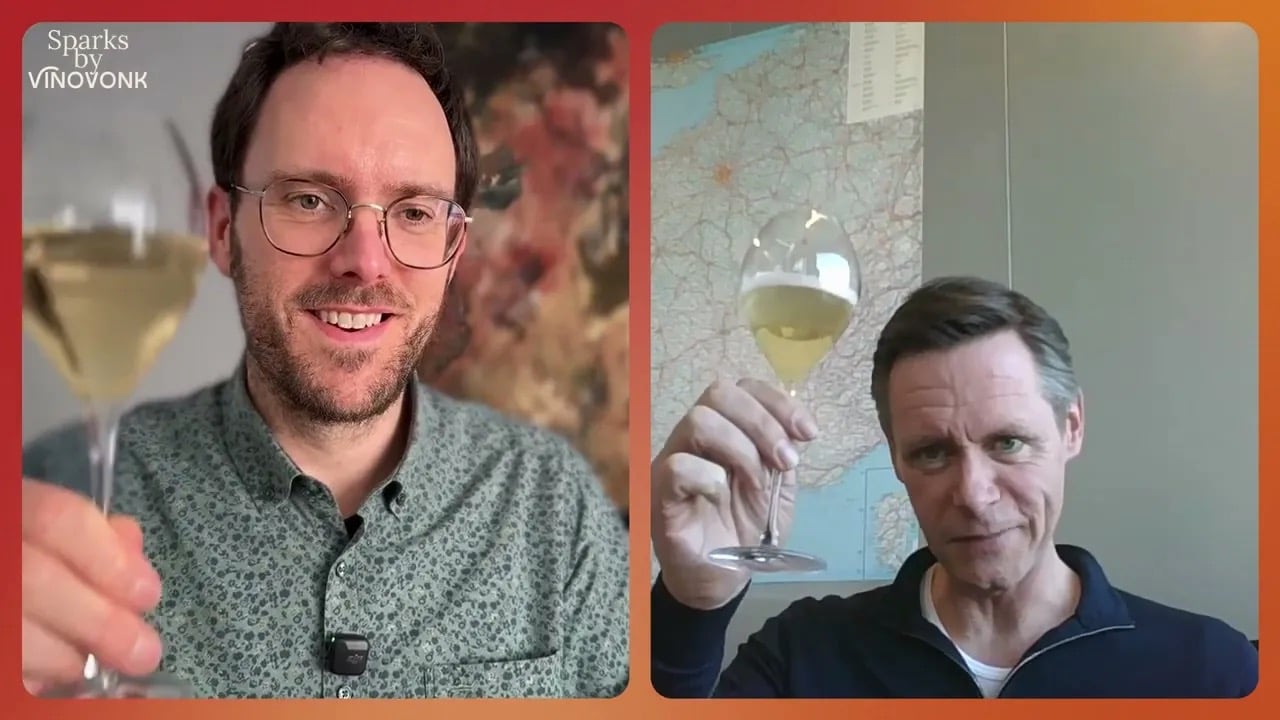
Welcome to the very first episode of Sparks by VinoVonk. Every other week I sit down with someone from the wine world: winemakers, importers, sommeliers and other wine lovers. They are relaxed conversations of about a quarter of an hour about the person behind the wine, their passion, their outlook and, of course, their wines.
For the opening episode one importer was the obvious choice, because the moment is already in the name: Mijn Champagne Moment (My Champagne Moment). Joshua joined me with a Jean Laurent Blanc de Blancs from the Côte des Bar.
Joshua of Mijn Champagne Moment gave me the bottle for this recording; I received no payment and the opinions are my own.
This episode was recorded in Dutch. Watch on YouTube with auto-translated subtitles via the link above.
Who is Joshua
Joshua calls Mijn Champagne Moment a hobby that got out of hand. In 2010 he fell for champagne from small growers, the people who care passionately about what goes into the bottle. The big houses interested him less.
The name sums up his aim: celebrate small moments more often, with a glass of champagne. His example in this episode was launching a new series online, which is why this bottle was on the table.
What “small grower” means
For Joshua, small does not mean someone making 100 bottles:
- Smallest grower in his range: 2 hectares, roughly 20,000 bottles a year
- Largest grower in his range: 20 hectares, roughly 200,000 bottles in a good year
That largest grower is Jean Laurent, who made the bottle in this episode. According to Joshua, he harvested only 10 per cent of a normal crop last year and so has only around 20,000 bottles this year.
Many of these growers also grow vegetables, mostly for themselves. Some make a little red wine, which also goes into rosé and usually stays private. The third pressing cannot legally become champagne, so many growers turn it into Ratafia and nothing goes to waste.
How Joshua finds producers
It can be as simple as ringing the doorbell. His first experience came when he was getting married. His wife wanted to choose their wedding champagne in Champagne itself, so they started with a string of big houses and their imposing cellars. On the drive home he spotted a tiny house with a champagne sign and rang the bell.
The woman who answered was cooking. Joshua said he had hoped to taste but could see she was busy. She invited him in anyway: the people working in the vineyard would be in for lunch shortly, they did everything together, and he was welcome to join. The first glass won him over; by the fifth he knew he wanted to do something with it.
He now has more than 100 different champagnes in his cellar, and for Jean Laurent he is the exclusive importer, which is printed on the back label.
“My goal is really to find my favourite champagne grower in every village.” (Joshua)
Tasting the Jean Laurent Blanc de Blancs
Jean Laurent is a family estate in the Côte des Bar, the southern end of Champagne, just north of Burgundy. According to Joshua, the family were originally winemakers in Burgundy and have been making champagne for a little over a century. Part of their production and harvest features in Joshua’s YouTube series.
What is in the bottle
- Grapes: 100 per cent Chardonnay (Blanc de Blancs)
- Cuvée: wine from five harvests, so the style stays consistent from year to year
- Ageing: a further five years in the cellar
- Oldest wine in the bottle: around ten years
- Dutch importer: Mijn Champagne Moment (exclusive)
How it tasted
I got flowers and white blossom, fresh apple and something herbal that made me think of rosemary and thyme. Behind that, bread dough and, in the distance, vanilla biscuits. It struck me as very fresh.
Joshua pointed to the maturity: notes of butter, pastry and a little almond, while the first impression on the palate is fresh. He puts that down to the long ageing in bottle. Champagne only has to spend 15 months in the cellar, which gives you a young wine, and he loves champagne with some age on it.
Where I have reservations
- The five harvests are not on the label. I asked Joshua how a buyer is supposed to know. His answer: the importer should know. The back label does give the bottling date and the disgorgement date, but for the blend you have to ask.
- Supply is tight. After the poor harvest Joshua mentioned, Jean Laurent has about a tenth of his usual volume this year.
- One bottle, one sitting. I tasted a single bottle during the recording, and price did not come up.
How to open a bottle of champagne
Joshua’s method:
- Well chilled, not too cold, or you taste too little
- Bottle at 45 degrees, thumb on the cork
- Untwist the muselet (wire cage), six turns or five and a half, according to Joshua
- Hand on the cork, turn the bottle, so you can feel when the cork starts to rise
- At the end let the cork turn slightly, and it opens with a gentle sigh
- Pour into a tulip glass, not a flute, as a straight flute leaves the aromas too little room. Joshua tilts the glass as he pours to keep the mousse under control
My own addition: never point the cork at anyone’s eyes.
Frequently asked questions
What is Mijn Champagne Moment? A Dutch importer of champagne from small growers, now with more than 100 different champagnes in its range. Joshua wants to find his favourite grower in every village and prefers to be their exclusive importer.
What is a Blanc de Blancs? A champagne made only from white grapes. This Jean Laurent is 100 per cent Chardonnay, but as Joshua points out that is not a given: other white varieties are permitted too. Beyond Chardonnay, the appellation rules allow Pinot Blanc, Pinot Gris, Arbane and Petit Meslier.
What is the Côte des Bar? The southernmost part of Champagne, just north of Burgundy. Pinot Noir is the main grape here, though Chardonnay is grown as well. Most visitors head for Reims and Épernay, so the Côte des Bar is less well known.
What is Ratafia de Champagne? An aperitif made from grape must fortified with alcohol. Small growers make it from, among other things, the third pressing, which can no longer be used for champagne.
The bottle in this episode
Jean Laurent Blanc de Blancs. 100 per cent Chardonnay from the Côte des Bar. Wine from five harvests, then five years in the cellar. In my glass floral and fresh, with bread dough and vanilla in the background. Imported exclusively by Mijn Champagne Moment.
More about Mijn Champagne Moment
mijnchampagnemoment.nl lists the range and, according to Joshua, carries plenty of background on the families who make the champagne. He also runs a YouTube series filmed at the growers.
For the second conversation with Joshua, about champagne basics and the difference between Blanc de Noirs and Blanc de Blancs, see Sparks episode 25.
Transcript
The full conversation transcript.
Show full transcript
This transcript is generated automatically from the audio and has not been edited. Speech recognition makes mistakes, so treat wording as an approximation rather than a verbatim quote. It is here for accessibility and search.
Welcome to the first episode of Sparks by VinoVonk. I am Jeroen, wine writer and from now on I will take you into a conversation with inspiring people from the wine world every other week. In short personal stories, personal conversations of about fifteen minutes, we discover the story behind the wines. And so we always look for new insights, connections and discoveries. And in this series I will look at winemakers, importers, sommeliers and other wine lovers who shape the Dutch wine landscape.
But of course we also sometimes take a step outside the Netherlands, the Low Countries, other countries. Don’t expect stiff interviews, but relaxed conversations in which we get to know the person behind the wine, their passion, vision and of course their wines. a new Sparks every other week. So pour a glass and travel with me. And for this first episode I thought, this is really my champagne moment.
And now I am quite well known in the wine world and I know that there is an importer called My Champagne Moment. So who better to do this first episode with than My Champagne Moment? And that’s why I have Joshua here. Joshua, welcome. Bonjour Jeroen, thank you for a great intro!
And it’s really nice that you want to open this first episode with me and immediately celebrate because you gave me a very nice bottle of champagne. Look. And can you briefly tell us something about what exactly my champagne moment is, your company? Well my champagne moment is actually a hobby that got out of hand. So I really fell in love with champagne in 2010.
From small champagne farmers, so not the grand mark, but real farmers who are passionate about what is in the bottle. And my champagne moment is my champagne moment because I think we should celebrate more moments to celebrate things, more small moments and that we should drink champagne more often. For example, if you are going to put a very nice new series online. It’s amazing if you can drink a nice glass of champagne with it to toast such a beautiful series that is coming up. Super cool!
And you say small winegrowers, but am I supposed to think that they only make 100 bottles? How should I see that? No, not 100 bottles. My smallest farmer has 2 hectares. That amounts to approximately 20,000 bottles per year.
My largest farmer, which is actually the one you have on the table now, has 20 hectares. So around 200,000 champagne bottles per year. If the harvest is good, last year he only had 10% of his harvest. He only has 20,000 bottles for this year. But normally it is 200,000 bottles.
compared to mass production really very small. Interesting. But do they really only focus on champagne or do they also make a lot of other wines and do they grow other vegetables or… Well, they often also grow vegetables, but that is more because they are very concerned with nature and that more for themselves. Actually you see that they mainly only build champagne.
They do some red wine every now and then. It is also used to make rosé. But usually that is also a private collection, so not really for sale. They really focus on champagne production and sales. And of course Ratafia is still available to many farmers.
So you are not allowed to make champagne from the third pressing of the drive and they still make Ratafia from that. So that the entire cycle is actually closed and everything is reused. And let’s see, we have a very nice champagne from Jean Laurent here. That name means something to me, because I think I saw it in one of your video series on YouTube. Can that be true?
Yes, that is certainly correct. Yes, Jean, that’s a family I really enjoy working with. It is located in the south of the champagne region. So when people ask me, go to champagne, do you have any tips? they usually go to Reims Epernay This is really in the Côte des Bar, so not long ago champagne, just above Burgundy.
So from ancient times the family was a Burgundy maker or at least a winemaker. And they’ve been going for just over a century now. You have seen this because we filmed part of the production process there in the YouTube series. And we also filmed part of the Harvest next year there. you can certainly know that.
I have chosen Jean’s Blanc de Blanc for you. So in this case 100% Chardonnay. Most people think that is always the case, but that is not the case. You can make champagne from other white grapes. The Chardonnay also has other white grapes.
That, I think, makes him very interesting. In this case you have blandeblanc. Five harvest years of the Chardonnay grapes are in the bottle and then it goes into the cellar for another five years. So the oldest grapes are actually ten years old and have therefore been matured for ten years, which means you will get a very nice round glass of champagne. What a beautiful story, let’s open it.
That seems like an excellent plan to me. Do you have any tips for people when you say, when you open a bottle of champagne, do this, absolutely don’t do this. Make sure it is well chilled, but not too cold. That’s a bit of a shame if you taste it there, as it has nothing to do with opening. But actually just remove what you can easily remove.
I actually always hold the cork slightly at an angle of 45 degrees with a thumb on the cork. And then I loosen it. They say six times or five and a half. Then I loosen it up a bit. Then I hold my hand on the cork and turn the bottle.
Then I can feel it much easier whether it is going up. At the end I let the cork turn a little and then it is already open. Do I do that? you have already practiced it. I always do it a little more carefully.
I’m always afraid that someone will soon be missing an eye or something. You shouldn’t point it at your eyes, that doesn’t seem very useful to me. No. That sounds really good, just a little sigh. Little sigh, yes.
And a nice glass. A tulip, not a flute. Not a flute, no, what I just said, it has been here in the bottle for five years so it really wants to release its aromas and in my experience if you have a flute that really runs straight up then it actually doesn’t have enough space in the glass to release its aromas so I always pour it at a bit of an angle then it is also easier to check the effervescence then you can immediately see that it is fizzing madly in the glass and that’s how you feel And then it’s just a matter of tasting it and that As far as I’m concerned, you can actually do it the way you like it. I usually rinse my mouth briefly so that I can then properly experience the flavors and aromas. But especially right now it’s for you because I think what you do with the wines is really crazy.
And I really feel very honored that I can kick off with you. So Jeroen, this one’s on you. Cheers! Very nice scent. Mmm.
That is really a very nice serious champagne. It is very flowery, floral, a bit of white blossoms, but also fresh apples. was also something spicy, I immediately think of rosemary and thyme. But also something made of bread dough. Mostly vanilla cookies in the distance.
this is very fresh. That was very nicely chosen. Yes, congratulations! Thank you. Very beautiful.
But you’re talking about this wine being made up of wine from five vintages. And yes, you said it, so I believe it. But it’s not there. How are people supposed to know things like that? Yes, the importer should certainly know that if you were to ask me.
If you look at the back etiquette, yes, I am very proud of the fact that it says there, I am the exclusive importer for Jean Laurent, so that is also on the label. What you also see is when it went into the bottle and when it was disgorged. So the disgorgement means that the cork that we just removed was put on it. Yes, and champagne is a mixed wine, in this case only from Chardonnay, which is why it is a blanc de blanc, but from different harvest years, because the goal of the champagne maker is always to continue the taste. So whether you have it now or would drink it again next year, you buy the bottle because you really like the cuvee, the composition of the champagne.
Well and that’s basically what they do. And for this he uses five different harvest years. That’s not necessary, it could also be fewer years, but Jean chooses twelfth exactly because of that. Interesting. Then we’ll have to discuss it another time about what exactly it is with all those terms and such.
I will definitely come back to that at some point. The last thing I wonder is, how do you actually end up with those people? I think, you go there by car, you drive there. But is it really that simple? It can be that simple.
My first experience was when I got married. I proposed to my wife and she wanted to choose our wedding champagne in the Champagne region. So we went to the area at her request. That’s where we started working at many large houses where they have very impressive cellars and where they run large volumes. On the way home I saw a very small house with champagne.
I said well, let’s not look there and just rang the doorbell. That lady was cooking. he said what do you want? I actually wanted to taste something, but I think you’re very busy. She said no, come in and sit down.
But people are working in the fields. They will all come here soon for delicious lunches. I’m preparing lunch because we do everything together. So if that’s okay with you, come and join us. And there I had my first glass that I was immediately sold on.
And by the fifth I thought wow this is really crazy. I want to do something with this. so then you started with one and then before you know it, it expands, it expands. what you just said yourself, on the back it says that you are an exclusive importer, that is also your trade mark, that you say, well, I want to be the exclusive importer in the Netherlands of certain champagnes. Of course.
But my goal is actually that, I actually want to find my favorite champagne farmer in every village. So really fantastic champagnes that also add quite a bit to the range. actually what, the champagne you have now is characterized by the fact that it has really matured. So what you say, notes of butter and pastry. Some almond is in it.
While in the mouth the first taste is very fresh, but you really taste the ripeness in that champagne. That is simply due to the maturation in the bottle. I think that is very beautiful. Of course, in particular, it only needs to be in the cellar for 15 months to sell it as champagne. Then you have a very young product.
I really like that ripe champagne. So my goal is to find my favorite in each village. I now have more than 100 different champagnes in the cellar. I can represent all of them. The people in France also really want to collaborate with them.
I am very honored to be the one who can represent this on the Dutch market. Well, nice story. Let us come together again to explain a little more about what champagne exactly is, how it is made, the difficult terms and how people can choose the most beautiful champagne for their favorite champagne moment. This was indeed my champagne moment, a very beautiful blanc de blanc in honor of the first department of Sparks by VinoVonk Joshua from MijnChampagneMoment, thank you very much. do you have a website where people can buy things?
Yes, definitely www.mijnchampagnemoment.nl You can find everything. there is also a lot of information about the families, because they are the ones who really need to be in the spotlight. Because those are the ones who make the products. And I am the humble person who gets to market it in the Netherlands. Thank you Jeroen for letting me be there.
This was the first episode of Spark at VinoVonk Well, I’ll be back in a week. So well, every other week. Because yes, every week, that gets a bit much. And now I thought, every other week for a year, 25 episodes, that should be doable. So I would say, do you want to know something specific about a certain kind of wine, about a certain kind of innovative drink, maybe something non-alcoholic?
Please let us know. And we’ll see you soon. Cheers! Cheers!
Listen
Watch