

No grape gets recognised more and understood less than Chardonnay. Everyone has drunk it. Few people know what it actually is. The Chardonnay grape has almost no character of its own, and that is precisely what makes it interesting.
What is the Chardonnay grape?
Chardonnay is a white Vitis vinifera variety, genetically a cross between Pinot Noir and Gouais Blanc. On its own terms, it is not remarkable: low aromatic compounds, neutral skin, moderately thick. That makes it malleable. Clay gives it weight. Limestone gives it tension. Cold climates give it acidity. Warm climates give it ripe fruit. New oak gives it vanilla and butter. No oak gives it minerality and focus.
That is why a Chablis and a full Californian Chardonnay can be made from the same grape and taste completely different. That is not a lack of identity. It is the point.
Chardonnay grows everywhere. Burgundy is its reference, but you find it across the Mâconnais, in Champagne as the base for blanc de blancs, in Italy, Australia, New Zealand, Argentina and Chile. It does something different in each place.
What decides the glass
| Factor | What happens | Where you taste it |
|---|---|---|
| Cool climate | Little or no oak needed, since oak overwhelms what is there | Green apple, lemon, chalk and taut acidity; slim in texture but precise. Chablis, Champagne, northern Burgundy |
| Moderate climate | A broader texture, where restrained oak works as long as it is integrated | Ripe apple, peach, white blossom, sometimes nutmeg. Mâconnais, Pouilly-Fuissé, Côte de Beaune |
| Warm climate | Richer and fuller, but with less tension | Mango, pineapple, melon and butter; ready to drink early and less suited to long keeping. Australia, California, Languedoc |
| Malolactic fermentation | Sharp malic acid converts into softer lactic acid | Creamy texture; nearly every Burgundy producer allows it, while some in Chablis deliberately block it |
| Bâtonnage | The lees are stirred after fermentation | Bready, yeasty and sometimes nutty; a Meursault or a good Pouilly-Fuissé almost always shows it |
Flavour profile: what do you taste in Chardonnay?
Three factors shape the answer: climate, terroir and winemaking.
Cool climate (Chablis, Champagne, northern Burgundy): green apple, lemon, chalk, sharp acidity. Precise and lean. Little or no oak needed; wood overwhelms what little is there.
Moderate climate (Mâconnais, Pouilly-Fuissé, Côte de Beaune): ripe apple, peach, white blossom, sometimes a hint of nutmeg. Broader texture. Subtle oak works well here if integrated.
Warm climate (Australia, California, Languedoc): mango, pineapple, melon, butter, sometimes tropical fruit. Richer and fuller, less tension. Ready to drink early, rarely worth ageing long.
Malolactic fermentation, converting sharp malic acid to softer lactic acid, gives Chardonnay its creamy texture. Almost all Burgundy producers use it. In Chablis it is more contested: some skip it to keep the acidity sharp.
Bâtonnage, stirring the lees after fermentation, adds another layer: bread-like, yeasty, sometimes nutty. A good Meursault or Pouilly-Fuissé almost always carries that quality.
Chardonnay in Burgundy: the benchmark
Burgundy remains the reference. Not because everything is better there, but because the region shows what the grape does under extreme conditions.
At the top: Montrachet, Corton-Charlemagne, Meursault Perrières. Prices that end most conversations. But below that level the story gets more interesting: a village-level Meursault from a small producer, a Pouilly-Fuissé premier cru, a Saint-Véran from a careful winemaker. That is Chardonnay at a level that is still approachable and still shows what the grape can do.
Outside Burgundy, the most serious addresses right now include: Jura for oxidative styles that make the grape sound entirely different, Limarí in Chile for cool and chalky Chardonnay, and Australian producers like Leeuwin Estate or Oakridge following the Burgundian model with real results.
Oak or no oak?
This is the question that creates the most confusion among Chardonnay drinkers.
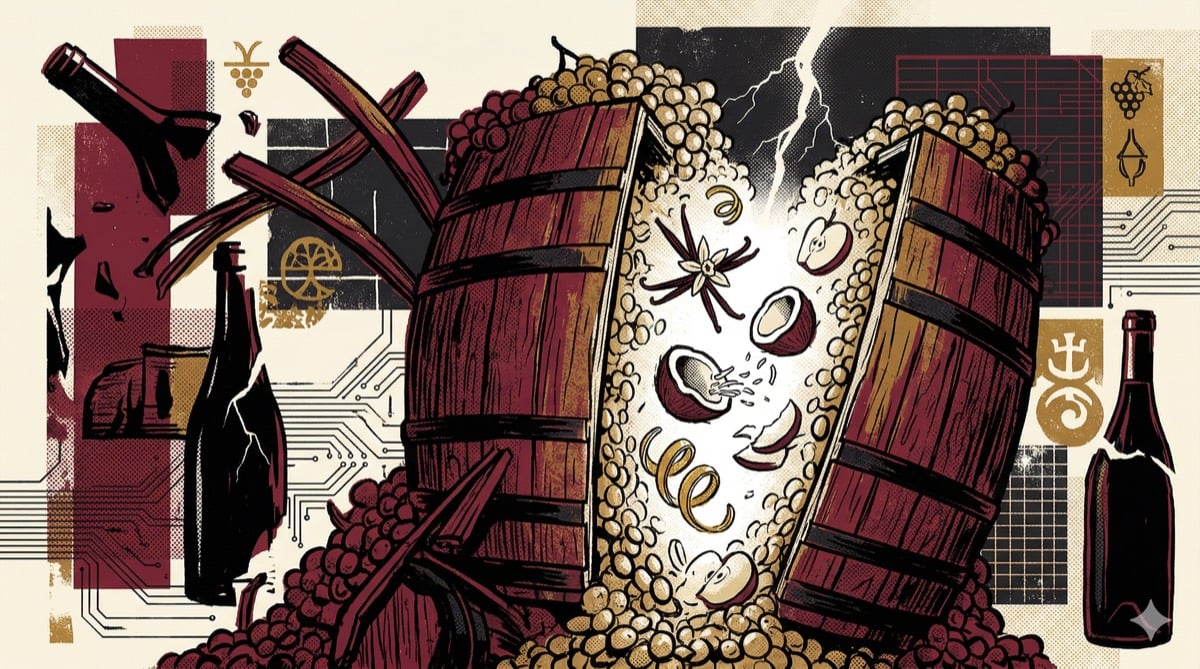
New oak gives vanilla, coconut, butter and sometimes a smoky tone. Too much wood hides the grape. That was the problem with a lot of Australian and Californian Chardonnay in the nineties: the fruit was barely there.
The trend has been moving toward less and older oak, or none at all. Stainless steel or large neutral barrels. The result is cleaner: you taste the terroir, not the cooperage.
A rough guide: if a Chardonnay smells strongly of vanilla or butter, a lot of new oak was used. If it smells mineral, spicy or purely fruity without that overlay, little or no new oak was involved. Neither approach is better in the abstract. What matters is whether the balance works.
Where to start buying Chardonnay
For entry level: a Mâcon-Villages or a Saint-Véran from a good producer. Fairly priced, no fuss, honest grape.
A step up: a Pouilly-Fuissé village or a Bourgogne Blanc from a small producer. More depth, more ageing potential.
For serious tasting of what Chardonnay does in cool climates: a premier cru Chablis from Domaine Raveneau, William Fèvre or Vincent Dauvissat. Expensive, but it answers the question.
Serve cool-climate Chardonnay around 10°C. Fuller styles can go slightly warmer, around 12°C. Too cold and everything closes up. Too warm and the acidity fades. Taking it out of the fridge ten minutes before pouring is not a suggestion. It is part of drinking the wine properly.
Sources
- Bowers, Boursiquot, This et al. (1999): DNA evidence Chardonnay = Pinot × Gouais Blanc, published in Science: science.org
- Jancis Robinson, Julia Harding & José Vouillamoz, Wine Grapes (2012, Allen Lane): reference encyclopaedia of grape varieties
- BIVB: Chardonnay in Burgundy: bourgogne-wines.com
- OIV: global plantings data on grape varieties: oiv.int