The Amsterdam sunshine bathes Nazka in golden light as I step inside – one of those rare, perfect spring days that feels plucked straight from central Italy. The warmth follows me in, setting the perfect scene for La Grande Bellezza Italian Wines Tour 2025. As I settle at the elegantly set wooden table, tasting sheets and menu cards arranged with precision, I can’t help but feel transported to Tuscany despite being in the heart of Amsterdam.
I’m immediately drawn to the tasting guide that explains this is the eighth edition of the prestigious tour, founded in 2019 by oenologist-turned-critic Raffaele Vecchione. The carefully curated event promises “the true essence of Italian wine” – a bold claim that has me eager to dive in.
The Setting and Format
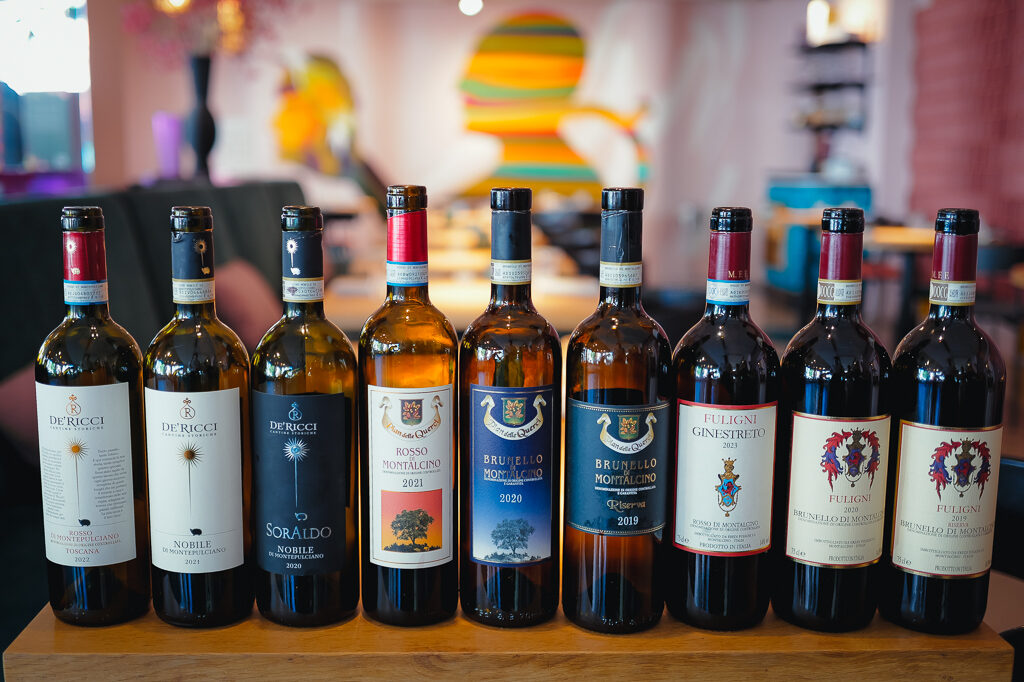
The elegant tasting guide before me revealed a thoughtfully curated selection of wines from three distinguished producers. Each winery’s logo appeared beside their offerings, providing a visual anchor as I navigated the nine wines. Have you ever tried comparing Brunello and Vino Nobile side by side? This format made such direct comparison not just possible but illuminating.
Exciting News: The Pieve Classification
One of the most intriguing developments discussed during the tasting was the introduction of a new “pieve” classification system in Montepulciano. While we didn’t taste any Pieve-designated wines—they’re too new for that—this topic generated considerable excitement as it represents a significant evolution for Vino Nobile di Montepulciano.
The Pieve designation represents a new top-tier category exclusively for Vino Nobile di Montepulciano, debuting with the 2021 vintage and becoming available from 2025. The term “pieve” refers to historic parish churches, and the region has identified 12 distinct subzones, each representing a unique terroir within Montepulciano.
The requirements for these wines are stringent: grapes must come exclusively from a single pieve and from vineyards at least 15 years old. The wines must contain at least 85% Sangiovese (locally known as Prugnolo Gentile), with only traditional native varieties permitted for the remainder; international grapes are strictly prohibited. Maximum yields are restricted to 70 quintals (7 tons) per hectare to ensure quality.
Perhaps most significantly, Pieve wines require a minimum of three years’ aging before release, including at least 12 months in wood and 12 months in bottle—more stringent than the Riserva level. Additionally, the producer must own or control the vineyards, and all grapes must come from the named pieve.
This system aims to highlight the distinctiveness of each subzone, similar to Gran Selezione in Chianti Classico but with more rigorous geographic and quality standards. Early reviews praise these wines for their depth, complexity, and strong sense of place, with each pieve offering unique expressions based on its soils and microclimate.I am very excited to taste these wines soon!
De’ Ricci: Montepulciano’s Standard-Bearer
De’ Ricci’s presentation highlighted their commitment to quality: 32 hectares of estate vineyards (organic since 2007), with the three wines on offer representing different terroirs within their holdings.
Their 2022 Rosso di Montepulciano presented as approachable and drinkable—a basic blend from their eastern vineyards. In the glass, I noted austere aromatics with spicy, fruity characteristics, high acidity, and firm tannins. The fresh sage notes complemented the bright red fruit, making it particularly enjoyable when served slightly chilled.
The 2021 Vino Nobile di Montepulciano, their flagship wine (25,000 bottles produced), impressed with its 100% Sangiovese expression aged 18 months in wood. From the southern part of Montepulciano, where volcanic soils dominate and temperatures run cooler, this wine offered a soft nose of chocolate, leather, cocoa, warm cherries, strawberry, and rosemary. The high acidity was tempered by gentle edges, with medium-plus tannins that similarly softened at the finish. The lengthy conclusion featured beautifully defined flavors.
The 2020 Vino Nobile “Soraldo”—named after the family grandfather—comes from a historic site 500 meters above sea level, with some sand and predominantly gray limestone and seashells rather than volcanic soil. The soft nose revealed coffee, toffee, leather, tobacco, chocolate, cocoa, and black cherries. Both acidity and tannins balanced perfectly, creating a medium-bodied, elegant wine of admirable accessibility and refined complexity.
Pian delle Querci: Montalcino’s Elegance
Moving to Montalcino, the 2021 Rosso showed austerity, with cranberries and cherries complemented by subtle tobacco notes. It tasted more mature than I expected, with greater concentration of fruit and a hint of orange.
Their 2020 Brunello embodied what I consider quintessential Brunello: warm cherries, chocolate, leather, spice, ripe red fruit, blackberries, red cherries, plum, nutmeg, black pepper, sage, and rosemary—a thoroughly pleasant experience that reminded me why this region commands such respect.
The 2019 Brunello Riserva presented very differently, with an elegant nose featuring orange peel, yet feeling somewhat closed and austere during the initial tasting, with the fruit remaining somewhat restrained.
Fuligni: Historic Excellence with Modern Thinking
Introduced as an important name since the 20th century, Fuligni represents a historic family with a modern approach—a significant presence in Italian winemaking, particularly in the Montalcino region.
Their 2023 Rosso di Montalcino “Ginestreto” offered a pleasant if slightly closed and modest nose, with fresh fruit balanced by herbs. In the mouth, it seemed to lack some character, likely due to its youth—a wine to revisit in 6-12 months.
The 2020 Brunello di Montalcino impressed with a warm, elegant nose of red cherries, ripe strawberry, tobacco, cocoa, lavender, roses, and spicy seasoning—a beautiful representation of the vintage.
The 2019 Brunello Riserva showed an elegant but somewhat restrained nose during the initial tasting, with both fruit and spice elements remaining too much in the background.
The Magic of Decanting: A Revelation
One of the day’s most valuable lessons came after the formal tasting, when we revisited the more closed wines—particularly the 2019 Riservas from both Pian delle Querci and Fuligni—after they had been decanted. The transformation was remarkable.
These wines, which had initially seemed reticent and tightly wound, opened up beautifully with air, revealing layers of complexity and nuance that had been hidden during the first tasting. The Fuligni Riserva particularly impressed, with its fruit coming forward and its structure softening just enough to showcase its true potential.
For anyone planning to drink these young Brunellos and particularly the Riservas, a minimum of 60 minutes in a decanter proved essential. This experience offered a powerful reminder that many premium Italian wines, especially those built for aging, benefit tremendously from proper aeration. What might seem austere or closed in a young Brunello often transforms with patience and proper service.
The Culinary Complement: Nazka’s Peruvian-Italian Fusion
After the thoughtful progression through these nine expressions of Sangiovese, Nazka demonstrated why they were chosen to host this prestigious event. Their menu skillfully bridged Tuscan tradition with Peruvian innovation.
The amuse-bouche prepared our palates for what followed. The starter featured Rocoto LDT—a seabream crudo with cherry tomatoes, cancha, and coriander oil that complemented the high-acid Rossos beautifully.
For the middle course, Vinicunca Millefeuille—layers of oca tubers with Peruvian chili sauces—created an intriguing bridge between the medium-bodied Vino Nobiles and the heartier Brunellos.
The main course of braised ox cheek in Anticuchera sauce with choclo mousseline and green chutney chalaca provided the robust flavors necessary to stand up to the most structured Riservas, with the earthiness of the dish highlighting the wines’ complexity. By this point in the meal, those previously decanted Riservas were showing magnificently alongside the rich main course.
Final Reflections
What made La Grande Bellezza truly special was not just the quality of wines presented, but the educational format that encouraged contemplative tasting. The progression from lighter Rossos to structured Riservas, coupled with Nazka’s thoughtful menu pairings, created a comprehensive experience greater than the sum of its parts.
For anyone seeking to understand the nuances between Brunello and Vino Nobile, or between different producers’ interpretations of Sangiovese, this format provided invaluable insights. The introduction of the Pieve classification system signals an exciting new chapter for Brunello di Montalcino—one that promises even greater terroir expression and specificity in these already remarkable wines.
The eighth edition of this tour confirmed why these Tuscan classics remain central to any serious wine lover’s education—and why I’ll be first in line when the ninth edition is announced, perhaps featuring some of the first Pieve-designated Brunellos. Just remember, when approaching these wines in their youth: patience and proper decanting make all the difference between a good experience and a truly transcendent one.