

In a cool climate, vineyards planted with traditional grapes such as Riesling, Chardonnay or Cabernet Sauvignon need twice the pesticides of vineyards planted with modern grapes such as Solaris or Johanniter, and twice as many interventions. Vicky Corbeels worked that out in 2021 for her postgraduate thesis on Belgian winegrowing. In some wine regions, she says, the gap is closer to a factor of ten. It is one of the reasons she thinks Belgium can’t simply borrow what works in Bordeaux.
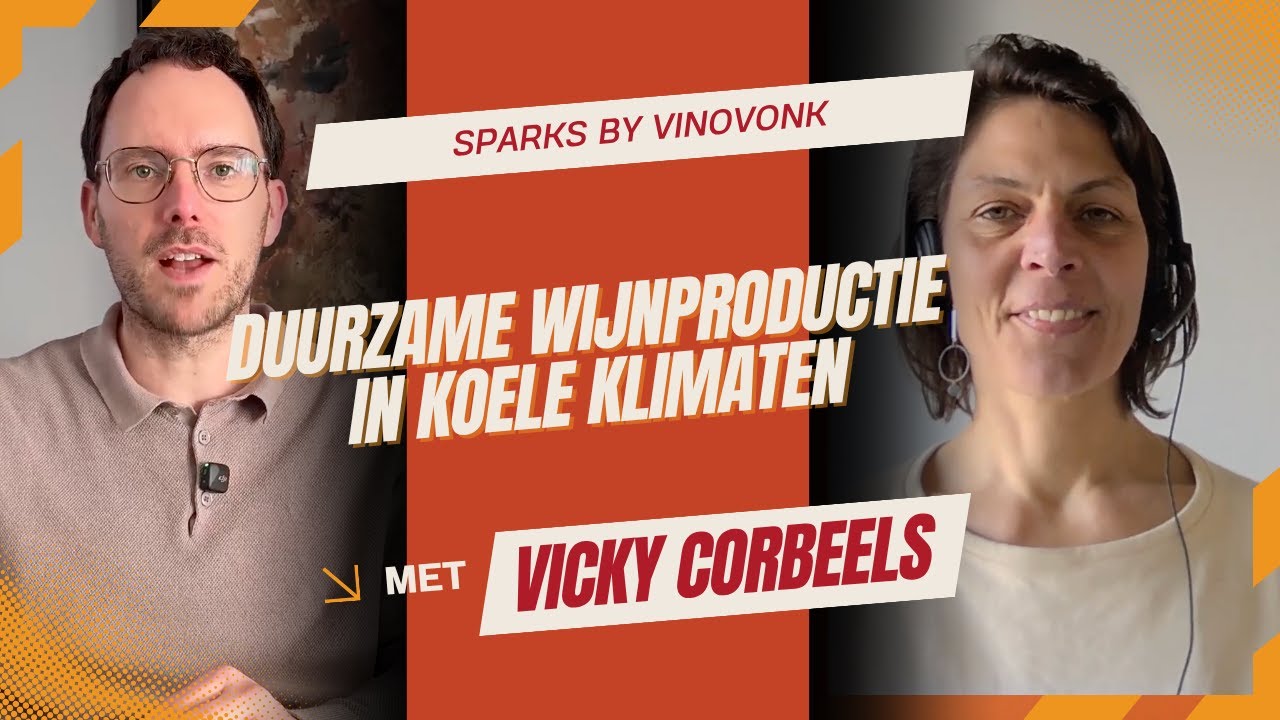
I heard Vicky speak last year at the Wijnfestival van de Lage Landen, the Low Countries wine festival. In this Sparks episode we talk about her PhD at the University of Antwerp on sustainable vitiviniculture in cool climates: European wine policy shaped around the warm Mediterranean wine countries, certified-organic growers who turn most often to the most polluting form of frost protection, and an EU funding bid with partners in the Netherlands, Denmark and Estonia.
This episode was recorded in Dutch. Listen on YouTube or Spotify above. The full Dutch transcript is on the Dutch version of this article.
Who is Vicky Corbeels
Vicky didn’t start out in wine. She trained as an Arabist and Islamologist and graduated more than twenty years ago. Around fifteen years ago she moved into the wine trade, working as a restaurant sommelier, then a wine writer, then an independent wine consultant. For the past decade she has earned most of her living selling her wine knowledge.
In 2021, in the middle of the pandemic, she went back to study for a postgraduate degree in Energy and Climate, and applied everything from it to Belgian winegrowing in her thesis. Large clients kept asking her to explain their sustainability plans to Belgian trade and consumer audiences. Seeing how much was happening in the traditional wine countries made her wonder how resilient the Belgian sector itself was. She began her PhD in Antwerp a year and a half before we spoke. Through her platform Cru Design she teaches masterclasses and publishes on her research.
Why Belgium can’t borrow from Bordeaux
The warm, traditional wine countries have already done a great deal of sustainability research. They have the money, they get subsidies for it, and they carry weight in Brussels. Belgian practice still leans heavily on their work.
“The whole of European wine policy is also written to suit those traditional warm climates,” Vicky says. “But those solutions aren’t necessarily the ones we need in cool climates.”
She points to different grapes, different practices, and different angles and hours of summer sunlight. Her research sets out to find where Belgium’s real needs and weak spots lie.
Vitiviniculture: the first two phases only
Wine production runs from the vineyard through vinification and ageing to bottling, distribution, sale and consumption. Vicky limits herself to the first two phases, which together she calls vitiviniculture: growing the grapes and making the wine up to bottling. That, she argues, is where a cool climate makes the difference compared with the south.
At the festival someone asked why she leaves packaging and transport aside. As I remembered it, and she confirmed, her answer was that those studies already exist and apply equally to beer or fruit juice in glass or bag-in-box. Cutting a one-kilo bottle down to 500 grams is the same sum in Belgium as in Bordeaux.
Modern grapes: half the pesticides, sometimes a tenth
I once compared “hybrid” to a hybrid car: not electric, not petrol, never quite either. Since the festival Vicky has used modern grapes consistently, rather than hybrid, interspecific, tolerant or resistant. “It always has a whiff of wanting to and not being able to,” she says. “Something half and half.”
She means specially adapted or cloned varieties with tolerance to fungal pressure and the other problems of a cooler, damper climate. In 2021 she calculated that traditional grapes needed twice the pesticides and twice the vineyard interventions. In some regions, she says, it is ten times as much, in both dose and frequency.
The EU is urging member states to focus on adapted crops across agriculture as a whole. Even so, according to Vicky, two thirds of Belgian vineyards are still planted with traditional varieties. The Netherlands, she says, is much further ahead in embracing modern ones.
Four phases of research
Phase 1: the maturity gap. Vicky compared the sustainability maturity of cool-climate wine countries, with Belgium as the case study, against the traditional wine countries. She found a wide gap, and the programmes from the traditional regions can’t be transferred as they stand. That study was being published at the time of recording.
Phase 2: scenario thinking. With around 25 Flemish and Walloon winemakers plus a number of key stakeholders, she is running strategic interviews on how Belgian vitiviniculture will look in 15 to 30 years. One factor that keeps coming up is the growing use of modern grapes. The result will be four scenarios with early-warning signals, so growers can tell which scenario they are in and change course in time.
Phase 3: a life-cycle assessment (LCA). An inventory of every product, material, process, and all the water and energy used in viticulture and vinification, with the climate impact of each. That should expose the hotspots and let her propose alternatives.
Phase 4: socio-economic. This depends on funding, including the EU bid. It would also extend the Belgian case study to the Netherlands and countries further north.
A consortium with Maastricht, Copenhagen and Estonia
For an EU fund supporting agro-ecological projects, the University of Antwerp put together a consortium with Maastricht University, the University of Copenhagen and a university in Estonia. When we recorded, the bid was still at pre-proposal stage.
The four countries share traits in their winegrowing, but Vicky says the areas above 56 degrees north face quite different challenges. Denmark’s main regions are cooler than Belgium, yet there is also winegrowing in areas where figs, olives and exotic fruit grow. If you don’t know that, she says, you are less likely to give those wines a chance.
The organic frost-protection paradox
If two or three nights of frost hit just after budburst in spring, you lose part of your crop. One way to protect the vines is to burn material in the vineyard. Her 2021 postgraduate research found that certified-organic producers were the ones using that polluting practice most.
“I’m not saying it’s all suspect,” Vicky says. Her point is that a certificate is a means towards sustainability, not the goal. Sometimes, she says, people cut corners to get a certificate that in the end goes no further than that. Certification isn’t a research topic in its own right, but she does examine it, to clear up doubts among growers.
Who pays for the research?
Not Belgian growers, though more and more of them are asking for it. A vineyard and a winery require heavy investment, and sustainability often gets forgotten or treated as an extra cost. Vicky points out that the studies agree: if you make no effort towards sustainable production now, it only gets more expensive later.
During our conversation I suggested Belgian growers could release a special wine and put the proceeds towards the research. Vicky called it a lovely idea and said she would put it forward. Belgium produces about 3.5 million litres a year, which she says makes it one of the largest cool-climate producers, though England may already make more. Even so, the sector is still in a pioneer phase. Her aim is to start from a group of pioneering estates that take part in the research and grow from there to the whole sector.
What’s still open
Vicky herself is cautious. She doesn’t want to state conclusions that haven’t been calculated yet, and the outcome of the PhD is still open. The pesticide figures come from her own 2021 calculation, and the factor of ten only applies in some regions. She also says Belgium gets “incredibly beautiful results” from traditional grapes; whether that is sustainable, or could be more so, is exactly what the research has to show. And phase 4 and the European consortium depend on money that hadn’t been awarded when we recorded.
FAQ
What are modern grapes? Specially adapted or cloned grape varieties with tolerance to fungal pressure and the other challenges of a cool, damp climate, such as Solaris and Johanniter. Vicky prefers the term to hybrid, interspecific or resistant.
How much less pesticide do modern grapes need? In 2021 Vicky calculated that traditional grapes need twice the pesticides and twice the interventions. In some regions, she says, it is ten times as much.
Why isn’t European wine research directly usable in Belgium? Because policy and most programmes are designed around the traditional warm wine countries of the Mediterranean. Cool climates have different grapes, different practices and different summer daylight.
What is vitiviniculture? Grape growing (viticulture) and winemaking (vinification) together, up to bottling. Vicky limits her research to those two phases because that is where a cool climate makes the difference.
When will the first results be available? At the time of recording, phase 1 was being published and Vicky expected to finish phase 2 within two to three months. The life-cycle assessment was due to follow.
More about Vicky Corbeels
Vicky publishes on her research, talks and masterclasses at cru-design.com, where there is also a form for questions about the research. Shortly after we recorded, she hosted an evening on modern grapes at Belgian Wines, an Antwerp shop that sells only Belgian wine.
Listen
Watch