

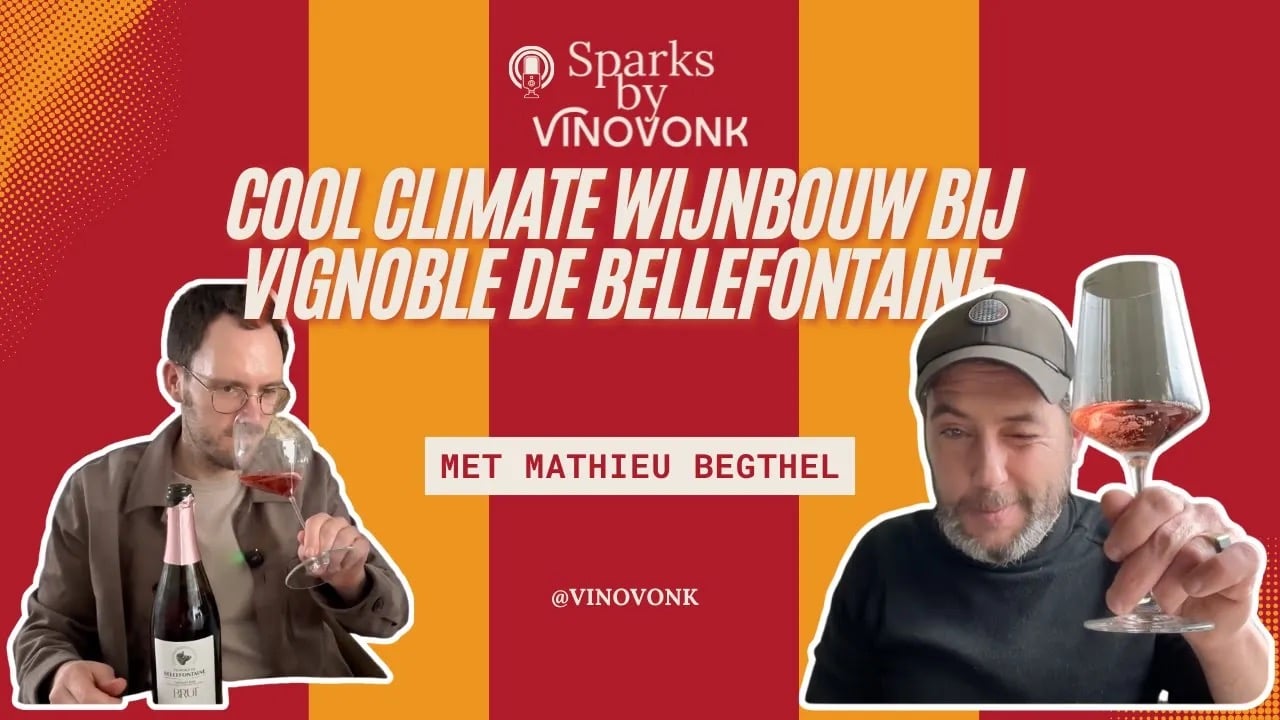
At 420 metres, Vignoble de Bellefontaine is, according to Mathieu Begthel, the highest vineyard in Belgium. It lies five kilometres from the French border and an hour and a half’s drive from Reims, on half a metre of clay over slate. Mathieu came to Wallonia for a quiet year after a long career in hospitality. The house he rented turned out to be three kilometres from a vineyard, and after one email and some volunteering in the rows, he slowly worked his way in.
I met Mathieu at the Wijnfestival van de Lage Landen, and I already knew the name from the Gault & Millau wine guide. In Sparks episode 15 he explains how Bellefontaine farms a cool-climate site in Wallonia, how Phénix and Pinot Noir meet in a Crémant Rosé, and how Solaris from a cool year differs from Solaris from a warm one.
Vignoble de Bellefontaine sent me the bottles; I received no payment and the opinions are my own.
This episode was recorded in Dutch. Watch on YouTube with auto-translated subtitles via the link above.
Who is Mathieu Begthel
Mathieu was born in the Netherlands and now speaks French. After a winding road and many years in hospitality he needed calm, so he left for Wallonia without a plan and rented a small house to spend a year closer to nature.
Walking the woods in his first weeks, he found Vignoble de Bellefontaine three kilometres from his door. He sent an email and started out as a volunteer in the vineyard. Today he is maître de chai: he mainly handles sales, is responsible for everything that happens in the cellar, and makes the wines with his boss, Jérôme Naets. He also makes cuvées of his own, with full freedom to do as he likes.
The estate
Bellefontaine has two plots of roughly 5 and 2 hectares, both 300 to 500 metres from the cellar. The first vines went in in 2015. The flagship is Crémant de Wallonie, an AOP sparkling wine made by the traditional method. Alongside it, the estate makes:
- Crémant Blanc
- Crémant Rosé, only in years with a Pinot Noir crop
- white wine and, not every year, red
- a rosé of Mathieu’s own, recently added
- orange wine
- ratafia
With every hectare in full production, Mathieu expects 40,000 to 45,000 bottles a year. In 2024 the estate brought in almost nothing: while the Phénix and the Solaris were flowering, close to a month’s rain fell in a single day. Mathieu spent that year finding new customers, ordering new tanks and designing a new label.
Classic and modern grapes
Bellefontaine works mostly with what are often called hybrid or resistant varieties. Mathieu prefers to speak of classic and modern grapes. The modern varieties were bred for a climate like this one.
- Classic: Pinot Noir
- Modern: Phénix, Solaris, Cabernet Cortis, Cabernet Dorsa
Phénix gives large bunches with plenty of juice and flavour, yet according to Mathieu it never gets past 9 percent alcohol, however hot the summer. That makes it the source of freshness in both the Crémant Rosé and the Crémant Blanc. Mathieu calls Solaris its opposite: small, concentrated bunches with more flavour and more sugar.
Pinot Noir is the difficult one. It has no resistance to mildew, and because the altitude puts Bellefontaine one to three weeks behind other Belgian vineyards, it misses the October sun it needs unless the summer is excellent. In 2023 and 2024 there was no Pinot Noir to pick, and so no Crémant Rosé.
AOP rules and the traditional method
According to Mathieu, the Crémant de Wallonie AOP requires:
- at least 9 months on the lees (Champagne requires 15)
- hand harvesting
- second fermentation in bottle
A company from France comes in to start the second fermentation and again for disgorging. Bellefontaine is too small and too isolated to own that equipment or share it with neighbours, and Mathieu says nearly every Belgian producer works this way. Picking, winemaking, blending and ageing all happen on the estate, and small runs of still wine are bottled in-house.
Mathieu is experimenting with ageing. The 2022 Crémant came to 11,000 bottles: 8,000 have been disgorged and are ageing further under cork, while 3,000 are still on their lees. He says Champagne is having the same debate: longer on the lees, or disgorge after 15 months and give the wine more time under cork.
Crémant Rosé 2022
72 percent Phénix, 28 percent Pinot Noir, AOP, 9 months on the lees. Bellefontaine always works with a single vintage and keeps no reserve wine. Mathieu enjoys Bollinger and likes that it tastes the same every year, but for his own estate he finds it impossible to make nature taste identical from one year to the next.
The Pinot Noir had six hours on its skins for colour, then spent almost a year in two small oak barrels. The Phénix fermented in stainless steel and stayed there for ten months. After blending, sugar and yeast go in, the wine is bottled under crown cap and rests on the laths for at least nine months.
Just after opening I still picked up some yeast, a hint of bread dough, and a lot of fresh red fruit: young raspberries and sweet, candied strawberries. Mathieu pointed to a faint smokiness that he puts down to the slate in the soil, plus white pepper and a touch of almond from the barrel-aged Pinot Noir. I found it vinous, with good acidity, a long finish and a fine, well-integrated mousse. Tasted blind, you might wonder for a moment whether you were drinking a red or a white. Tuna tataki came up as a pairing.
It sells for €24 including VAT. Bellefontaine made around 3,500 bottles of the 2022; 3,000 have been disgorged and 500 are still on the lees. The estate won the audience prize at the Wijnfestival van de Lage Landen, and Mathieu says this crémant took bronze in a Belgian competition the year before. The new label leaves off the vintage, a mistake Mathieu owns up to, because it keeps customers thinking the estate does not make vintage wine.
Solaris 2023 against Solaris 2022
Two bottles of 100 percent Solaris, one from a cool year and one from a warm year. For Mathieu they show the full range of what the grape can do. The older bottle is Bordeaux-shaped and the newer one Burgundy-shaped, and all the whites, orange and rosé are moving to Burgundy bottles. The estate once used clear glass, and the cellar now has orange lighting to keep UV off the wine.
Solaris 2023 (filtered, cool year)
12.5 percent alcohol. Mathieu is no fan of chaptalisation, but here he raised the alcohol by half a degree, because a white at 11 to 11.5 percent feels very different in the mouth. After the tropical 2022 he felt the 2023 lacked structure and flavour, so he stirred the lees (bâtonnage). Part of the wine spent a year in a 1,600-litre foudre of Belgian oak, and it also aged in used 500-litre and 228-litre barrels. His aim is to work only with Belgian oak one day.
Mathieu finds it more reserved and less aromatic than the 2022: spicy, with something mysterious about it, like morning mist. I tasted juiciness, plenty of acidity, a little bitterness and fresh fruit, with banana, pineapple and passion fruit in the background. It is not especially complex, but it is not flat either. Mathieu calls it more classic in style, a bottle he can pour for anyone.
Solaris 2022 (unfiltered, warm year)
13.2 to 13.3 percent alcohol, with no adjustment. Eight hours of skin contact, which the 2023 did not get. With this vintage Mathieu emptied the foudres and barrels every three months and rotated the wine, so each portion spent the same time on each type of wood.
Mathieu finds apple and lemon and calls it his “voyage tropical”, with passion fruit and pineapple. To me it had the same profile as the 2023, only more powerful and wilder. On the finish there is a slightly oxidative note reminiscent of the Jura, which Mathieu says is typical of Solaris. Mathieu says this vintage does well in restaurants and with sommeliers. The 2022 is listed in the Gault & Millau guide; the 2023 had been submitted at the time of recording.
Cabernet Cortis 2023: Mathieu’s own cuvée
The last bottle had no label yet, just a name and vintage written in marker. Cabernet Cortis is a modern, tannic variety from the plot planted in 2020. In 2022 Mathieu made a small red from it that he compares to Nebbiolo. With the 2023 harvest he pressed, at the lowest pressure he could, tasting the juice until he felt it was right.
The wine spent four to five months in stainless steel on its coarse lees, then almost a year in a used oak barrel. He did not have enough Cortis to top up the barrel, so it contains 2 to 3 percent Solaris. No sugar was added and it comes in at 11.2 percent. Mathieu suggests serving it at around 16 degrees.
On the nose I found ripe strawberry, candied cherry, something lactic and cheesy from the yeast, and a sour, earthy smell that reminded me of volcanic wines, with gooseberry and blackcurrant. A light red with something of an orange wine and a rosé about it. I tasted a lot of power, tannin and good acidity, with wet earth and wet leaves. It is still austere, having only just been bottled, and the body hides the low alcohol.
There are only 275 bottles. According to Mathieu, the buyer he calls his importer asked for around 150 straight away. His colleague who runs the vineyard expected at least 1,000 litres from the 2025 harvest.
Price and excise
Belgian wine costs more than French or Italian, and Mathieu explains why. Bellefontaine pays over €2 excise duty per bottle of wine, against 20 to 30 cents in France. On top of that, everything is still an investment: no neighbour to share machines with, smaller volumes and no generations of built-up infrastructure. The standard Crémant costs €21, the Crémant Rosé €24.
Caveats
- At the time of recording the wines were not sold in the Netherlands. Mathieu was looking for an importer.
- Crémant Rosé and red wine only happen in years when the Pinot Noir ripens cleanly, and that did not happen in 2023 or 2024.
- I found the Solaris 2023 not especially complex, and the Cabernet Cortis was still austere because it had only just been bottled.
- I tasted one bottle of each wine, sent by the producer. The details on winemaking and volumes are Mathieu’s account.
What comes next
After 2024 Mathieu expected a good harvest, as the canes were thick and healthy. His list included more Cabernet Cortis, the return of the rosé, and an orange wine with 28 days of skin contact that was already in bottle. Six months before the recording, he said, it was so drying you almost needed a glass of water alongside.
The ratafia, which had sold out, is coming back too. Bellefontaine has its own wine distilled for it, so the spirit also comes from the estate, and Mathieu describes the result as a yellow ratafia, fresher than the darker style from Champagne. His dream is for the Netherlands to be his first export market, so his mother in Alkmaar could buy his wine.
Frequently asked questions
What is Crémant de Wallonie? A Walloon sparkling wine made by the traditional method, with second fermentation in bottle. The AOP requires at least 9 months on the lees (Champagne: 15) and hand-picked grapes.
What is Phénix? A modern, disease-tolerant variety with large, juicy bunches that, according to Mathieu, tops out at 9 percent alcohol. At Bellefontaine it is the main component of the Crémant Rosé and also goes into the Crémant Blanc.
Why is Belgian wine more expensive than French? According to Mathieu, mainly because of excise duty of over €2 per bottle against 20 to 30 cents in France, and because of small scale: no neighbours to share equipment with and no inherited infrastructure.
Does Vignoble de Bellefontaine farm organically? Mathieu says the estate works as naturally as possible, with as little sulphite as possible and no additives. Organic certification did not come up in the conversation.
The bottles in this episode
Vignoble de Bellefontaine Crémant Rosé 2022. 72 percent Phénix, 28 percent Pinot Noir. AOP, 9 months on the lees, traditional method. €24.
Vignoble de Bellefontaine Solaris 2023. 100 percent Solaris, 12.5 percent alcohol, filtered, bâtonnage, partly aged in a Belgian oak foudre. More classic style.
Vignoble de Bellefontaine Solaris 2022. 100 percent Solaris, 13.2 to 13.3 percent alcohol, unfiltered, eight hours of skin contact, aged in wood. Tropical, powerful style.
Cabernet Cortis 2023, a cuvée by Mathieu Begthel. Cabernet Cortis with 2 to 3 percent Solaris, 11.2 percent alcohol, used oak barrel. 275 bottles.
More about Vignoble de Bellefontaine
Importers, restaurants and private buyers interested in these wines can get in touch through Vignoble de Bellefontaine. Mathieu runs tours and cellar tastings at the estate.
Transcript
The full conversation transcript.
Show full transcript
This transcript is generated automatically from the audio and has not been edited. Speech recognition makes mistakes, so treat wording as an approximation rather than a verbatim quote. It is here for accessibility and search.
Hi Jeroen, and welcome to another episode of Sparks at VinoVonk. The series where I take you into the wonderful world of wine. The people who make the wine, sommeliers, importers. But we also talk about innovative drinks, non-alcoholic beverages, and spirits. And today we’re going all the way to the south of the Netherlands, to Belgium.
Wallonia, to be precise. French-speaking Belgium. And I have a very special guest with us, Mathieu Begthel. I’m going to spell it right. Vignoble de Bellefontaine.
That’s a vineyard in Wallonia. I met Mathieu at the Low Countries Wine Festival. It’s a fantastic festival. I had already checked who was there beforehand. And then I thought, that name sounds familiar.
And I was right, because they were listed in the Gault & Millau wine guide. And then I thought, I really have to go there. Mathieu was kind enough to send me a few lovely bottles. And Mathieu, before I forget, welcome to the broadcast and thank you for your time. Thank you, thank you.
With great pleasure. And thanks again for sending me these beautiful bottles. But before we get into the tasting and the action, could you tell us a little about yourself and what you do at Vignoble de Bellefontaine? Yes, as you just so eloquently mentioned, it’s in the French part of the country, but as people can probably hear, I do speak French now, but I was born in the Netherlands. After a long career in the hospitality industry, I finally ended up doing something else.
I needed a bit more peace and quiet, and I actually left for Wallonia without a plan. I rented a cottage there to spend a year in peace. A little closer to nature, a little closer to myself. And sometimes when you let go of things, things come to you. And what do you do when you arrive here in the first few weeks?
Yes, you walk through the woods, and then, quite unexpectedly, there turned out to be a vineyard three kilometers from my door. What are the odds? I sent an email. And I literally started working there voluntarily, helping out in the fields. That’s how I gradually got into it.
And what do I do there now? Yes, wine has always been my passion. I work a little bit in the fields, but I mainly do sales, and I’m what they call a maître de chai. So I’m basically responsible for everything that happens with the wines in the cellar. I make the wines together with my boss, Jérôme Naets.
But I do more of the daily follow-up. And besides that, I’ve also started making my own cuvées. So I have complete freedom to do what I want. I’m really grateful for that. Our main product is Crémant.
Crémant de Wallonie. So that’s essentially a sparkling wine. Voilà, Jérôme keeps the bottle looking nice. We make that every year, in principle. Of course, last year, for example, was a very difficult year for us.
We simply didn’t bring in anything. We also have the luxury that, only if you’ve had a vineyard for 50 years, do you have roughly the same volume every year. But we’re still a young vineyard; we were planted in 2015. So your volume is still increasing every year, more and more. So we mainly used 2024 to find new customers and expand sales a bit .
But we don’t make the Crémant Rosé, which we’ll be tasting soon, every year because we need Pinot Noir for it, and we don’t bring that in every year. Besides that, we also make wine. And again, I’m very grateful, because we make bubbles. We make white wine, we make red wine. I’ve also recently started making my own rosé.
We also make orange wine. And we’re going to taste that together. You still have a bottle of it. We also make ratafia. I also saw in one of your last episodes you had a champagne moment, I think.
I secretly watched the episode to get a feel for what it would be like. So we also make ratafia. So, actually, I always laugh about it, we make the whole range. You can have an aperitif with us, you can have wine with your meal, and you can have a glass of wine before dinner to finish. What a great story.
Shall we start with this Crémant de Wallonie? I always say Wallonia, but it is Wallonia. How do you make this wine? It’s actually made the traditional way, which means it’s also a true AOP. Belgium is still a country, of course, a wine country in its infancy, but it is an AOP.
What do we have to do for the AOP? A minimum of nine months on the lees, and for Champagne that’s a minimum of 15 months. We have to pick everything by hand. In the traditional method, that means the second fermentation that creates the bubbles, that has to be bottled. Of course, we’re also looking…
Do you handle that process yourself? Yes, we do, for example, for the… When we start the second fermentation, a company from France will come and help us with that, because we’re still too small. And the same with disgorgement. If disgorging is necessary, the company also comes from France.
But yes, that all sounds very far away. But I can get to Reims faster, within an hour and a half, than I can to Ghent, which is almost two and a half hours. So we’re 5 km from the French border, so we’re really close to the Champagne region. That’s also very convenient. But almost no one in Belgium uses such companies; everyone uses them.
We’re still too small. And we, especially, are very isolated. So you don’t have the same situation in France where you often have winegrowers together. We can’t share equipment. So they do come and help us with that.
But if there are small bottlings of regular wine, for example, 2,000 bottles, we simply do that ourselves; we also have bottling machines for that, and so on. The fact is, the wine isn’t necessarily made with your machines, but on your property. And the bottles are also aged on your property. Yes. So I’m very grateful for everything.
We have the wine cellar, which is called the chai. We have two plots, one of about 5 hectares and one of about 2 hectares. But everything is within a little over 300 meters, 500 meters, of the wine cellar. So that’s why we can work beautifully with the terroir. But indeed, we harvest ourselves, we make the wine ourselves, we let the wine age in the cellar ourselves.
And when we think, “We usually work with a 10-month delay for the crémants,” we say harvest, we ferment, we let it age. And then after 10 months, we start making the blend. I’ll explain what the blend is later. And after the blend is made, we do all that ourselves, of course. We add sugar and yeast again to a large stainless steel vat.
Fortunately, fermentation doesn’t start yet. And then it’s bottled very quickly, and that’s when the beer crown cap actually comes. When it is actually set up, then you don’t have the nice cork yet and then they literally lie on the slats on the lie and then the choice is actually up to us, yes we have to do that for at least 9 months but we can also say we are now also testing that once 15 months or once 24 months there are also discussions going on these days what is better? Longer sur lie, so leave it on the lees for longer with the crown cork disgorged later or In Champagne too they are considering whether to just disgorge after 15 months but then let it mature longer sur bouchon, so on the cork So for example, we are also going to taste in the future because I think we will see each other a few more times in the future Our crémant from 2022, there were 11,000 bottles We still have 3,000 left, those still need to be disgorged and 8,000 have been disgorged and we will let those mature longer on the cork and then after a few years we can see from And that is also the nice thing about us being so young. We can still experiment a bit and see what works best for us.
Super interesting. Shall we taste this together and then you tell us a bit about it? Because then you will of course get a bit thirsty from all that talking. So I’ll just quickly, we mainly work in general with, they call it hybrid, resistant, you can put a lot of names on the new grapes, but as Vicky Corbeil is very beautiful, also at the Low Countries festival. We should rather talk about the classic grapes and the modern grapes, because some of the grapes we use are created more for our climate.
Look here again at… …the Heem cork. So what’s in this 70% 72% Phoenix. Phoenix is a modern grape. Phoenix produces very large bunches.
Lots of juice, also lots of flavor. But… It can be a hot summer when we convert the sugars into alcohol. 9 degrees alcohol is the maximum. So the Phoenix provides a lot of freshness.
We also use the same Phoenix for our crémant blanc, which we will taste another time. And this one contains 28% Pinot Noir. The real Pinot Noir, the classic Pinot Noir. We always work with vintages. So we don’t actually keep any wine in the cellar.
Why not? Because that’s our choice. Personally, I’m very happy that that’s the estate’s choice. Because I really like that every year is different. And maybe every year it will also be reflected in our crémant.
Because in my mind, nature is different every year. So I can’t possibly… I love drinking a glass of Groegglas Bollinger. I’m glad Bollinger tastes the same every year. But in my mind, it’s impossible to create the same flavor every year.
So with us, it’s always vintage. That actually makes it very young for me. You can easily put this aside for a long time. If I open our first crémant of 2018 now, I actually think it’s the best. So I’m also very curious about what the future will bring…
Cheers, by the way! Thank you. Beautiful, isn’t it? This is beautiful. You still have such a little bit…
When it’s just opened, that yeast still comes through the nose a little. A bit like bread dough, but also a lot of fresh red fruit, like young, fresh raspberries. A bit like candy strawberries. Correct. I have these days, but that’s nice, those wines are alive, so those wines, I also have a bit of that touch, don’t say it, that touch of fumée, it’s a bit smoky, already a little bit in the nose and that’s actually, we have slate around, they call it, we first have a good half meter of clay and then we have slate.
So that slate, that’s really what gives it that little fume, that little smoky note that’s in it. Also a lot of spice. Is that from the modern varieties? Also from the Pinot Noir, mind you. In terms of vinification, so the Phoenix, of course, fermented in stainless steel and then it also matured for ten months in stainless steel.
Pinot Noir had six hours of maceration, which gives it that color, very briefly actually, and then after its fermentation, the Pinot matured for almost a year in a small wooden barrel, two small wooden barrels, so that gives it that extra touch, it will also have a bit of almond later on . White pepper also comes through very strongly. You also have a beautiful, large glass, Jeroen. Very kind of you. Yes, it’s a Pinot Noir glass from the Riedel Vinum series.
Always lovely with rich champagnes. Yes, because this one also lets it open; it’s very vinous, with a long finish. Lovely acidity, nice and fresh, packs a punch, and has a lovely, beautiful structure. But it’s also immediately packed with red fruit. And if you were to taste this blind, you’d sense those bubbles.
But then you’d also think, is it a red wine? No, is it a white wine? There’s so much going on; it’s incredibly complex. Incredibly beautiful. We have a really cool climate.
New vineyards are being planted, of course. But we’re still the highest vineyard in Belgium. We’re at an altitude of 420 meters. That also gives it that freshness. But I still have it now—it’s practically still salivating.
So that’s what I mean, put this aside for a few more years. Of course we are not going to do that because we also have to sell wine, we are still a young company but for me there is really a lot of potential and what I said, for me that white A little pepper that comes through nicely at the end, very vinous, I can also eat it with it. I’m thinking something with tuna, a tuna tataki, or yes . Beautiful, but also plain, it has a very long finish. I can still taste it.
It’s a very refined mousse, that mousse is very integrated. And it’s only aged on the lees for ten months. No, nine months. You wouldn’t say that, because it’s already very integrated. It doesn’t have those big bubbles.
No. And that too, the total edition of that year, 2022. So that, yes, mistake on our part, we finally have new labels. Yes, it doesn’t have the 2022 on it yet. That’s a bit of a shame, of course, because people still think we don’t make a vintage.
But is that even allowed according to the AOP to put a year on it? Yes, yes, of course. But I’ve completely lost track of the question. I don’t remember either. Do I ever have problems with losing track?
No, but this is fantastic. I’ve got it now, that’s what I was saying, that’s why my ADD mind distracted me so quickly. Because I said 2022. So we’ve made almost 3,500 bottles from memory. 3,000 have been disgorged.
But even of that, there are still 500 bottles on the side that we haven’t disgorged yet. So I’m very curious to see how that will evolve. Also nice, of course, I was with you at the wine festival, and you also got it . We won the audience award. And last year we didn’t get much from Belgium, but we also received bronze for this crémant.
It’s going step by step. A truly beautiful wine. And in terms of retail price, what should people keep in mind? This one costs 24 euros for private individuals. Including VAT?
Including VAT. Here anyway, thankfully it’s getting better and better, but they can already buy champagne for 15 or 16 euros. That’s not always good. I’ve also seen, you once got something from Albert Heijn, whatever. It doesn’t always have to be good.
But for example, taxes, excise duties—how do you say that? Customs. In France, that’s between 20 and 30 cents per bottle. We pay a hefty 2 euros on that here. So that’s already factored into the price.
So in that respect. And generally, Belgian wines are still more expensive in the Netherlands, because everything is still an investment. You don’t have a neighbor, as I mentioned before, with whom you can share machinery. So that’s why the ratio of Belgian and English wines is still a bit more expensive than French wines, for example, or Italian. It’s also often smaller-scale, while in France it’s often a bit larger.
They’ve been able to make much more use of history. It all costs money. Our regular crémant, for your price indication, comes to 21. Why is it more expensive? Again, we work with vintages.
Pinot Noir remains a difficult man or woman. So we don’t bring it in every year. So yes, that’s also why it’s… So in 22, we had Pinot Noir. In 2023 or 2024, we didn’t have any Pinot Noir.
So we didn’t make any crémant rosé either. What do you do with those grapes then? We make the regular ones, and the Pinot Noir lingers because it’s not resistant, so it’s a classic grape. So I quickly get problems with that, powdery mildew, diseases like that. So then you simply can’t harvest them.
Unfortunately, we don’t use them. Red is a real bonus for us. We also make red wine, but we don’t do that every year either. That’s a bit of a problem, because with our cool climate, we’re also quite… I said we’re at an altitude of 420 meters.
Compared to other vineyards in Belgium, we’re usually a week or two or three behind. That’s it. The problem is that if you’re a bit behind and you don’t have a peak summer, we miss that little boost of sunshine we actually need in October to harvest those reds . We don’t have that then. So we simply don’t harvest reds every year.
So then the grapes are essentially lost. That happens every year. Those grapes are hanging there, impossible to collect. That’s a bit of a stretch. But we harvest white grapes every year.
Except for 2024, because that was a really difficult year for us. But I think that was the case in many other wineries too. Ours was the problem. The vineyard was actually in perfect condition. But we were just unlucky twice when both the Phoenix and the Solaris, which we’ll be tasting next, were in bloom.
We got almost a month’s worth of rain in one day. That ruins the flowers. No flowers? No bunches. So I assume.
The branches are really thick this year. So I think the vineyard has been able to pump itself up completely. So I expect a very good harvest this year. So I’m really looking forward to that. And one year’s disadvantage might be another year’s advantage.
Yes, but every time, as Johan Cruyff once said, every disadvantage has its advantage. And that’s really true. As I said, I’ve been able to invest in finding more customers. We’ve already ordered new vats. We’ve been working on a new label.
We’ve been able to use a lot of time for other things that also… Now that you’re talking about new customers, are these wines available in the Netherlands? Not yet. So in some ways, I hope this video can contribute to that. I’m still searching and looking.
And I do send an email or something every now and then, but you really have to think about visiting people; they have to try it. It’s the same in restaurants. Importers too, sometimes get so many emails saying, “Hey, we make wine, don’t you want to import?” So in some ways, I hope the video can help with that. But my dream for my first export country would have to be the Netherlands, because nothing would be cooler than my mother walking around Alkmaar and being able to buy my wine somewhere. And also, we have to—the Belgian market isn’t already exploding, but a lot of vineyards are being added.
If we’re operating all the hectares at full speed, full capacity, we’ll reach 40,000,000 bottles a year. So you have to get rid of them all. Luckily, we don’t make a light rosé that you have to drink within two years. So, thankfully, our wines can be left for a long time. So that’s not a problem.
But of course, yes, that also has to be sold abroad. So those are our goals for this year. We’re going to do our best. And to give a very good example, you also sent two very nice bottles. I think, nice, two different ones.
But no, they’re the same bottles, and yet they’re not. I have them all neatly lined up, of course. Old versus new. I always find it a funny anecdote, because people ask why they have such a plastic label. Our first bottles Bruno made simply had a paper label.
And Bruno once put the wine in an ice bucket on a beautiful summer evening. And then the label came off. And he found that so frustrating that he thought, I have to find a solution. And with the plastic, it was solved. If we could do it too, we could.
I’m still very grateful for taking over everything. And we really felt like we should have put a paper label back, a neat back label too. Because that other bottle, it’s just this and the rest, and it doesn’t have anything on it. And ultimately, of course, the most important thing is the contents of the bottle. But when people walk by, they see the bottle.
Appearance also makes a difference. So what are we going to taste? Two Solaris bottles. Actually, a cold year versus a warm year, so we’re going to open the ones we have here first because that’s an elegant year. If we immediately taste the 22, you almost don’t taste the 23 anymore because the difference is so enormous.
So it’s two 100% Solaris bottles, which I just explained about the Phoenix. Phoenix makes very large bunches. Solaris is a bit of a contrast, so I always say it’s a bit of the yin and the yang. Solaris makes small bunches, much more concentrated, much more flavor, much more sugar. So, for example, the second wine we’re going to taste, compared to the other, is 13.2, 13.3 in alcohol, a natural high.
What a fantastic professional wine you have… A Coravin. I think, when I open all those wines today, I think it’s a shame if it deteriorates, and drinking so much at once isn’t good for you. Do you have that before we smell and taste it? It’s not just a label, but also a different bottle shape.
We have a Bordeaux bottle and a Burgundy bottle. Yeah, that’s right. That was just my thing. I really wanted Burgundy bottles. I thought they were a bit nicer and more mature.
We’re going to stay with the reds, and I was just pointing at you on the screen. For the reds, we’re going to stay with the Bordeaux bottle, as you said. Bordeaux bottles, but all the whites, and also the orange and rosé, are now all going to Burgundy. We even used to have these in transparent bottles. But that’s not good for the wine at all.
Because we now also have—I always joke when I give the estate tour—we also have regular white lights in the wine cellars, but I also have orange lights. I always say, “That’s for me because I’m from Holland,” ha ha ha. But it’s actually just that we don’t get any UV, no UV radiation on that wine. Because if they’re not packed in boxes, I’m going to open the other one in the meantime. You can pour it from now on.
You can smell them really nicely side by side; on the nose, it’s already… So that’s what I always say, grape sapient, sans fin, we make it without end. Why? Because you can say, “I love Solaris,” for example. Or you can say, “I love Chardonnay.” But now we’ve had Solaris twice, which for me is A and Z in terms of taste.
It also depends a lot on what year it was and which estate it is. What I sometimes do with this one is… Look and hear? Do you hear it? Why?
Look, you can already see the difference in color. You can see it clearly in the picture. This one still has a little bit of fizz in it. The difference, one of the differences between the two is… The first Solaris 2023 is filtered.
The 2022 is unfiltered. Here, I’m always an open book, you probably already know that. I’m not a big fan of, how do I put it, chaptalization or adding a lot of sugar to the wine. I don’t like it, of course, but if it’s just for a little bit of adjustment, I’m happy to do so. Why?
I always say it jokingly, alcohol is good for your head sometimes, but it also gives a certain structure in your mouth. So if my white wine suddenly goes to 11, 11.5, you have a completely different mouthfeel. So, from memory, I let it rise another half a degree for this, added a little more sugar at 23. At 23, I also did bâtonnage, so that basically means stirring. After fermentation, you always have lees, that’s what they call it, you have coarse lees, fine lees.
And when you transfer the wine, the fine lees always remains in your wine. It actually sinks to the bottom of your barrel as a kind of powder. And then you actually, I just call it my coffee stirrer, you gently stir the barrel and then you actually mix that lees with the wine again, which normally ensures better integration in the wooden barrel and also adds extra flavor. Because, yes, after the 2022, which was super tropical, I still missed a bit of structure and flavor in the 2023, so that’s why we did that. It’s just a real 12.5.
The 2022 is at 13.2, 13.3 in alcohol. Yes, I didn’t have to do anything about that. It had 8 hours of skin maceration. The 23 didn’t. Also because the grapes are a little less…
I’m not going to say less quality, but less full-bodied and less rich. The 22 truly got the most out of it. And you can also play around more with grape juice or with your wines if it was a really good year. For example, the 23, part of it was aged in a large 1600-liter cellar. Made of Belgian oak.
That’s also our dream for the future: to work exclusively with Belgian oak. And preferably as densely packed as possible so that we can preserve everything as close as possible, terroir-wise… Because on the other hand, of course, I’d love to try American oak. But also, in the context of wood, a bit local. So, it matured in foudres, in used wooden barrels of 500 liters and 228 liters.
And it stayed in the barrel for a year. With the 22… Every three months, I emptied the foudres and the barrels. Put everything back together in the stainless steel. Because I actually spent the same amount of time in the barrels for each part of the wine.
One part spent three months in the foudres. Then that same part went to a small barrel. So everything… But then that wine also becomes much more lively. Voilà.
We’ll… What I personally notice with the 23 is that it’s a bit more restrained, a bit less aromatic than the 22. But it has something very interesting. On the one hand, it’s a bit spicy, but it also has something mysterious. That kind of morning mist.
That you think, what’s going on here? While with that… 22, all the aromas are a bit more pronounced. You really have apple, lemon, it’s a bit more straightforward, but it hits your nose right away. I always call it en français mon voyage tropical, my tropical journey.
I also have my own passion fruit, pineapple—all sorts of things come through. But you’re right, this one is a bit more mysterious. Personally, I find the 22 the most interesting. But I’m super happy with the 23, why? It’s a bit more classic in style.
I’m not going to say Chardonnay-y, but I had someone yesterday who said it’s a bit nice, a Chardonnay. This bottle, I can give it to anyone. Both those who like it a bit natural and the more energetic drinkers, they really enjoy it. This one, on the other hand, has to say, this is doing really well in restaurants at the moment. Super interesting for sommeliers, for a certain dish.
And for me too, there’s a smoky note again. Of course, that slate also comes through in the 23. That spiciness and just a bit of that tension. And then we start tasting with the 23. Yes.
*** Well, then it opens up more, you notice. That juiciness again, lots of acidity. A bit of that bitterness, nice fruit, nice fresh fruit. Not super complex, but it’s not that flat either. But you do have a bit of banana, pineapple, passion fruit.
But not so incredibly pronounced, which I think makes it more of a crowd-pleaser than something you say, well, it’s very original. Voilà. And that’s what I like so much. Yes, that’s how a vintage speaks. Well.
You ever listen to music and think, I’m missing just a little bit of something, and then you adjust the equalizer a little differently, then it comes through more. And that’s the case with this wine too. You have the same profile, but just a bit more powerful, a bit wilder, and everything just feels a bit more present. That makes it gastronomically super interesting. I especially enjoy tasting the difference in years.
Because if you taste really concentrated, it’s the same. But it’s still different. You think, what’s different then? I think, for example, you’ve already evolved so much. You’re already making certain connections in your mind.
You’ve already tasted so much. I think your palate is still much larger than mine. But for an average customer, it’s really A and Z. They almost make that connection. The sommelier does.
But when I’m tasting wine in our cellar, people really think that… It also varies from day to day. One day we’ll sell a lot of the D. And another day, no, that’s tropical. This one has already been in Gault & Millau.
Thanks, Gault & Millau. That helps too. It’s in Gault & Millau. Then it must be good. The new one has also been submitted to Gault & Millau.
I’m curious. So the 22 is in the Gault & Millau guide. Not yet with the 23. I submitted the Crémant Rosé this year. So they are now being tasted, now we have to wait and see whether we will be included in the guide again or whether we might even win a small prize, step by step.
But of course, we want to make a little progress every year. But this one really needs to be poured into a carafe, let it sit for a while. To me, you have a bit of a Savoyard-like note from the Jura at the end. That oxidative quality comes through a bit. But that’s also typical of Solaris.
I’m very happy with Solaris. I think it’s a fantastic grape. It’s very interesting. I know I’ll definitely keep it aside for a while. And I also received a very special bottle from you, Mathieu.
Written on it in marker: Le Rocher 2023. Are you going to taste it too? We’re going to taste it now. So, we actually have two grapes in our red wine. We use Cabernet Dorsa in our red wine.
And we also have Cabernet Cortis. That’s another modern hybrid grape. It’s very tannic. I had a small red from it in 2022. Almost Nebbiolo-style, lots of tannins.
I actually just put it in a small wooden barrel on the wood, left it there for a year. And then in 2023. There simply wasn’t much Cortis left, because that’s from the new plot. That was planted in 2020. So we didn’t have much Cortis.
But I can still see that moment. It was a Tuesday evening. The grapes were in. I said, everyone, go ahead and leave. I opened the hatch.
I was nice and alone. And I just started pressing. At the lowest possible pressure, first at one bar, then again at one bar, and just continuously hanging my glass under that thing, tasting, tasting the juice until I thought, okay, now it’s ready. I didn’t press the rest again after that. I just put it straight into stainless steel.
It sat in stainless steel for about 4 or 5 months with a coarse lees, and then I put it in a used wooden barrel for about a year. I’m always very honest because I only had a certain volume. Your wine naturally starts to evaporate, so you always have to top up your barrel. At some point, I ran out of Cortis. So there’s 2 to 3 percent Solaris in there too, because I just needed wine to fill my barrel…
Beautiful, beautiful color, delicious… It really reminds me of that sparkling wine, color-wise. Incredibly beautiful color. You still have a bit of ripe strawberry in the nose for me. A little cherry in there, a confit cherry.
You also have a bit of that lactic, that cheesy touch. That’s still a bit from the yeast, and because it’s only just bottled, it also has a touch of what you sometimes get with a volcanic wine. It’s a bit of that sour, earthy aroma. But also very spicy; it reminds me of gooseberries and blackcurrants. Incredibly interesting.
That’s why I’d love to taste it with you, and also because I know what I said. I’m very grateful to my importer—I call it my importer—but when that “weave” bottle was sold, they immediately wanted about 150 bottles. So I only have 275, so it’ll sell out quickly, and I’m very grateful for that. So next year we’ll make more bottles of that, of course. That’s the plan.
Yes, because you said, serve it around 16 degrees Celsius, so I put it in the refrigerator for half an hour to cool it down a bit. But it’s a truly beautiful wine. I’ve mainly marketed it to restaurants. This would be a really interesting addition to a menu. I do that too, you know.
And French, I don’t care. When I do a tasting in a new restaurant, I sometimes actually bring samples from the barrel. Because I want them to be able to taste everything we do. And the reactions of the sommeliers and even the chefs who taste it. They say, “Wow, what’s that?” That’s completely different.
And that’s what I like. So not like, “It’s something we already know, and I want to make something that’s different for people and gives you a different taste.” This is actually a light red wine, but it also has something of an orange wine. It also has something of a rosé, but it’s just a very complex rosé. That one has a bit more power. It’s really just incredibly powerful.
Tannins too, lovely acidity. It’s still nice and astringent, because it’s only just bottled. But I do hope that astringency remains a bit. Incredibly gastronomic, and it’s very complex in terms of… Different layers.
I even have a bit of wet soil and some wet leaves. A wet feeling to it. While you normally get that with a red wine; it really needs to mature. And this one is truly me; this is just pure nature. The process here is as natural as possible anyway.
As little sulfite as possible. We’re not going to regret adding anything junk to the wine. But I haven’t added anything in terms of sugars here either. That’s why I’m hoping for a bit more of that this year. Because it’s only 11.2 in alcohol.
Yet it has a very nice, ripe, full structure. But actually, it’s a fairly light wine. Because 11.2 isn’t really that high. No, it’s low. But you don’t taste that, because it has a nice, full body.
You’ll be making more of this this year. Yes, that’s also so nice. I have a colleague who’s 20 years younger than me, but he’s more of a head farmer, so he’s responsible for the fields. I was there yesterday, again, going to help my Achterhoek, and he was pruning the Cortis and he said, “His branches are really good.” I expect we can make at least 1000 liters this year. That’s fantastic.
So it’s nice that he’s so involved. And also because the reactions have been really great. The label is now on, and I’ve almost sold everything. So that’s really great. And there’s demand for it, and I’m also noticing—this might be a fun anecdote—last Friday I was at Comme Chez Soi, a super-famous restaurant, an institution in Belgium.
It’s been around for almost 100 years, has always been 3 stars, 2 stars, and now it’s back to 1 star. So I’m talking to the man, and they’re also adding it to their wine list. And of course, I love being yawned at. Esco, Jumilla, Marlborough, but they’re also going to other continents. It’s all going to expand a bit, and the focus will simply shift back to Europe.
Like, “We already have good things here.” That’s really true, I think the Belgian wine market, and the Dutch one too, is still a bit smaller. But I think there’s a lot of future in that. Because you’re increasingly noticing that people want to keep it local again. And stay local. Yes, it’s a different taste, too.
Because in Belgium too… I’m a big fan of Chardonnay, but in Belgium too, they’ve already planted a lot. Then they put it in wood, and then it’s all very well made. By then, I’ve tasted it 8,000 times, and it’s all very good. We’re really trying to find a bit of an authentic flavor of our own.
Super nice. Super nice story. We’ll have more of this in the future. And looking to the future, what else can we expect from you? In what context do you mean that?
You’re probably still experimenting. Will there be another orange wine, for example? Are you moving towards natural wine now? Or not? I notice, but again, natural wine has been a huge hype.
And because of that, a certain style has developed. Natural wine, as far as I know, has actually been around for a long time. I think even classic Bordeaux wines are ridiculously expensive, where they still use horses and where there are no sulfites and no… But because that taste is so classic, natural wine lovers think it’s not natural wine. So I also notice from a very trendy natural wine bar I work with.
They also say for us, in the future, it’s going to be somewhere in the middle. Between the conventional and the natural. So we’re kind of creating that middle ground. I think we’re very well placed in that middle ground. It’s not super classic, not super funky either.
But what’s coming next? Yes, we’ll always keep making our crémants here, of course. If it’s a good year, the rosé. Wits. The rosé will be back next year.
So I’m also an orange. It’s bottled. Yes, with my enthusiasm. I haven’t had eight days, not ten days, but I’ve done 28 days of skin maceration. So it’s truly a tannin feast in your mouth.
Six months ago, you practically had to drink a glass of water. It was that dry. So that’s still coming. In principle, yes, what I said. Crémant, white, rosé, orange, and red.
And our ratafia is coming again. But that was sold out. The Pipi de Jésus, which actually translates to the little angel that pees on your tongue. And for those who don’t know the concept, what ratafia is, is basically: you have grape juice, sugars, and alcohol. We should be able to buy alcohol, but we also leave that aside; we take wine aside and distill our own wine, so the alcohol actually comes from our own terroir.
And we often make the alcohol from our third press. And we often just press real grape juice, not the final press. That juice also has a really nice freshness. We actually have a kind of fresher style of ratafia than, for example, in Champagne. It’s a bit darker there.
We actually have a yellow ratafia. So there’s actually a lot more to come. Well, I’m curious. Mathieu, I’d like to say thank you so much for the tasting. What a wonderful story.
If you’re interested in importing wine, look in the show notes; there’s Mathieu’s contact information. Mathieu, thank you so much, and I hope to see you again soon at a nice wine festival or in a nice wine bar. We’ll definitely stay in touch. And again, I think, this year at the Festival of the Low Countries. I’ll be there again.
I think you’ll be there too. So we’ll definitely see each other there. August this year, I think, if I understand correctly. And we’ll definitely stay in touch. And I really hope to be able to raise a glass with you live again soon.
Voilà, I’ll do it one more time . Thank you. Cheers! Thank you and see you soon. And thank you for your time, too.
Thank you.
Listen
Watch