

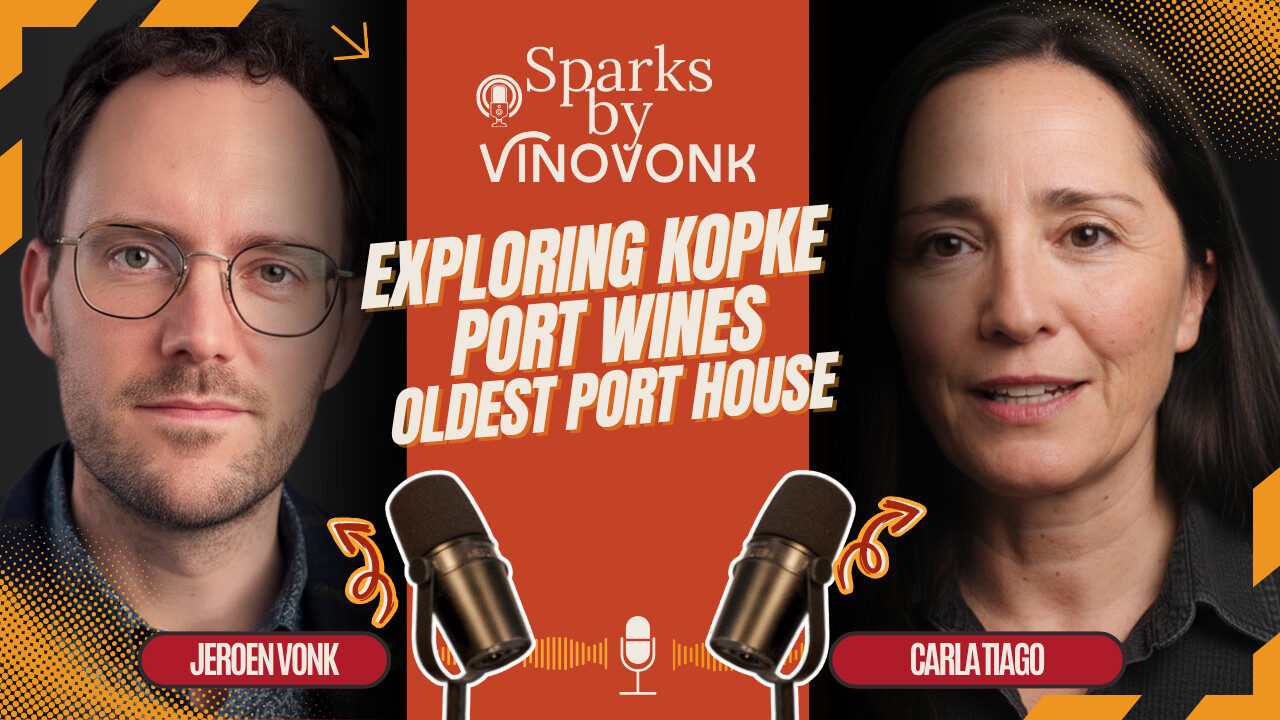
Four bottles on the table, two of them under wax. Carla Maria Dias Tiago joins from Kopke’s tasting room, shelves of bottles behind her. When I say that surely isn’t a virtual background, she laughs: “No, not at all. This is the tasting room of Kopke.”
For Sparks episode 29 I spoke to Carla, the winemaker in charge of Port at Kopke. The house was founded in 1638 and calls itself the oldest Port house. We tasted two white and two tawny Ports and talked about temperature, white Port, and why so few houses bother with Colheitas.
Recorded in English. Dutch and English subtitles available on YouTube.
Who is Carla Maria
Carla works for Sogevinus, the company behind Kopke. She did her first harvest in 2005 at Cálem, because Sogevinus did not own Kopke yet. After the Kopke purchase in 2006 she joined Kopke in 2007, starting with still wines in the Douro. She moved into Port in 2012 and has been the winemaker responsible for Port since 2022. Carlos Alves, the master blender and now director of oenology and fortified wines, is still in the tasting room with her.
She describes the job as looking after all the old wines in the cellars and making new ones for the next generation.
What sets Kopke apart, in her view, is its old tawnies and old whites. According to Carla, Kopke holds more Colheita vintages than any other house, white as well as tawny. The oldest white still in cask and still being bottled is a 1934. After that come a white and a red 1935, among others; the white is a dry Port.
Colheita or 10 Years Old
A Colheita comes from a single harvest and ages in old casks so the oxidation stays slow. By law a Colheita can be bottled after seven years; Kopke waits ten. That is why the 2014 was bottled for the first time last year.
Kopke only bottles a Colheita when a customer orders it, and prints the bottling year on the back label. The same 2014 bottled later has spent more years in cask, so every bottling is a slightly different wine. “It’s a wine that is always, always changing,” Carla says.
A 10, 20, 30, 40 or 50 Years Old is a blend across vintages. The Port Wine Institute assesses each blend, by analysis and by tasting, before it can carry the age statement. Kopke makes the blend again each year and aims to keep it as close as possible to the last one.
Which grapes go in is hard to pin down. The Douro allows more than a hundred varieties, thirty of them white, and many old parcels are field blends. Carla names Malvasia Fina, Gouveio, Viosinho, Arinto and Rabigato: varieties with the acidity and structure you need for long ageing.
Why few houses make Colheitas
“Most of the Port wine companies don’t do Colheitas, because you have to keep them for a long, long time in your cellar,” Carla says. “So it’s quite expensive. It’s like a huge project, you always have to think about the next decades.”
The wax on the two Colheitas has no technical purpose, she admits. It marks them out as premium wines and is mostly marketing. All four bottles have bar-top corks, so you need no corkscrew. I only realised that after cutting the wax off with a knife.
Serve it cool
“For all Ports, even Tawny style or even Ruby style, I always recommend to chill them,” Carla says. Port carries around 20% alcohol and roughly 100 grams of sugar per litre. Chilled, you notice less alcohol, less sugar and more acidity.
I suggested 6 to 8°C for white Port. Carla goes warmer: serve white at 12°C to drink it at 14°C, and tawny at 14°C to drink it at 16°C. A touch colder is fine, as the wine warms in the glass. She suggests trying a Port at several temperatures, and admits the old school still refuses to chill theirs.
I pour Port into a standard white wine glass, because I dislike the tiny Port glasses restaurants use. Carla agrees: a small glass leaves the wine no room to show its aromas.
Four wines tasted
1. Kopke White Colheita 2014
Paler gold than the 10 Years Old. The nose is complex, with blossom, orange and lemon peel, lime, peach, almond and a hint of cookie dough, yet it stays fresh. Carla calls the 2014 a baby: young Colheitas still show fresh and tropical fruit. 2014 was a rainy year without the usual hot Douro summer, which she says gives a more elegant, less concentrated wine. She suggests it chilled before dinner.
2. Kopke 10 Years Old White
Darker, richer and more concentrated. I get dried fruit, almond and marzipan, plus something spicy that reminds me of red chilli. On the palate it is structured and slightly grippy, almost as if there were tannin. Then the sweetness, almond and marzipan arrive, and I find it a little confusing to follow. Carla describes the house profile as honey, honeycomb, dried flowers and dried peach. She pairs it with foie gras, a salad or a curry: anything with sweetness and spice.
3. Kopke 20 Years Old Tawny
For Carla, the classic for people who love tawny and can afford it. She finds dried figs, nuts, honey, cinnamon and cloves, and says it reminds her of Christmas. To me it smells like a warm blanket by a wood fire. Carla points to the layers: warm at first, then fresher, with a light bitterness at the end. She would put it next to hard, salty cheese, well-caramelised roast meat or grilled mushrooms.
4. Kopke Colheita 2004 Tawny
More orange than the redder-brown 20 Years Old, and just as translucent. Carla finds more citrus and orange peel than in the 20 Years Old. I get bergamot and roasted almonds and hazelnuts. On the palate it is fresh, with orange peel, orange juice and an elegant bitterness. Carla says that bitterness marks a good old tawny, because it stops the sweetness from lingering. It does not taste like sugar water. It is sweet, but nowhere near as syrupy as a Pedro Ximénez or Dutch appelstroop.
Where I had doubts
I found the 10 Years Old White hard to read. A lot happens on the palate and I could not quite follow it. The wax seals look special, but Carla herself says they are mostly a marketing choice.
We also disagree on open bottles. I would finish one within two or three weeks. Carla says a well-stoppered bottle keeps for two to three months in the fridge. Prices and UK or Dutch availability did not come up. These are four bottles from one house, tasted without other Port houses alongside.
Port and tonic
Port and tonic is catching on in the Netherlands, but Carla would not use these complex, not-cheap wines for it. Kopke makes it with dry white Port, or a fine white: one third Port, two thirds tonic, ice and mint. Her own favourite garnish is orange peel; rosemary or lemon peel work too.
On the future of Port she is matter-of-fact. Younger generations have never had a Port, and at twenty she did not drink it either. Port houses need to get more people tasting, cocktails included.
Frequently asked questions
At what temperature should you drink Port? Carla recommends chilling every Port, tawny and ruby included. She serves white Port at 12°C to drink at 14°C, and tawny at 14°C to drink at 16°C.
What is the difference between a Colheita and a 10 Years Old? A Colheita comes from one harvest, stays in cask until a customer orders it, and changes with every year in wood. A 10 Years Old is a blend of several vintages with the profile of ten years in cask, made to taste as consistent as possible each year.
How long does an open bottle of Port last? According to Carla, a well-stoppered bottle of white or tawny Port keeps for two to three months in the fridge or a cool, dry place.
Which glass should you use for Port? A standard white wine glass. A small Port glass leaves the wine no room for its aromas.
The bottles
Kopke White Colheita 2014, single-harvest white Port, first bottled last year. Kopke 10 Years Old White, blend, richer, with almond and marzipan. Kopke 20 Years Old Tawny, blend with dried fig, nuts and warm spice. Kopke Colheita 2004, single-harvest tawny, more citrus and an elegant bitterness.
Kopke sent me the bottles; I received no payment and the opinions are my own.
More about Kopke
Visit kopke1638.com for the range and the Colheita vintages. Carla invites everyone to visit the cellars in Porto, Kopke’s and those of other houses.
Full transcript
Open the full transcript (English)
Taken from the episode’s English subtitles. Timestamps mark each minute of the recording; there are no speaker labels. It is here for accessibility and search.
[00:00] Welcome to Sparks by VinoVonk. I’m Jeroen, wine writer and WSET level three wine expert. And today we’re talking about Port. Port, who wants to talk about Port? Well, we want to talk about Port. Port is from Portugal and we have a very nice winemaker from Kopke. And we’re here with Carla Tiago from Sogevinus Fine Wines. They make the port of Kopke. Welcome Carla. Thank you, thank you so much for having me. And thank you very much for making time for me. You sent these four beautiful bottles, but I see in your background there are many more bottles because it’s not a virtual background. No, no, no, at all. This is the tasting room of Kopke. Perfect. And can you tell me something about who you are and what you do at the winery? Okay, so I’m one of the winemakers for Kopke.
[01:00] Kopke is the oldest port house, so it was established in 1638. And since that time, we’ve been producing wine. So all over these decades, years, many different people worked on these wines. And right now, I have the privilege to be one of them. So I’m not alone, of course. We are a great team. We work together for a long, long time and our job right now is to make sure that we are taking good care of all these old wines that we have in our cellars and making sure that we are producing new ones for the next generation. So that’s what I do. That’s tough job. How long do you work in this winery? So I started my first harvest in 2005 and at that time Sogevinus didn’t have Kopke yet, so I made this harvest for Cálem. And in 2006 when Sogevinus bought Kopke I also worked during the harvest.
[02:00] And then in 2007 they invited me to work with them. I started in Douro Valley with still wines. At that time I was working with Francisco Alves and Ricardo Marcia, who right now is responsible for all the still wines. And since 2012 I also started to work with port wines. So since 2022 I’m the winemaker responsible for the port wines. Carlos Alves is the master blender. Right now he’s our director of enology and fortifieds. So of course he’s always in the tasting room with me, but they need someone that should be more focused on the daily things, so that’s me.
[03:00] What is your philosophy of making wine at Sogevinus? So well, we have different brands, port wine brands, and each of them has its own profile. Of course, it all starts in vineyards, so all of them have different vineyards where we pick the grapes to produce these wines. We have our own estates, but at the same time we also buy grapes from different producers that work with these companies for decades and centuries. So our job is to make sure that every year we produce the best wines that we can with these grapes. So to produce a port wine, well, you have to be fast, you have to be quite precise, and you have to make sure that during all this time, and especially because the fermentations are quite short in time, you extract everything that you need.
[04:00] Basically it’s like intense and soft to make sure that the final wine is going to be perfect for decades. What makes Kopke unique among other port wine makers? Well, I think, well, of course, being the oldest one is something quite remarkable. I think one of the things that really distinguish us from others is that we are very well known for our old tawnies and old whites. So Kopke is the company that has more different years of Colheitas. And Colheitas are port wines from one single year that age in barrels. But not only tawnies, but also the whites. So we have many different wines, white wines, aging also in barrels.
[05:00] So perhaps I think that’s what makes us so special. Of course, all the other wines are beautiful, like the Ruby style, vintage. But these ones are quite unique and singular, for sure. I got two white and two tawny wines. But when we start with the white, because I think, I hope I’m correct, we start with tasting the white wines and then other varieties. What can you tell me about the key differences? Because this is a white Colheita 2014 and this is a Kopke 10 year old white port, aged in, matured in wood.
[06:00] Yeah, so these are two wines that are very different. So the first one is a Colheita. So Colheita means it’s always a wine from one single year and the year that appears on the front of the bottle is the year of the harvest. And this one, if it’s written Colheita, means that this wine has been aging in barrels. In wood, always. By a very, very, very slow oxidation. That’s what we want from these barrels. We always use very old barrels to make sure that this process is very, very slow. So the Colheita from 2014 is a wine that you can legally start bottling seven years after the harvest. In Kopke we start to do it after 10 years. So that means the first time that we bottled a 2014 wine was last year.
[07:00] So this year, we are going to bottle for the first time the 2015 White and Tawny. We do both of them every year. So these are wines that we only bottle by demand of the client, when we have a request. So that means that every time that we bottle it, it’s going to be a unique wine. So you can have a 2014 bottled last year and you can always see the year of the bottling on the back label. We always put the year of the bottling. So that way you can always know how many years it stayed in the barrel because we only put these wines in the bottle when you request, okay? So that’s the year when we put it in the bottle. So you can have a 2014 bottled last year or this year or bottled in 20 years, and it’s going to be the same wine but with 10 more years in the barrel.
[08:00] So it’s going to be different. It’s a wine that is always, always changing. The 10 years white is a blend. And in port wine, when we say that it’s a 10 years old wine, it means that it’s a wine that has a profile of a wine that has been 10 years in the barrel. And who decides that is the Institute of Port Wine, chemically and by tasting. They decide which blends that we send them can be bottled as a 10, a 20, a 30, a 40 or a 50 years old. So this blend, we do this blend every year and we have to make sure that this new blend is going to be very, very similar to the last one. So that means that we hope that every time that you taste a 10 years old white, you’ll have the same experience. So you can imagine these wines as any dynamic blends. So that’s the big difference.
[09:00] So 2014 is always going to change every time that you taste it. It’s always going to be different. A 10 years old or 20 or 30 or 40, well, we hope that you will always have the same experience. So it’s a finished wine. And this finished wine is bottled forever. And this one is only bottled when the demand is there. No, not really. We only bottle both of them when our clients request. So this doesn’t age or change, but this one changes over the years. Yes, well during a year of course the 10 years old is going to change a little bit, whether we bottle in the beginning of the year or the end of the year, but you are not going to notice it as much as the 2014. The ones that we bottle in the beginning of the year or the end of the year, the difference is not going to be huge, but in 10 years it’s going to be a big difference.
[10:00] Yeah, so this is a blend of different kinds of years and also different kinds of grapes. And this one, the 2014, is only grapes from 2014 that we harvested in 2014. But is it a single variety grape or are there different kinds of grapes inside? Well, normally, it’s different, but it’s very difficult to talk about the quantities of grapes that we use in each of the blends. Why? Well, in Douro Valley, you can use more than 100 different varieties. 30 of them are white. And then sometimes, well, we have some parcels that have only one variety, but we also have many field blends. Some of them very old and we don’t really know exactly the varieties that we have, not even the percentages of it.
[11:00] So normally when we talk about these wines we talk about the grapes that we know that we have there in more quantity like Malvasia Fina for sure. These ones that we select for aging: Gouveio, Viosinho, Arinto, Rabigato. So normally grapes that give you plenty of acidity and structure. That’s what you need in a wine if you want to age it for a long time. So it’s very difficult to understand, but how is the terroir expression different between these kinds of wines, between these two? Yeah, so when we think about how we are going to make these wines, we always think, well, 10 years old is a wine that is going to be ready quite fast.
[12:00] So 10 years, more or less. When we think about a Colheita, well, this is going to be a wine that will age for decades, we hope, in barrels. Normally we are going to use grapes from the highest places where you can have better acidity and freshness, but at the same time a good concentration. And sometimes to make the perfect blend for that year, we use grapes from the highest places exactly for the freshness and acidity and some of them from the lowest ones so you can have some concentration. All these things are, I think, before the harvest. We make these different wines separately and in the end, before we decide the final blend to age, we do this blend with different wines.
[13:00] So all the fermentation is made with skins so we can extract everything, all the flavors. And the fermentation takes place between four and five days and after that we press it, we add the spirit to make sure we stop the fermentation and these wines are going to rest during the winter in Douro and only after that we start to bring them to Vila Nova de Gaia where they are going to age. And I saw these two wines and the closing was different because one has a wax capsule. So I thought, okay, will I use a corkscrew?
[14:00] I thought, okay, do I need something to take the cork out? All of them have bar tops. Yeah, because I started with this one and I thought, okay, it’s simple. I thought, okay, I’ll use a knife. I managed to take it out, so I opened the wax and I opened it. But how do people know? Why do you use the wax on it? Well, normally we use the wax when it’s a more premium wine. And the truth is that for us, Colheitas are quite precious. And most of the port wine companies don’t do Colheitas because you have to keep them for a long, long time in your cellar.
[15:00] So it’s quite expensive. It’s like a huge project, you know, you always have to think about the next decades. But Kopke always did that. When we started in this company and we started to see all these old, old wines, we knew that we wanted to make sure that we were going to continue that. So every year we select wines which is a Colheita Tawny or a Colheita White. To distinguish them because they are Colheitas, both of them use wax. So that’s why. Perhaps it’s like a style thing more than, it’s not scientific. It doesn’t have like a scientific purpose. It’s more a marketing one, for sure. And when people see, okay, we’re drinking four different kinds of port wines, when do people have to decide, okay, I want to choose this one or this one or this one?
[16:00] How can people decide which one they want? Well, I think to begin, they have to taste all of them. So only after that you can decide what you want to have. But one of the things that we always try to challenge people is like, try them. And yes, they are great solo like at the end of the day, after a meal, even during desserts. They are sweet ones for sure. But they also have one thing that I think is quite special in Kopke: after you drink it, you don’t feel the sweetness in your mouth. You feel more freshness, because the acidity and the sweetness is very well balanced. So we always challenge people to, well, try it with food.
[17:00] Why not? You have to find different times, different moments to have this kind of wines. And the truth is that when people start to try them with different things, they really appreciate them. You are not going to drink port wine every day with your meal, of course, but once in a while, I think you can have great, great experiences. So the 2014, if you taste it, you still feel the fruitiness of it. So it’s quite fresh. Compared with the 10 years old, it seems much younger than the 10 years old. And the reason is because, well, this 2014 is still a baby. So it’s in the beginning of all this aging process. And the 10 years old is already a finished wine. So it’s a blend. And Kopke has had this profile of blends.
[18:00] So this 10, 20, 30, 40, and right now the 50 years old. They were created not a long time ago, but when they were created, the profile was already thought out. So it’s like a wine where you can find the honey, the honeycomb flavors, some dry flowers, some peach, dried peach. So this is the kind of wine that has all the things that you are expecting in a wine that aged for 10 years in the barrels. This 2014 or if you try right now the 2015, they are very, very young. They still show much of the fresh fruit, some tropical fruit too. So perhaps you could have them at different times like the 2014 perhaps at the end of the day, chilled before dinner, and the 10 years old you can have it like with a starter like foie gras
[19:00] or even with a salad, so something that has sweetness and spiciness normally works very well, like a curry, something like that. So for these kinds of wines, the trick is to identify the moment to drink them. You first have to taste them. That’s for sure. Yeah, I’m very excited to taste. Before we’re going to taste, you said you also make wines of 50 years old? Wow, that’s very old. Yes it is and right now we also have a very, very old port, it’s more than 80 years old. Kopke has very many different wines that are aging for decades in our cellars.
[20:00] So to have an idea, the oldest white that we have in barrel that we are still bottling is a 1934 and then we have the ‘35 white and red. The ‘35 white is a dry port so it’s quite amazing, very elegant, it’s beautiful. We have the ‘37, the ‘38, we have the ‘40, ‘41, we have the ‘50, ‘51, ‘52, ‘53, a very, very small amount, ‘57, ‘58, well, and so on. So, Kopke always had these beautiful wines that are aging in barrel separately, with different identities, so it’s amazing. So you’re not only a winemaker but also a wine keeper, a wine guardian, because you want to keep them in the perfect conditions. So you’re like a wine bodyguard also, and the bodyguard of the heritage and history.
[21:00] Yes, that’s one of our main jobs, to make sure that we are really taking care, taking good care of these wines. And every time that you make a new blend of 10, 20, 30, 40 or 50 years old, you have to make sure that you are leaving wines so in the next year you can reproduce something very similar to the one that you are doing. So in Kopke you have a whole range of different ports that you can taste. Perfect. And when we taste, because we already discussed what kind of glasses do you use, I have some standard white wine glasses. Because in restaurants you have these very tiny glasses. I don’t like them. So your opinion is just use white wine glasses. Yes, I think it’s the perfect choice because those small ones normally don’t give you space to smell and to have the proper experience.
[22:00] You need some space so your wine can show all the flavors that they have. So these ones are great. And you know, for all ports, even for Tawny style or even Ruby style, I always recommend to chill them. These are wines that have 20% of alcohol. They have around 100 grams of sugar per liter. So when you chill them you are going to feel less the alcohol, you are going to feel less the sugar and more the acidity. So everything is going to be more balanced. That’s the perfect way to have them.
[23:00] And if you look at the color, the 2014 is much lighter than the 10-year-old. Yes, normally when they are younger, the 2014 has this golden color but the 2014 is a little bit lighter than the 10 years old, always. When you go for the 20, normally the color is much more similar than in this case. And the smell is very complex, full of aromas, like perfume, blossom, orange peel, but also a lot of lemon peel, lime. If you smell very well, also a lot of peach, almond, like a bit of cookie dough.
[24:00] But it’s very complex, it’s a lot of dry fruit, but it’s fresh also at the same time. Normally you have dry, sweet, but not a lot of freshness. Yes, that’s one of the things that we always try to put in this one. So we want them very complex but at the same time fresh. So you can drink it, you feel the sweetness in the beginning but then in the end it seems like all your mouth is very, very fresh and you want to continue to drink. Of course you have to be careful, okay? They have 20% of alcohol but well, sometimes people say, “I don’t like port wine, it’s boring, it’s sweet.” Well, it’s not boring at all. And the sweetness, of course, it’s a sweet wine, but you have to look for the ones that are more balanced, that have this acidity that makes your mouth…
[25:00] How do you say in English? I’m not sure. But, well, basically you want to keep drinking without it being heavy or full or boring. It fills your mouth, but also refreshes your mouth a lot. Because the freshness is there, there’s a lot of acidity. How a lot of people know port is just you have a bottle in your cupboard, staying there for a couple of weeks, maybe some months. Drink it too warm, but you have to chill it and drink it fresh. Open it up and don’t drink it all in one time, maybe over two or three weeks, but not longer. You know, for these ones that are already oxidized, okay? So the oxidation here is very slow and that’s what permits us to have all these different layers of flavors.
[26:00] After you open it, what you can do is cork it very well, put it in the fridge or in a very cold and dry place. You can have it for 2-3 months without any kind of problem. That’s one of the great things about these wines. You can keep it. That’s why they have this bar top cork. It means that you can open it, you can cork it and you can keep it for some months without any kind of problem. You can have only a little bit every night before going to sleep and to relax. That’s at the end of your meal or at the start because when I smelled it I thought, okay, this could also be very nice with oysters or with some shellfish or mussels but not too heavily cooked
[27:00] and not too many flavors to freshen it up. So you can also start with these kind of wines. Yeah, something salty normally goes very well. Even like, you know, Sherry, Sherry has these salty wines that normally they have with jamon and even white port wine goes very well with that kind of thing. So salty things, spicy things, I think it’s always a good pairing. Yeah, Port and Sherry are not so different in that kind of way in food pairing. Yes, in fruit pairing I think most of the things are quite different but the truth is that you can have equal pairings. They have some things that touch each other that normally work very well.
[28:00] I love it very much. It’s very fresh, it’s sweet, but it’s also very complex, but it’s very youthful. It’s, well, we’re now in 2025, so it’s 11 years old, but it still feels very light and fresh, youthful. It’s very nice. I’m very curious about this one because this one is, okay, it’s 10 years old, but it’s much darker. Yes? And when you smell it, it’s much richer, more concentrated, more dried fruit, more like almonds, marzipan. Yes, yes, much more, much more of that and you can have that in the 2014 but here it’s more concentrated. It seems like you have it in more quantity. So this is the profile of our 10 years old. So here you start to have all the things that are expected in this kind of wine.
[29:00] So when you go for the 20 years old, it’s going to be a little bit more concentrated than this one and you start also to have more spiciness in it and more orange peel. After 20 years in the 30s it’s very, very common. So even the sweetness in the nose starts to disappear. It’s like more spiciness that you are going to find. Of course the sweetness in the mouth is still there but in the nose it’s not so obvious. I want to taste. I forgot it in the other glass, but salute, prost, cheers. In Portuguese it’s saúde and prost in your language.
[30:00] There’s also something spicy in it, like red chili peppers. Yes, and when you put it in the mouth it’s a little bit more full-bodied than the previous one. You know, 2014 was also a very rainy year. During the winter, even during the summer you didn’t have these hot summers that are so common in Douro Valley. So it was not a typical year. So even the wines are more elegant, they are not so concentrated. And you can find that in this Colheita. So 2014 was not this concentrated year, instead of that, we have more elegant wines. And that’s also very, very interesting to find in ports. So of course the aging is going to give them all the complexity.
[31:00] But the wine where you start is very, very important to understand all the things that will happen during the aging. I mean, because this one is very… So, that’s the last one, the 10-year-old white matured in wood. It’s much more structured. It’s a little bit grippy, also a little bit like tannins. But I thought, okay, they’re not tannins because it’s white, but in your mouth, it’s like there’s a lot happening. And also a lot of red chili peppers, but also jalapeño but it’s not too spicy because then the sweetness kicks in and the almonds and the marzipan and then you feel like a little bit of dancing in your mouth and you think okay, it’s a little bit confusing but what’s happening and yeah…
[32:00] You know, one of the things that I think is quite exciting in this kind of port is that all of them are different. Every time that you taste it, you are going to feel different things because you have so many different layers of flavors and even things to taste that you really need time. You need to sit down, enjoy and well, thinking good things normally helps and at the same time you are going to feel different kinds of things. And the complexity with time, with aging, is going to increase. Always. So when you buy these bottles you can still forget them and leave them for a while. Yes, you know, when we bottle these wines, the tawny, the white aged in the barrels,
[33:00] when we bottle them, they are ready to drink. So normally people, when you buy a vintage, you normally buy it and you forget it. And it’s going to age in the bottle. It’s the only port that we do in style, Vintage, to age, to really age in the bottle. The other ones, when we put them in the bottles, they are ready to drink. But you can keep them, of course. Of course, they are going to change in the bottle because until the time that we bottle it, they were in barrels, so they were having this very micro-oxidation through the wood. When you put them in the bottles, well, they are going to be in a different kind of environment. So they are going to change. And you can keep it as long as you want. Of course, when you open them after we bottle them, perhaps you are going to feel more the freshness.
[34:00] If you keep them for a few months or even years, you should always make them breathe before you drink it. Not like a vintage, okay? Because if they are in a bottle, completely closed, after a while you should aerate them because it’s an oxidized wine. People sometimes think no, because it’s already oxidized wine, but if you keep it for a long time in a bottle you should also decant it. But you can keep it, no problem. These kinds of wines always have this guarantee. Of course sometimes they are going to appear better, others worse, but they are always going to be good. Yeah, you can keep them, but please don’t just buy them later because then you have to freshen them up and aerate them. Yes, yes, I think that’s what normally we advise, but well, if you want to buy them and keep them, you can do it.
[35:00] But we are always bottling them. If you request us, we are going to bottle it for you. I think you should have them fresh. Yeah, and it always says on the label when it’s bottled. Yes, yes, you can always see it. Don’t worry. Okay, okay, don’t worry. Who’s at the door? Hi. Sorry, I’m in a meeting. Ah, English? I’m sorry, I’m recording a podcast now. Oh, that’s okay. Thank you, bye bye. Okay, bye. I’m sorry.
[36:00] No, don’t worry. It’s good. Somebody asking for money. I don’t know. Yeah, I don’t know why, but I’m recording, working. Shall we continue with the other wines in the same glasses? Oh yes you can do it in the same way. I’ve already put mine in others but you can continue in the same, no problem. So from the white to the tawny ones. I already have mine. You’re very well prepared. Look at this color. Yes, in this one we are going to start with the 20 years old and then we’ll go for the Colheita. Why? Because well, in the whites the 2014 was very, very young so if we started with the 10 years old which is more complex at this time,
[37:00] we wouldn’t appreciate the Colheita as we should, okay? So normally we start always with the simpler one and go for the more complex one. In this case, well, I think the 2004 and 20 years old, they are more or less at the same level. And the older they get, like if you go for the 30s, and we have a Colheita from the 90s and the 30s old, they should be at the same level. But when we go for the 40s, well, I’m pretty sure that the Colheita will be much more complex than the 40 years old. So one of the things that we have to do when we taste is try to understand which of them is more complex.
[38:00] So here, and I tasted them before, and I think the 2004 is quite brilliant at this point. So I think we should try first the 20 years old. So 20 years old is a classic for people that really enjoy good tawnies and can afford it and it’s not so expensive. I think 20 years old is one that you should always keep in your fridge. It’s the kind of wine that has all these different things that always remind us of a place that we love. I’m not sure why, perhaps because it reminds us of Christmas, our home. It has all these very cozy flavors like all the dried fruits, dried figs, the nuts, some honey, some… but at same time some cinnamon, some cloves.
[39:00] So I think it has everything that reminds us of some good moments. And then when you taste it, because in the nose it’s quite sweet, but in the mouth it’s going to show this beautiful freshness and a little bit of bitterness in the end that helps us to discover all the different layers. And I think that’s what makes this wine so beautiful. Yeah, it smells like a warm blanket over yourself. Put some fire, some wood in the fire. But also a lot of spiciness. But then in the mouth it’s explosive.
[40:00] Oh, it’s very different from the white ones, but it has the same identity, like the same spiciness, but this one has more of the warm spices like cardamom, cinnamon, and it’s very warm and cozy. It’s still fresh. I have a lot of strawberry. Yeah, for a long time. After tasting you have different layers. In the beginning it’s more warm and then it becomes fresher, a little bit of bitterness that appears in the end. And a little bit plums also, but the fresh plums, not the dried plums. And then you have some dried figs, right. Dried lemon, but also some dried cherries also.
[41:00] And it’s very complex, yeah, it’s very nice to drink standalone, but I think, okay, where’s the cheese? Where’s my dessert? Like with hard cheeses, you know? And salty ones. I think it goes very well. Or even with roasted meat. With roasted meat? Like caramelized, you know, the ones that are really crunchy meat, I don’t know how to say this in English, I’m sorry, but when you have this roasted meat very caramelized you know, sometimes with some dried plums or even… I think it goes very, very well. You should try it.
[42:00] Also I think mushrooms, different kinds of mushrooms and you grill them and yeah, the salty flavors, umami flavors. And also the colors because we don’t forget the colors. If you’re only listening to this, go and watch the video. In this one, the 20 years old has this more red-brown color. In the other one, it’s a little bit more orange, but at this point they have almost the same intensity and the same tone. But they are very see-through. They’re not as thick as a lot of people know port. They think, okay, it’s ruby red, thick, you can’t see through, and it’s full of red fruit flavors in your nose, it’s full and full and sweet.
[43:00] This is very complex, very sophisticated. If you want to try something more sophisticated, you have to try this one. Yes, so the different styles. So when we talk about Ruby style, it’s for people that… it’s quite easy to recognize all the flavors that you have in a Ruby, especially when it’s young. After a while, especially Vintage, after some years and decades in the bottle, it will become much more complex. But in the beginning, it’s quite easier to discover, to understand what you have there. All these red and blackberries, the acidity, even some orange peels, sometimes some eucalyptus, some mint. They are quite present when they are young.
[44:00] And I think these are the kinds of flavors that we are used to recognizing easily. In the Tawny style, sometimes it’s more difficult because we are not used to distinguishing the different spices. Even when you cook, and if you cook with different spices, well, sometimes it’s easier. But even though sometimes you are always like, well, this smells like something that I really recognize, that I know that I’ve already smelled before, but I don’t know the name of it. So sometimes we need more time to understand this kind of wine. Yeah, I totally agree. But again, the same identity, very complex, but the spiciness and the fruitiness is there. A little bit less of the freshness, but when you swirl your glass, the freshness is there.
[45:00] It’s very fresh. And in this one you have more citric flavor, like orange peel. It’s much more present than in the other one. The other one seems like a little bit more warm wine, in the nose. This one, you go more for the citric flavors. Yeah, and for people who aren’t watching this, Colheita 2004, we’re smelling now and we’re going to taste it. But it also has a lot of bergamot, also a lot of almonds, hazelnuts, but also roasted almonds and roasted hazelnuts. Both of them, it’s very complex and it’s very lovely to smell. I want to taste it. Let’s taste it.
[46:00] It’s very fresh. It is like… The acidity is more present than the other one, than the Colheita, but it’s very gentle and elegant and the fruit flavors are more present than in the Colheita. And this is more round and elegant and also a lot of orange peel, but orange juice also. And the sweetness and the sour. But also a lot of, yeah, I don’t want to call it bitterness, but it has… Yeah. It’s like something… and I really think that these old tawnies, when they are really, really good, when they have high complexity, normally they show this little, this very elegant bitterness in the end
[47:00] that normally doesn’t leave you the sweetness in the mouth, but this bitterness, this freshness, this plenty of different things that change every time that we try them. Yeah, it doesn’t feel like you’re drinking a lot of sugar water. It’s not like you’re in a sugar rush. It’s like a very complex wine. Its thickness, of course, it’s sweet, but it’s not over-sweetened. It’s not like a Pedro Ximénez where it’s a lot of sugar and it’s like, yeah, like in Dutch we say, appelstroop, apple syrup. Yeah, yeah. I understand what you say. Exactly.
[48:00] It has this sweetness, and it has all this, also it’s quite creamy, but at the same time it has this freshness at the end, this acidity that almost explodes in your mouth. It’s different. And I think most of the people when we talk about port wine, they are not expecting this kind of experience. And after you try them, especially these more complex ones, then you start to understand that, well, port is much more than sugar and alcohol. No, there are so many different things that you can find in this wine. You can drink it all day, all your meal with lunch or with your dinner. But to make it not too complex for people, the white ones you can serve chilled, like between six or eight degrees Celsius.
[49:00] I would try even less, like you can serve it at 12 to drink it at 14. I think it’s the perfect temperature. And this one, you can serve it at 14 to drink it at 16. But even if it’s a little bit less, it’s better because after sitting for a while in the glass, the temperature goes higher. So even if you put them in the fridge, take them out, put it in a glass, after a while, like five minutes after, they are perfect to drink. And one challenge is to try them at different temperatures and see at which temperature you really enjoy it better. The truth is that I normally prefer them chilled but well, the old school people always say, well no, I don’t chill my ports, but well, try them. I think a little bit less temperature, they are going to be much more balanced and lighter.
[50:00] Those are all good tips. And the last thing I heard a lot from my friends Nadine and Jan-Jaap from… they have a very famous podcast in the Netherlands, Le Club de Vin, and so many other podcasts. They always say, okay, port and tonic. It’s the new thing, port and tonic. But what kind of port do you use in a port and tonic? So normally we don’t use these kinds of ports because I think these are very complex, not very cheap. Normally, if you come to Porto, if you come to our cellars, we would offer you a port and tonic. And normally we do it with a dry port that is not so sweet. You can use a fine white too, but normally you use a dry port.
[51:00] We use like one third of dry port, two thirds of tonic water. We put some ice, some leaves of mint. I really love it with orange peel but you can also use rosemary, a lemon peel. So there are many different kinds of things and normally we challenge people like, well, how do you like your gin and tonic? This one you can put here whatever you want also and try different things. With rosemary is very good, with mint is very good, orange peel for me is my favorite. So try them and then tell me which one do you really prefer? I will let you know. Because port is not a new kind of drink. It has been here for ages.
[52:00] But what do you think for the future of port? Well, I think one of the things that we as port wine houses have to do, all of us, is to show more what we have. You know, I think we were used to, well, everybody around the world knows port. We already had our clients, but these clients are changing. And the truth is that these new generations never had a port before. So what we have to do is show them. Sometimes it’s easier using cocktails, of course. And I think most of these wines can be used in cocktails from the Ruby style, even Tawny style, for different kinds of things. But I really think that when people start to drink these wines with time, because we all were young, and when I was like 20 years old, I was not drinking port wine, it’s true.
[53:00] But when I came to my 30s and I started to, of course, well, I started to work in this business too, so it was easier. But I started to see people in their 30s when you start to really enjoy what you are drinking. If you have the chance to start to really taste these great ports, I think this is what we have to do. We have to show them more. We have to go to the street and make them try them. Please try them. I think you are going to like it. And I think with time and with work, I think we are going to accomplish showing these wines to everybody. I hope so. Yeah, thank you very much. You really have to explore more in the world of port, because it’s not only the typical red kind of port that you know that is only sweet.
[54:00] There’s a lot more to discover and explore. Carla, thank you very much for your time. Thank you and the only thing that I really want to say before I say goodbye is if you come to Porto, well, you have plenty of different houses to visit. We have Kopke of course, please come and visit us, but there are many others and I think take a chance, please. And I hope that next time you come to Porto I hope you come and visit us. We’d love to receive you here in Douro Valley. It’s a beautiful city and beautiful landscape in Douro, so please come and see us. Thank you very much. I really enjoyed this conversation, this chat, this tasting. Thank you very much for your time. This was another episode of Sparks by VinoVonk. Join us in the next episode where we explore more different kinds of wines, spirits or innovative drinks.
[55:00] Maybe port isn’t your kind of thing, but try it. Go to your wine shop, explore something new and explore it on the website. I will write an article on it. Go to vinovonk.com, in the show notes, everything. Go visit Kopke when you are exploring Porto or Portugal. Carla, thank you very much for your time. Thank you. Thank you. Thank you for everything. It was great. See you, hopefully, here in Porto. Saúde!
Listen
Watch