

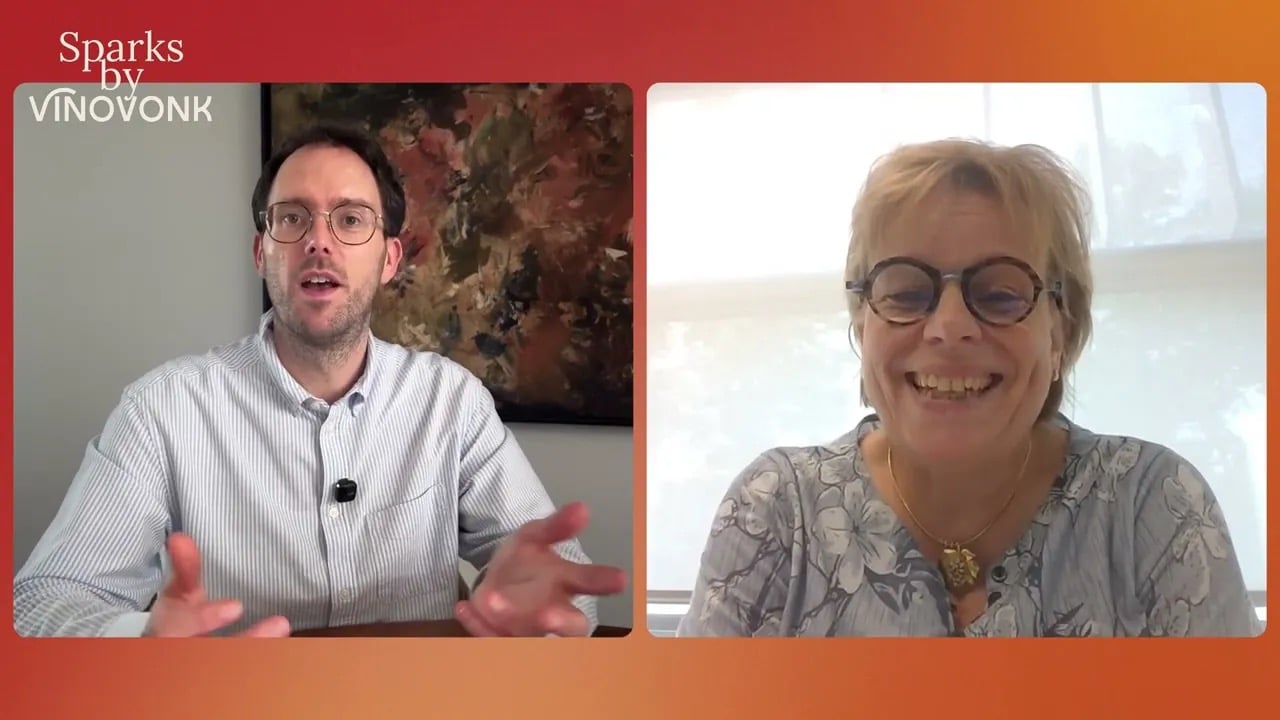
I took the Comité Champagne’s Champagne Specialist Course with Anja Vondenhoff over three Sundays in Amsterdam. Two things stayed with me: eight or nine champagnes on the table every class, and a bottle from a very famous brand that cost as much as four others I found more exciting. Anja teaches the course in the Netherlands, in English.
For Sparks episode 13 she joined me to explain how the course is built, what changed with champagne.education, and why pricier champagne is not always the better one.
Who is Anja Vondenhoff
Anja lives in the eastern Netherlands and teaches across multiple wine-education institutions:
- WSET Diploma: sparkling wine unit
- Wijnacademie: Vinologenopleiding (upcoming)
- Comité Champagne: Champagne Specialist Course (level 4) in the Netherlands, in English
She also has Wijncampus, the website where I found the Champagne Specialist Course. I ended up there thanks to Janja Altenburg, one of Anja’s former students, who told me on Instagram: if you want to do something with champagne, go to Anja.
How the Champagne Specialist Course is structured
According to Anja the course has been completely renewed. There are now four levels, each harder than the last:
- Levels 1, 2, 3: free online at champagne.education (note: not .com)
- Level 4 (Champagne Specialist): in a classroom with Anja, taught in English in the Netherlands
When I signed up, the first thing I got was a link: seven hours of preparation through the online courses. They cost nothing, so anyone in the world can do levels 1 to 3. Anja all but insists that everyone starting level 4 has finished that theory first.
“You only learn if the people around you in the course have the same level of knowledge already. So for me it’s almost mandatory that all students who enter the course have done the theoretical part already. So we get that out of the way, and we can focus on the tasting.” (Anja Vondenhoff)
Why eight or nine champagnes per class
The course I took had a minimum of four champagnes per class, across three classes. Anja finds that too few. We had eight or nine a day, and that is the number she aims for.
Her first argument is the travelling. In my edition a student flew in from Dubai every Sunday, and Anja reckons it would have been cheaper to send her four bottles. Others drove in from Groningen and Maastricht.
The second is comparison. At home you might open two bottles. In class you open more, one after the other, and keep comparing them for ten minutes or so, which is where Anja says the learning happens. Four bottles you can taste at home.
The exam
I thought champagne had three grapes: Pinot Meunier, Pinot Noir and Chardonnay. There are seven, and the exam expects you to know all of them. It is an official exam in three parts:
- Multiple choice: mostly history, according to Anja
- Open-style questions: where you show what you have taken in
- Tasting exam: tasting and assessing champagnes
The papers are marked in Épernay, and if you pass you receive a certificate. I found it a hard, complex exam.
Anja prefers the open-style questions. In her view the tasting and the open questions are where you can show how much you know and how much you have learned. The multiple choice is simply part of the deal.
Cellaring champagne
I had always been taught to buy champagne and drink it straight away, vintage aside. The course taught me otherwise. A champagne that spent two years on its lees is better left for another two years after you buy it. It keeps developing, matures and becomes rounder.
Anja had us taste a young and a matured wine side by side, and the difference was striking. As she points out, you only get that experience at home if you keep bottles for the same length of time.
Pricier is not always better
One bottle in class came from a very famous brand. I thought it was good, but it cost as much as four other bottles, and I would rather buy those four because they excited me more. So why is that one so expensive? Anja points to marketing:
“People sometimes wear expensive clothing, but the fabric itself is not very expensive. And the same thing is about any other wine, I would say, maybe a little bit more true for champagne, since there’s a big marketing aspect involved within the champagne business.” (Anja Vondenhoff)
What the course gives you, she says, is the chance to taste all these wines next to each other.
Champagne and food
For every wine I had to work out what food it would go with, and why. Everyone thinks champagne means oysters. We did a tasting with sushi, cucumber, soy sauce and ginger. Same champagne, completely different taste. I had never experienced differences that big.
Anja explains it with thresholds. Every champagne has flavours you only pick up once their intensity crosses a certain threshold. Eat something with the same flavour, such as soy sauce, and the umami of the food adds up with the umami in the champagne. Without that food you would not notice how many flavours the champagne carries. She adds that pairing with food that does not obviously suit a champagne can also work well.
Who the course is for
Anja usually gets a mix:
- People who sell champagne, and importers
- Sommeliers and people working in restaurants or wine bars
- Consumers with a taste for champagne or a more professional approach to it
The sellers bring knowledge about importing and trends, the consumers about their own preferences. Our group included consumers without any wine education, and as far as I know everyone passed. Anja’s explanation: those students may have arrived less prepared on theory, but they had already tasted a lot of champagne.
Do not underestimate the level. Anja puts the tasting standard at WSET Diploma level. Her feedback forms show that people sometimes think they have written a good tasting note when it is incomplete or illogical. Her tip: read the course booklet, around a hundred pages, a few times before you start. It is thin but very dense.
October 2025 edition
At the time of recording, the next edition was planned from October 2025: four Monday evenings from 19:15 to 22:00, plus two online sessions on food pairing and on new vinification techniques. Check wijncampus.nl for current dates.
Location: HHS, the hotel school in Amsterdam, which has a fully equipped tasting room. Free parking five minutes’ walk away, or a few euros to park under the building. Parking at the previous venue was difficult and expensive.
Availability: about six places at the time of recording.
Caveats
I am one of Anja’s former students and enthusiastic about her course. So this is a satisfied participant talking to the teacher, not a comparison with other champagne courses. The price of level 4 did not come up in the conversation.
Frequently asked questions
What is the difference between the online courses and level 4? Levels 1, 2 and 3 are online at champagne.education and free for anyone worldwide. Level 4 (Champagne Specialist) is taught in a group, with the focus on tasting and discussing together. Anja expects you to have completed the online levels first.
How many grape varieties are allowed in champagne? Seven: Pinot Noir, Pinot Meunier, Chardonnay, Pinot Blanc, Pinot Gris, Arbane and Petit Meslier. The first three are the best known, but the exam expects you to know all seven.
What is “effervescence”? The term on the tasting form for the bubbles in champagne. As a Dutch speaker I knew it as “mousse”.
Is the course suitable for consumers with no wine background? According to Anja, yes, if you are motivated, have passed online levels 1, 2 and 3 and have already tasted plenty of champagne. Expect a tasting standard that belongs to the WSET Diploma, though.
More about Anja Vondenhoff and Wijncampus
Visit wijncampus.nl for the Champagne Specialist Course and other wine courses. For the free online levels of the Comité Champagne: champagne.education. Course questions? Direct contact via Wijncampus.
Transcript
The full conversation with Anja Vondenhoff, recorded in English.
Show full transcript
This transcript is generated automatically from the audio and has not been edited. Speech recognition makes mistakes, so treat wording as an approximation rather than a verbatim quote. It is here for accessibility and search.
Hello everyone, welcome to a new episode of Sparks by VinoVonk. My name is Jeroen and today we’re going to talk about champagne. What again, champagne? Yes, but this time about the Champagne Specialist course that I did with Anja Vondenhoff and I’m very glad Anja made some time for me to talk about it. Anja, welcome.
Thank you very much, Jeroen. And thanks again for giving me the opportunity to share my story, but also your story about the Champagne Specialist course. The Champagne Specialist course was like this booklet, “Understanding and Recommending Champagne.” But first of all, Anja, for the people that don’t know you, who are you and what do you do? Well, like you said, Jeroen, my name is Anja Vondenhoff. I live in the Netherlands, eastern part of the Netherlands.
What do I do? I teach the sparkling wine unit of the WSET Diploma course. I teach in the future the Wijnacademie, Vinologenopleiding. And obviously I teach the Champagne Specialist course as well for the Netherlands. in English language and that’s why we are speaking English right now, right?
Yeah, that’s a good one because we both speak Dutch, but the course is in English and to attract more people to the course because, spoiler alert, you will give the course again. So hopefully people will get very enthusiastic like I am about the course and want to follow it also. In my view, for me, you are the champagne specialist in the Netherlands. One of your students who did also the Champagne Specialist course, Janja Altenburg, someone on Instagram told me, oh yeah, if you want to do something with champagne, go to Anja, she’s the best. I thought, okay, I found it on your website, wijncampus.nl, I will link it in the show notes.
And I thought, oh, this is one I want to do. It was on a Sunday in Amsterdam, close to me. Well, I’m going to do it. Then you sent me a link. Well, first you have to do seven hours of preparation.
What? Seven hours of… drink a lot of champagne? No, you have to do online preparation with the online courses. Now they are at champagne.education.
And then I found out… that the course is from the Champagne Committee. Could you tell something about the course? Sure. Well, the course basically is totally renewed.
We have now an online level one, two and three course at champagne.education. So not dot com or anything. So it’s champagne.education where you have to prepare yourself on level one, two and three nowadays. And I teach level four. So that will be the Champagne Specialist course.
So that is how it’s structured. Obviously, the level of difficulty increases with each level, especially during the level four course, the Champagne Specialist course, is the course where we focus on the tasting aspect of champagne. So obviously, we also discuss the theoretical parts and the latest details and the latest news of the Champagne region. But we focus during the class especially on the tasting part I would say which is for me the logical reason why students would come and join the course actually. I think a lot of people feel that the theoretical part they can do at home, they can study at their own pace but for the tasting it’s very pleasant to just have several people around you of the same level as yourself.
To have the discussion about the flavors of champagne with. So that’s what we do during the course, yes. And an eye-opener for me was that the preparation you had to do is totally for free. So everybody in the whole world can do the level one, two, and three at champagne.education. And you learn so much about history, about different kinds of makers of champagne.
You have the big houses. You have the grower champagnes and everything in between. It’s fascinating to learn so much. Yeah, well, I always have really enthusiastic students. But the thing is that, you see, you only learn if the people around you in the course have the same level of knowledge already.
So that’s why for me it’s almost mandatory to demand, basically, that all students who enter the course have done the theoretical part already. So we get that out of the way, and we can focus on the tasting. Yeah, because during the course you taste several champagnes. The course that you do is a minimum of four champagnes every class and you have three classes. But you personally don’t like the minimum.
You want to learn how to taste more. Four for me is definitely not… You see, we had people come and drive for a long, long time. Well, you know, you were in the course, we had a student from Dubai flying in every Sunday. I think it would have been cheaper if I would have sent her four bottles to Dubai.
So no, for me it’s definitely a no-go to just taste four wines. In four or five hours on a Sunday. So I think we tasted about nine or something, eight or nine in a course per day. And I think that is the number I’m aiming for. Yeah, it should be worthwhile for you to come drive the distance and not just four.
Yeah, that’s not enough. And what was an eye-opener for me was that I thought, okay, champagne, you have three grapes, Pinot Meunier, Pinot Noir, and Chardonnay, and then, no, there are seven grapes. You have to know them all because you have an exam, an official exam with multiple choice, open questions, tasting exam. It’s very, very hard, very complex. Yeah, it’s a complete exam.
Yeah, you have to be a specialist in parts of the champagne business, selling, tasting, theory. Yeah. And my personal preference basically is the open-style questions. I think the multiple choice is very much about the history and, well, okay. Okay.
That’s just part of the deal. But the tasting and the open-style questions is a part where you can really show how much you really know and how much you really learned, I would say. So then once you’ve done and taken the exam, the exam questions are being checked in Épernay and they will then reward you with a certificate if you pass the course, which you did. You get your certificate very soon. Yeah.
Yeah. Then I will hang it next to… Yeah, I’m very proud that I made it. But is it only for wine professionals or also for serious consumers? I would say it’s both.
It’s for those who sell champagne, importers, it’s for people who work in a wine bar or restaurant, for sommeliers, and for consumers as well who obviously have a taste for champagne or who like to have more of a professional approach towards champagne. So usually we have a mix of sellers, importers and regular consumers. And that’s very good because those who sell, always bring extra knowledge about the importing part and the latest trends. Those who consume, they give us information about their personal preferences and how they have evolved in the tasting part. So we all learn a little bit from each other.
But tasting is the main part of the course. Yeah, yeah. And for the tasting part, for me, the most interesting part was that I always learned if you buy champagne, buy it and drink it straight away because you can’t store it too long, except for a vintage champagne. That’s a champagne made from grapes from one year. You can store it and it will get better.
But during the course, you learned. Us by tasting that if you have a champagne and it was aged on the lees for like two years, when you buy it, you have to wait two more years because then you get a better evolution of the wine, it evolves better and matures better and gets more round and I thought really and you showed us with a new wine and matured wine and it was such a difference. Yeah, people they know. And I think that is something that you can really experience during a course. And as long as you don’t keep the bottles at home for the same period of time, you will never get that experience.
And I think it’s one of the most fun things to do as a teacher, that you can just surprise people when you’re in the tasting part of a course. For sure. Yeah, that’s all part of the deal. What I found out was that the more expensive champagne isn’t always a better champagne. And that was very interesting.
We had one bottle that was a very famous brand. And I thought, yeah, it’s good, but it was the same price as four other bottles. Well, I’m going to buy these four bottles that excite me more. Than one expensive bottle and that is also about learning and learning, okay, but why does it make it so expensive? Yeah, you see, Jeroen, sometimes it’s all about marketing, you know, people sometimes wear expensive clothing, but the fabric itself is not very expensive.
And the same thing is about any other wine, I would say, maybe a little bit more true so for champagne, since there’s a big marketing aspect involved within the champagne business. But yeah, you see, and the good thing is that during a course you get the option to just taste all these wines next to each other. You don’t, you know, at home you would be maybe tempted to open two bottles. But I would say it’s just about opening more bottles one after the other and keep comparing them for like 10 minutes where you gain a lot of knowledge. More than drinking actually, or more than just comparing two or three.
So a certain number of champagnes and comparing them is necessary obviously. So that’s one of the reasons I don’t think four is enough. No, four, you can do it at home. Another very learning aspect for me or where I learned very much from was that with every wine you have to okay, how can I pair it with food and what kind of food and why? Because everybody thinks, okay, champagne, oysters, that’s it.
No, we learned so much also with… cheese with sushi, we did a tasting with sushi with cucumber and soy sauce and ginger. And it was the same champagne, but it tasted completely different. And I’ve never experienced such big differences before. Yeah, you see each champagne has a certain threshold.
So a threshold meaning that you can’t taste all the flavors unless the flavor intensity is above the threshold. So the threshold is the mark where you start tasting something. And if you have the same flavors in your mouth of food, for example, the soy sauce, then all of a sudden it adds up the… umami component of the champagne with the umami component of this soy sauce and then you get this explosion of flavors in your mouth. But without the addition of certain food components, you would not notice that the champagne has so many flavors so that is…
That is always a very good exercise to do I’d say yeah and also, I mean sometimes it works really good that you combine it with food that does not match with a certain champagne. Yeah, and for the people who are listening now and they think, I want to do it also, you are giving the course again in October, this October 2025. Are there still spots available? Yeah, there are like six more spots available. Okay, and I’m looking at your website now.
It starts on Monday evenings. Yeah, yeah, yeah. We’re starting on Monday evenings right now. And instead of three, we do four. Four evenings.
And also two online courses to elaborate on the champagne and food pairing. And to elaborate on the new techniques of vinification. Yeah. And why are you doing it in the evening? Well, basically because I figured it would be a good time.
A lot of people during the day, have their own personal work or they do their administration at home. And then in the evening, well, they might be free or available to take a course. In the evening, very often people are more relaxed and they have the time. So there’s no pressure. We can just elaborate on the tasting part.
Yeah, are you doing it in Amsterdam? I see that HHS, I’m not sure what it is. Okay, that’s the abbreviation for the Higher School of Education of the Hotel School in Amsterdam. And they have a complete wine tasting room. So that’s why I chose that room.
It’s a very, very nice room. Yeah, it’s another location where I was. I was at one of the locations of the Amsterdam Wine Academy. But this is a… At that location, the parking facilities for people who…
Because people came from Groningen, people came from Maastricht, and they traveled a very long time. But the parking for a car was not so good. No, that was difficult. Expensive. Is it better?
Yeah, yeah, yeah, yeah. Well, if you’re willing to walk five minutes, then it’s for free, yeah, free parking. And otherwise, if you’re not willing to walk, you can just park your car underneath the building for a few euros. So that’s not very expensive at all. Yeah.
And you’re now doing four in-person classes between quarter past seven till ten o’clock. Exactly. And then at the end we finish the bottles of everything that’s left over. Yeah, you can only go home when the bottles are finished. Yeah, and what are people going to learn?
Because I know I did it, but for people who are listening now, okay, what am I going to learn? Good question. I think they learn most about the tasting and how to judge and qualify champagnes basically. Learn about the tasting differences. Champagne and food pairing would be a good thing.
Yeah, that’s basically… The most important part, I would say, the tasting. And then obviously we spend some time on theoretical parts, but that’s more like do it yourself at home with a short explanation on my part. Yeah, I try to limit that as much as I can. Yeah, because the booklet you think it’s not so much, but it’s very condensed and you have to read it a couple of times before you start with the course.
That would be my tip. Every sentence has so much meaning to it that although the booklet is not very thick, you might say, okay, it’s actually quite thin. It’s like a hundred pages or something, but it contains so much information. Yeah, you might be mistaken about how much information is in there, right? Yeah, and also the tasting form for tasting.
It’s about the appearance, the color, and intensity of the nose. Effervescence. I thought, effervescence. And I looked it up, what is effervescence? It’s the bubbles inside of the champagne.
I thought, okay, but it’s the mousse. No, in English we say effervescence. And also the sweetness. Mousse though. Yeah.
The sweetness, the liveliness, the body, what kind of flavors, and then you go to the suggestions part. It’s very complete and you learn a lot. You learn also a lot about yourself because during this course you taste the wines, you assess it, you make your tasting notes, and then you compare your tasting notes with the group and you think, hmm. Did I smell bacon? No, I didn’t smell bacon.
No, I don’t smell bacon. And sometimes, yeah, bacon. Yeah, Yeah, that was, well, usually when I get the feedback forms, people say, okay, the assessment has been more steady, you know. Sometimes people feel they’ve done a really good tasting note or written a really good tasting note, but it’s not complete or it’s not logical. So actually the tasting level is definitely at diploma course level.
So maybe that would be a good thing to add to what we have already discussed because it’s really a high level, I would say. Yeah, but because in our group there were some consumers who didn’t have wine education or wine courses. I thought everybody passed the exam. Yeah, but those who did not do a wine education, usually you see, if you have very motivated and dedicated people, they learn quickly and they’ve done and studied the theory. And those private consumers, what they’ve done in the past was they actually tasted quite a lot of champagne already.
So they came maybe not well prepared theoretically, as you might think. But they came well prepared when it came down to tasting champagne. So everybody brings something to the course. So if you are motivated, you’re enthusiastic about champagne, you did some field research, tasting a lot of champagne, knowing different, you know that champagne is made of wine, how wine is made. Yeah, that’s very important.
Yeah, I think the Champagne Education Group did a very good job on leveling up the theoretical part to level 1, 2 and 3. It’s much more structured nowadays than it was in the beginning. So if you’ve passed those three courses already, I think you’re ready to take the course, actually. Yeah, and you could take the level 1, 2 and 3 now and find out, this is fun. I’m going to do the Champagne Specialist course.
Yeah. That’s exactly how it works. Yeah. Yeah. If you have any more questions to Anja, her contact details are in the show notes.
Anja, thank you very much for your time and thank you very much again for giving this wonderful course because somebody else can develop it but the one who gives it, yeah, it’s very important with a lot of knowledge and giving a lot of personal details also, sharing lots of your personal bottles. I can say it also. Yeah, thank you very much for your time. And if you have any questions about the course for me, just let me know. This was a new episode of Sparks by VinoVonk.
And yeah, thank you very much for your time. Bye. Bye.
Listen
Watch