

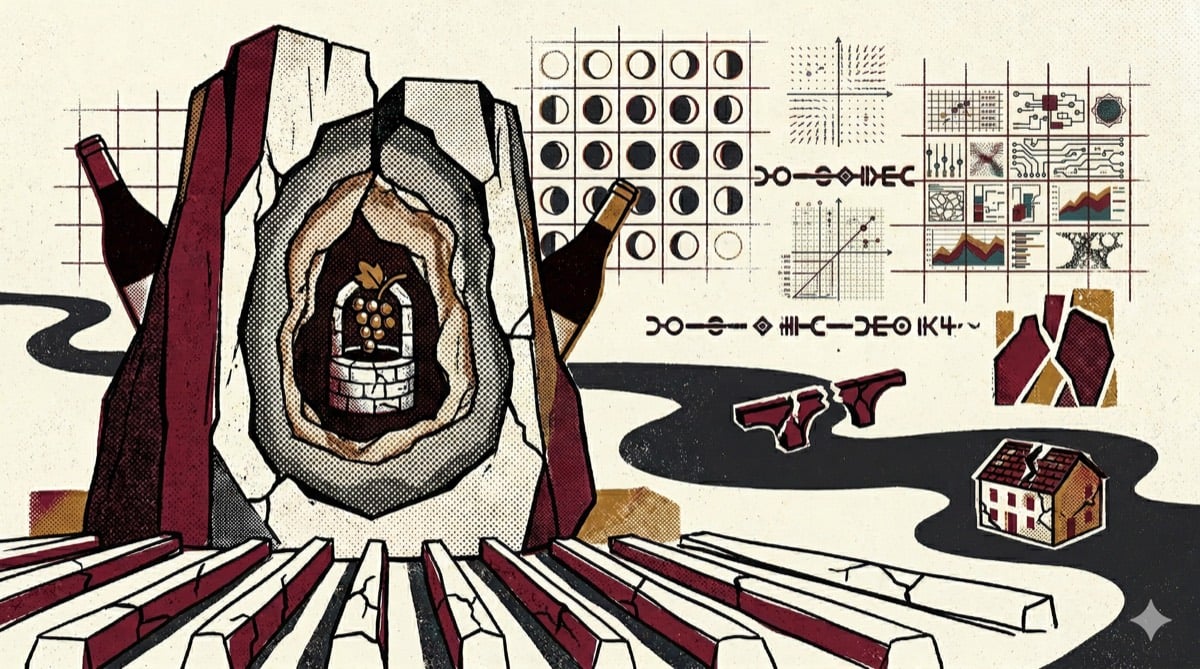
Drive south through Burgundy and somewhere around Tournus the air changes. Warmer, lighter, less overcast. The Côte d’Or is behind you and what opens up ahead is the Mâconnais wine region, the southernmost part of Burgundy, where Chardonnay ripens in something closer to actual sun and prices stay honest.
What is the Mâconnais?
The Mâconnais is a wine region in the Saône-et-Loire département, running from Tournus in the north down to Mâcon itself, with the Saône river as the eastern boundary. Rolling hills, old stone villages, and two dramatic limestone outcrops at Solutré and Vergisson that you can spot from kilometres away.
The soils are predominantly limestone and clay, the same foundation as the rest of Burgundy, but the climate is warmer and sunnier. Riper grapes, broader wines, fewer frost disasters.
Chardonnay is the dominant variety by a wide margin. Pinot Noir exists here as Mâcon rouge, but the region earns its reputation on white wine.
The appellations at a glance
| Appellation | What it is | What to look for |
|---|---|---|
| Mâcon | The base appellation | Approachable and early-drinking, but rarely exciting |
| Mâcon-Villages | Grapes from one of 27 approved communes | A named village on the label, such as Mâcon-Lugny, Mâcon-Verzé or Mâcon-Uchizy, is a quality signal |
| Saint-Véran | A separate appellation on the southern edge, right beside Pouilly-Fuissé | Lighter than its famous neighbour, but unmistakably interesting from a good producer |
| Pouilly-Vinzelles and Pouilly-Loché | Two small appellations next to Pouilly-Fuissé | Rarely discussed, which is exactly why they can offer value |
| Pouilly-Fuissé | The star of the region, with four communes and limestone crags | Home to all 22 premiers crus of the Mâconnais, recognised by the INAO in 2020 |
There are no grands crus in the Mâconnais, so the hierarchy reads differently from the Côte d’Or.
The appellations of the Mâconnais
The quality hierarchy here is simpler than on the Côte d’Or. There are no grands crus, and the 22 premiers crus that do exist all sit in Pouilly-Fuissé, recognised by the INAO in 2020. What remains is a ladder of appellations that is straightforward to read.
Mâcon is the base level. Accessible, early-drinking, rarely exciting.
Mâcon-Villages is one step up: grapes from one of 27 approved communes. Fresher and more focused than basic Mâcon. When the producer names the village on the label, such as Mâcon-Lugny, Mâcon-Verzé or Mâcon-Uchizy, that is a quality indicator worth noting.
Saint-Véran is a separate appellation at the southern edge of the Mâconnais, directly adjacent to Pouilly-Fuissé. Lighter than its famous neighbour but genuinely interesting from the right producer.
Pouilly-Vinzelles and Pouilly-Loché are small appellations sitting alongside Pouilly-Fuissé. Rarely discussed, but worth exploring for value.
Pouilly-Fuissé is the headline act. The appellation with the deepest terroirs, the limestone escarpments, the premiers crus, and the wines that show what this region is actually capable of.
What do Mâconnais wines taste like?
Riper and broader than Chablis, lighter and more accessible than the Côte de Beaune. That is the Mâconnais position.
A Mâcon-Villages from a good producer tastes of ripe apple, white pear and soft citrus. Fresh, not complex, ready early. A weekday wine that does its job.
Higher up the ladder the profile fills out. Saint-Véran adds a mineral undercurrent. Pouilly-Fuissé village has more texture, riper fruit, sometimes a subtle yeasty note if the wine has been aged on lees.
Oak plays a role in the better appellations, but the trend is toward restraint. The best wines let the Chardonnay grape and the terroir lead, or at least give that impression.
Producers worth knowing
The Mâconnais has strong cooperatives alongside individual domaines working at Côte de Beaune level.
Cave de Lugny is the region’s largest cooperative and delivers reliable quality at entry level. Not exciting, but honest.
Domaine de la Soufrandière (Bret Brothers) is the opposite: two brothers working biodynamically and making wines with a precision unusual for the Mâconnais. Their Mâcon-Vinzelles bottles are seriously good.
Olivier Merlin works from La Roche-Vineuse, making Mâcon-Villages and Pouilly-Fuissé with restrained elegance. Little oak, clean lines.
Domaine Ferret and Château Fuissé are the classic references in Pouilly-Fuissé: reliable across the range, with top cuvées that sit in a different category.
Domaine Valette in Chaintré produces wines with a deliberately oxidative edge that divides opinion, but for those who understand them they rank among the most interesting Chardonnays in the region.
Why the Mâconnais is underrated
The Mâconnais has never had the glamour of the Côte d’Or. No Romanée-Conti, no Montrachet, no name that ends up on a tasting menu in Tokyo. That works in your favour as a buyer.
A decent Mâcon-Villages costs less than ten euros. A serious Saint-Véran sits between €15 and €25. A proper Pouilly-Fuissé reaches €30 to €45, but a comparable quality level on the Côte de Beaune costs twice that or more.
For everyday drinking, the Mâconnais is the most honest region in Burgundy. For those who want to go deeper, the top appellations prove that Chardonnay has as much to say here as anywhere else; it just says it more quietly.
Sources
- BIVB: Mâconnais regional profile: bourgogne-wines.com
- INAO: Cahiers des charges Mâcon, Mâcon-Villages, Saint-Véran, Pouilly-Fuissé, Pouilly-Vinzelles, Pouilly-Loché: inao.gouv.fr
- Pouilly-Fuissé Premiers Crus: INAO 2020 decision: legifrance.gouv.fr