

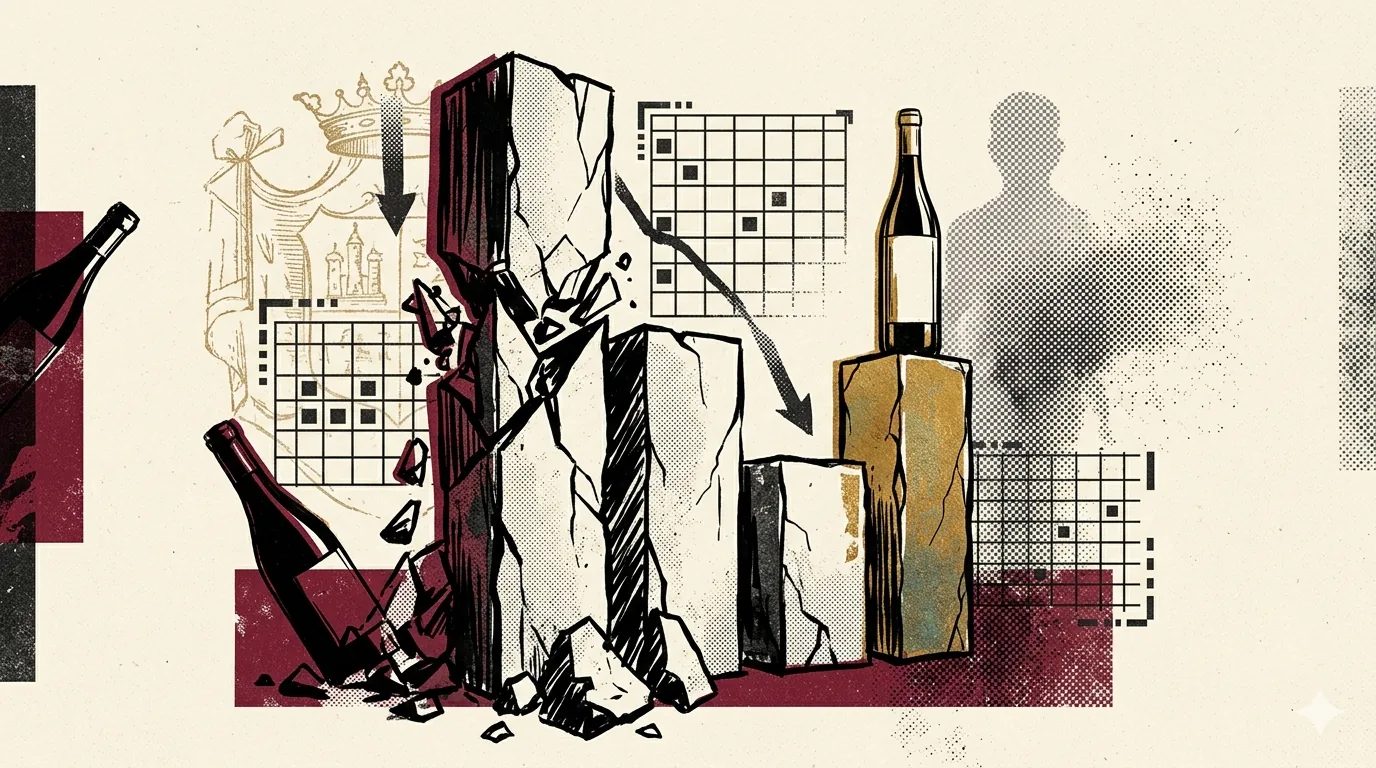
Volume is down 22% since 2019. Dollar sales are down 7%. That gap is the most important number in wine market trends 2026, and almost nobody is leading with it.
Over the past few months I’ve been reading three major industry reports back to back: the Wine Market Council findings from March 2026, Silicon Valley Bank’s 25th annual state of the industry, and IWSR’s global data. The picture that emerges is more nuanced than both the doom coverage and the “bright spots” cheerleading. Here’s what I keep coming back to.
The Premiumization Gap Is Real
The WMC number gets the headlines: US wine volume is about 70% of where it was in 2019. But SVB fills in the scale: 329 million cases in 2025, down from 410 million in 2019. That’s a loss of roughly one in five bottles over six years.
Revenue tells a different story. Total US wine value came in at $74.3 billion in 2025, down from $75.5 billion the year before. A 2% volume drop against a 1.6% value drop. People are buying fewer bottles at higher prices. The collapse is almost entirely concentrated below the $12 price point. That category has been deteriorating for years and now drags the aggregate volume numbers down with it. Wine above $15 is holding steady, or growing.
That’s why a thoughtfully chosen Champagne or a well-made Bourgogne Blanc sits in a different market than it did five years ago. Consumers are making fewer but more deliberate purchases, and that supports quality across the board.
SVB’s Rob McMillan was blunter than the WMC about the timeline: the market will likely bottom in 2027-2028 before returning to modest growth. “This is not a cycle you can wait out,” he said. The wineries growing today aren’t waiting for normal to return. They’re rebuilding how they engage.
Gen Z Is 7% of the Market and 90% of the Headlines
That’s WMC data, delivered by Zachaery Poelma from Southern Glazer’s. Seven percent. The generational hand-wringing is real, but the scale of the problem has been distorted.
What the numbers actually show: Gen Z wine spend grew 109% between 2020 and 2026. The once-or-twice-a-week drinking cohort is up 11 points over the same period. That sounds strong. Most of this generation couldn’t legally drink in 2020. Of course spend is up; the cohort now includes millions of legal adults it didn’t before.
The real constraint is financial. Boomers still spend three times more per year on wine than Gen Z. A 24-year-old with rent and student debt buys differently than a 55-year-old who has owned their place for fifteen years. That’s not indifference to wine. That’s math.
SVB adds a sharper warning, though: the industry can’t just wait for Gen Z incomes to rise. This cohort currently defaults to spirits, canned cocktails, and RTDs over wine. If wine doesn’t become relevant to their lives in the next few years, the income growth won’t automatically translate into wine purchases.
RTDs Are the Only Category Growing Globally
IWSR put global wine volume down 2.4% in 2025. Spirits down 1.3%. Beer down 0.2%. One category is growing: RTDs, up 1.3%. Wine-based RTDs specifically did substantially better in the US: dollar sales jumped roughly 30% to $1.2 billion off-premise (Impact Databank/Circana, 52 weeks to December 27, 2025).
That’s not a coincidence. It’s where convenience and accessibility intersect with the desire for lighter, lower-commitment drinks. US wine-based RTD volume reached around 15 million 9L cases in 2025, up from 12 million the year before — close to a quarter of growth in a single year (IWSR). The category has shed its reputation as the domain of cheap wine. Premium wine in cans is increasingly legitimate, and producers who figured that out early are well positioned.
The WMC made the blunter version of this point: a screwcap instead of a cork makes a bottle more portable. It sounds trivial. For someone buying wine for an outdoor occasion, it’s a real decision factor.
Europe Is in Structural Decline, Not Just Cyclical
US data dominates industry conversations, but Europe has its own version of this story. France’s per capita wine consumption fell from roughly 100 litres in 1960 to about 33 litres in 2025 (FranceAgriMer/OIV). That structural decline continues in the most recent decade: the behavior of daily wine drinking at lunch or dinner, which defined older generations, is not replicated by younger adults who live, eat, and socialize differently.
Ignacio Sánchez Recarte of CEEV, the European wine trade body, described it plainly: it’s a generational shift, not a temporary pullback. Spain and Portugal are exceptions (both showed growth in 2024), but the broader trajectory across traditional markets is down.
Germany and the Netherlands are tracking differently, with growing interest in premium and organic wines, rising online sales, and higher average spend per bottle. Premiumization works here, as long as the quality and the story hold up.
No/Low Is No Longer Niche
This is the trend I’m most focused on. In April 2025, Pernod Ricard completed the sale of its entire international wine portfolio (Jacob’s Creek, Brancott Estate, Campo Viejo, more than 10 million cases a year). The goal: focus on premium spirits and no/low alternatives. Diageo’s operating profit fell 27.8% in the fiscal year to June 2025, while its alcohol-free portfolio grew roughly 40% over the same period.
These aren’t companies chasing a trend. These are structural repositioning decisions based on where long-term demand is heading.
For wine, this has two implications. First, no/low is claiming occasions that used to default to wine: casual weeknight drinks, lunch with colleagues. Situations where “just having one” used to mean a glass of wine. Second, wine producers who take low-alcohol styles seriously now will be better positioned than those who wait. The Dutch market reflects this already: importers and wine shops increasingly present non-alcoholic wines alongside conventional bottles, not as an afterthought but as a parallel offering.
What the Wine Market Trends 2026 Actually Tell Us
The story across all three data sources is consistent: structural transition, not collapse. Volume shrinks, but quality spend holds. New formats lower barriers for new drinkers. No/low claims some of the casual occasion market. Gen Z exists, and will matter more as financial constraints ease.
The wine market trends 2026 don’t point to a dying category. They point to one that’s getting smaller, more selective, and more demanding of producers who want to stay in it. That distinction matters. For buyers, communicators, and anyone paying attention to where wine is actually heading.
Sources
- Wine Market Council & Southern Glazer’s (Zachaery Poelma, SVP Commercial Intelligence) — via Wine Enthusiast: “There Are Plenty of Bright Sides in the Wine Industry Right Now” (Kate Dingwall, March 2026)
- Silicon Valley Bank — State of the US Wine Industry Report 2026 (Rob McMillan)
- IWSR — Global beverage alcohol trends 2025
- Impact Databank / Circana — wine-based RTD off-premise data, 52 weeks to December 27, 2025
- Pernod Ricard — Press release on completion of sale of strategic international wine portfolio to AWL (April 30, 2025)
- Diageo — Preliminary Results FY2025 (fiscal year ended June 30, 2025)
- CEEV — Comité Européen des Entreprises Vins (Ignacio Sánchez Recarte, Secretary General)
- FranceAgriMer / OIV — historical French wine consumption data
More on News

EU wine labelling 2026: what changes on Dutch wine shelves?
Since 18 March 2026, the bottle in front of you reads differently. Kcal symbol, QR code, alcohol-free or dealcoholized. What does Regulation 2026/471 mean?
Read on →
Twelve Finos, ten cheeses, and one yeast layer that changes everything
The Secret Sherry Society went deep on Fino and Flor at a double masterclass featuring 12 wines and 10 cheeses paired by Betty Koster of L'Amuse.
Read on →
300-Year Time Machine: World's Oldest Sherry
Some discoveries happen by accident—a dusty barrel in a forgotten corner, a casual conversation about heritage, and suddenly, history reveals itself.
Read on →