

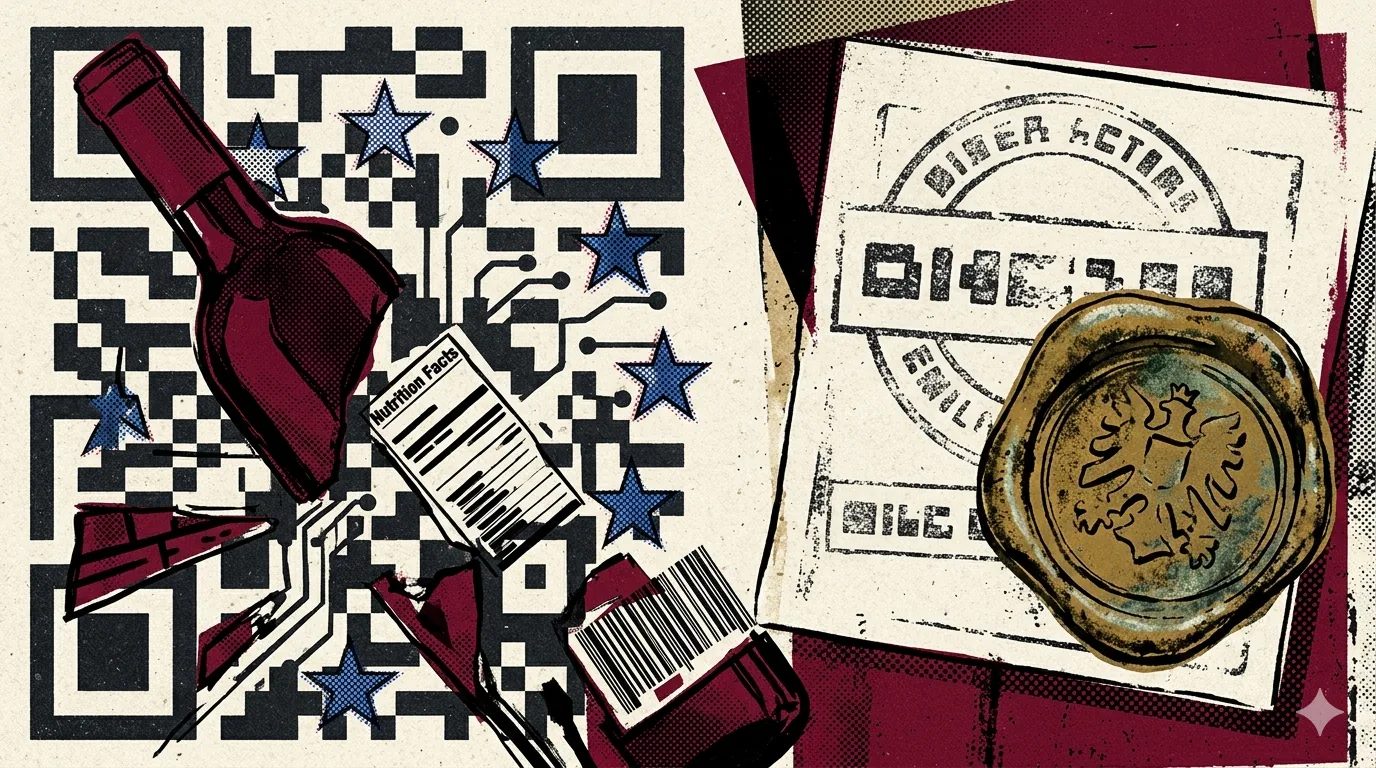
Pick up a bottle at any Dutch supermarket. Turn it round. Between the ABV and the allergens you now see a small black symbol: an E. Next to it sits a QR code. Welcome to EU wine labelling 2026 on the Dutch shelf.
On 18 March 2026, EU Regulation 2026/471 entered into force. The wine package aligns labels with general food rules, adds four new alcohol categories, and rewrites what Champagne or Chianti can call itself. Here is what now sits on that label, and why.
The big label changes
Since 18 March 2026 every newly produced bottle in the EU must carry four mandatory elements. On the physical label: the energy value next to an E symbol for kilocalories, plus allergens. Sparkling wines add the sugar content. Dealcoholized wines add a minimum durability date.
Everything else moves digital. A mandatory QR code links to full nutrition: fats, carbohydrates, sugars, proteins. The same QR also leads to the complete ingredients list, including additives, acidity regulators and substances that may trigger allergic reactions.
Brussels set tight rules for that QR. No personal-data tracking, no advertising, only a direct link to technical product information.
The European Commission is clear on the rationale.
“The additional information provided on the labels will enable consumers to make more informed choices. This comprehensive information will guarantee consumers maximum transparency when choosing and purchasing wine.” — European Commission, December 2023
Alcohol-free, dealcoholized, alcohol-reduced: what means what?
Four new categories appear on the shelf. They look messy at first, but the thresholds are strict:
- alcohol-free + 0.0%
- ≤ 0.05% ABV
- alcohol-reduced
- ≥ 30% lower than standard category strength
- partially dealcoholized wine
- 0.5% to minimum category strength
- dealcoholized wine
- < 0.5% ABV
A wine sitting at 0.03% may be called “alcohol-free 0.0%”. At 0.3% it becomes “dealcoholized wine”. A Chardonnay reduced from 13% to 9% qualifies as “alcohol-reduced”, because that is well over 30% below the category benchmark.
For brands like French Bloom, Leitz Eins-Zwei-Zero and Eins-Zwei-Zero this is a breakthrough. The terminology is finally harmonised across the EU. National-level fragmentation is over.
Champagne 0.0, Chianti 0.0: is that really allowed?
This part of the package made few headlines and may matter most. Before 18 March 2026, a wine with a Protected Designation of Origin (PDO) lost its name the moment you dealcoholized it. An alcohol-free Chianti could not legally be called Chianti. A 0.0% Champagne was legally impossible.
The new regulation flips that. PDO and PGI wines may now be dealcoholized and keep their geographical protection. “Dealcoholized Chianti” is legal. So is the equivalent for Champagne, Rioja DOCa or Bordeaux. The condition: clear labelling as reduced or dealcoholized, with QR access to nutrition and ingredients.
For a Bordeaux marketing team, that matters a lot. An appellation on a no/low bottle carries trust that a startup label simply cannot buy. Italian Argea, which invested €14 million in a dealcohol facility, can now take its existing name into the alcohol-free aisle.
What changes for the Dutch consumer in practice?
Your next shopping trip will surface three differences.
One: the E symbol makes calories visible without maths. An average Chardonnay delivers roughly 120 kcal per glass; a sweet dessert wine often double that. Conscious choices get easier.
Two: the QR code grants instant access to allergen info and additives. For readers with sulphite sensitivity or allergies this is directly practical. Scan and see.
Three: older vintages keep their old labels. The grandfathering rule states that wines produced before 8 December 2023 may sell through to stock exhaustion without relabelling. Expect a few years of mixed shelves before things look uniform.
What does it mean for importers and retail?
For anyone importing wine into the Netherlands, the pain shifts toward production and packaging. The European Parliament was explicit about the logic of the digital label.
“The content of the physical label placed on the back of the wine bottle can be limited to a nutrition declaration of the energy value. The full nutrition declaration and ingredients list can be provided through digital means identified on the label itself with a QR code.” — European Parliament, AGRI Committee briefing 2025
Dutch importers increasingly work with platforms like e-label.io. One QR covers multiple languages, so exporting to Germany or Belgium gets simpler. Albert Heijn, Gall & Gall and Hema do not need to relabel existing stock. New inbound stock will consistently carry the E symbol.
Fragmentation risk remains. If the Netherlands later adopts mandatory warning text the way Ireland did, the single market splits again. Until then, the EU format applies. For SME wine importers, promotion subsidies run sizeable: up to 60% from the EU budget directly and, combined with a national top-up, as much as 90% for SME promotion.
What else sits inside the wine package?
Behind the labelling sits a wider package: climate adaptation, overproduction, planting rights.
Growers can claim up to 80% EU subsidy on climate investments. Frost protection, water management, vineyard restructuring. For permanent grubbing-up, the removal of vineyard surface to fight oversupply, Brussels funds 100%.
Crisis distillation remains permitted, capped at 25% of the national wine budget per year. The 2045 deadline for planting authorisations is scrapped. A ten-year review cycle replaces it. Growers gain long-term certainty.
For a country like the Netherlands, with a small but growing wine industry in Limburg and the Achterhoek, the same subsidies apply. Applications run via RVO and the regional POP offices.
Timeline
Six dates worth remembering:
- 8 December 2023: nutritional info becomes mandatory for all wines produced from this date
- 5 February 2026: European Parliament approves the package 625-15
- 24 February 2026: European Council backs the measures
- 18 March 2026: EU Regulation 2026/471 enters full force
- Ongoing: grandfathering applies for wines produced before December 2023
- 2030: EU target for mandatory sustainable certification across all wine domains
Anyone walking into a Dutch wine shop today already sees the first vintage fully under the new rules. Within two years, the old label will have disappeared from the regular shelf.
Sources
- Vinetur (19 March 2026): European Union Enforces Sweeping Wine Labeling Rules
- European Parliament (5 February 2026): New measures to protect and promote the EU’s wine sector
- European Parliament EPRS Briefing (2025): Wine Package — PDF
- European Parliament Legislative Train: Wine Package overview
- European Commission Agriculture (7 December 2023): New rules for wine labelling enter application
- FoodIngredientsFirst (24 February 2026): EU Council backs new no-alcohol wine definitions and labelling reform
- Decanter: EU wine calorie labelling plan
More on News
Wine Market Trends 2026: What the Data Actually Says
Wine market trends 2026 are more nuanced than the headlines suggest. Key findings from WMC, SVB and IWSR data, and what they mean in practice.
Read on →
Twelve Finos, ten cheeses, and one yeast layer that changes everything
The Secret Sherry Society went deep on Fino and Flor at a double masterclass featuring 12 wines and 10 cheeses paired by Betty Koster of L'Amuse.
Read on →
300-Year Time Machine: World's Oldest Sherry
Some discoveries happen by accident—a dusty barrel in a forgotten corner, a casual conversation about heritage, and suddenly, history reveals itself.
Read on →