What happens when a fourth-generation Barolo producer decides everything needs to change? For Enrico Rivetto, the answer involved planting over 1,000 trees, creating 5 kilometers of biological corridors, keeping bees and donkeys, and making wines so unconventional that the DOC commission rejected them twice.
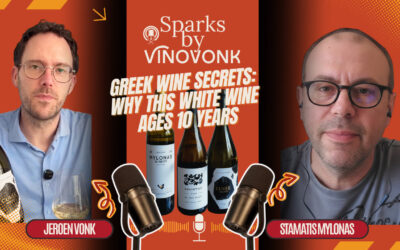
I recently sat down with Enrico for a Sparks by VinoVonk episode to taste two of his most radical wines: a Lange Nascetta 2021 (an almost-extinct indigenous white grape) and his controversial Nebbiolo dall’Anfora 2022. What started as a wine tasting turned into a profound conversation about agriculture, biodiversity, and what it means to put your heart before profit.
Thanks to Enrico for sending these wines and sharing his incredible story!
From Traditional Winemaker to “Trainer of Agricultural Organisms”
“I cannot be considered only a wine producer,” Enrico tells me. “Like a trainer of agricultural organisms, I can define myself in this way.”
That’s not wine marketing speak—it’s an accurate description of what he’s built over the past 17 years at his Vigna Lirano estate in the heart of Barolo, between the villages of Serralunga d’Alba and Sinio.
The Rivetto family has been making wine since 1902, and Enrico represents the fourth generation. But when he turned 30, something shifted. “I started a different approach in the vineyard and of course also in the cellar and of course also in my life,” he explains. “We decided to recreate one complex ecosystem.”
Why Biodiversity Matters in Barolo’s Monoculture Landscape
The Lange Hills are stunning—rolling vineyards as far as you can see. But that visual beauty hides an agricultural reality: extreme monoculture. “You see vineyards everywhere. But it’s never been like this,” Enrico points out. “Before, there was much more differentiation of the cultures.”
His biodiversity project is staggering in scope:
- 1,000+ trees planted in the last 12 years (big trees, not saplings)
- 5 kilometers of biological corridors with rosemary, sage, lavender, mixed bushes, and fruit trees
- 7 hectares of woods surrounding the winery as a protective buffer zone
- Sixbeehivess for pollination and honey production
- Fields for ancient grains: wheat and heritage corn varieties
- Composting area for natural soil amendments
- Donkeys as part of the integrated farming system
And here’s the crucial detail: 85% of his winery sits in the same place, all on the hill at 400 meters above sea level. This concentration allows for true ecosystem management.
“Everything is on my hill,” Enrico says. “And that’s a big advantage.”
The Lange Nascetta: Rescuing an Indigenous White from Extinction
Our first wine is the Lange Nascetta 2021, a grape variety that completely disappeared from the Lange Hills after World War II. Today, only 45 producers make it—and Enrico is the only one with north-facing Nascetta vineyards.
“We release the Nascetta after three years,” he tells me. “We consider the Nascetta almost like a Barolo.”
That’s not hyperbole. French oenologists who studied Piedmont’s wines in the 18th century compared Nascetta to German Riesling for its aging potential. But when Enrico began working with it in 2007, there was almost no information available. “We changed the approach at least three times because we didn’t know anything about this grape variety.”
The Vinification: Part Red, Part White
Here’s where it gets interesting. The current Nascetta vinification is split:
- 30% vinified in red: One month of skin maceration and fermentation in concrete or terracotta amphora
- 70% cold skin maceration: Three days before fermentation with natural yeasts
When both parts finish fermenting, they’re blended and aged in large oak barrels for nine months. The wine rests in the bottle for two more years before release.
The result? A white wine with serious structure and aging potential, expressing both freshness and depth.
Nebbiolo dall’Anfora: Seven Months of Maceration and Zero DOC Approval
Our second wine is where Enrico’s philosophy really shines—or rather, where it crashes head-on with traditional wine regulations.
The Nebbiolo dall’Anfora 2022 spends seven months macerating on skins in terracotta amphora. For context: most red wines macerate for days or weeks, not months. “After the first three months, the tannin extraction was very aggressive,” Enrico recalls. “But after three, four months, these tannins are starting to build a chain, more sophisticated, moderate.”
What fascinates him about amphora is purity: “The amphora keeps and preserves the wine like it is because it’s skin. The skin is the wine.” No oak influence. No steel. No concrete. Just Nebbiolo and terracotta, breathing together for seven months.
The DOC Rejection Story
This wine was rejected twice by the appellation commission, not for defects—simply for being too different.
“I was a little bit angry about that. So not angry, but disappointed,” Enrico admits. “There’s no defect. This is probably the real Nebbiolo. There’s no influence of anything. And you reject it to the commission.”
His response? A form of protest. The label features artwork painted by his daughter when she was six years old (she’s now 16). It’s beautiful, personal, and completely defiant of wine label conventions.
“That was a form of protest. I remember my daughter was drawing my logo.”
My Tasting Experience
Lange Nascetta 2021
The Nascetta presents a fascinating contradiction: fresh yet structured, delicate yet powerful. On the palate, you feel the dual vinification—there’s white wine brightness combined with a subtle tannic grip from the 30% red vinification—with complex layers that keep unfolding.
It’s a wine that demands food, that rewards patience, that completely rethinks what Piedmont white wine can be.
Nebbiolo dall’Anfora 2022
When Enrico told me seven months of maceration, I braced for a tannic monster. But here’s the revelation: “You feel the tannins but in a very nice way. It’s still very fresh, very fruity, and a lot of roundness.”
He’s absolutely right. The tannins are present—you can’t hide seven months of skin contact—but they’re velvety, integrated, sophisticated. The wine has remarkable freshness for such an extraction. Different layers of taste and aromas, lots of herbs and spices, and yes, serious food-pairing potential.
This is pure Nebbiolo—no oak to soften or shape it, just the grape expressing itself through terracotta and time.
“Put Your Heart First, We’ll Find a Way for the Money”
Perhaps the most powerful moment in our conversation came when we discussed his philosophy on who works at the estate.
“The people who are coming here need to have heart. They have to put the heart in front. Afterward, we will find a way to secure the funds. It’s not the opposite.”
This isn’t naive idealism—it’s 17 years of evidence-based practice. “You have to put your talent, your passion, your soul inside. And after we find a way.”
The Quantum Effect of Small Actions
Toward the end of our conversation, Enrico shared something profound about change:
“If I do something, even if in a small place, even if on a small scale, the energy that it develops—somebody in some other part of the world can receive it and can do the same thing. Or maybe I’m doing this because somebody else is already inspiring me in a small detail, and the things change.”
His message is clear: don’t wait for someone else to solve problems. Start where you are, with what you have, and create change.
“We don’t have to expect that somebody do something for us. You have to do it yourself.”
Conclusion: When Wine Becomes Bigger Than Wine
Sitting across from Enrico (virtually), tasting these two remarkable wines, I was reminded why I love wine so much. It’s never just about what’s in the glass.
These wines tell the story of a man who looked at his family’s 122-year-old winery and asked: “What if we did everything differently?” They represent biodiversity restored, monoculture interrupted, indigenous grapes rescued, and traditions questioned.
The Nascetta brings back a nearly-lost piece of Piedmont’s heritage. The amphora Nebbiolo challenges what Barolo “should” taste like—and gets rejected for its honesty.
Both wines are available in the Netherlands (links in show notes). If you find yourself in Piedmont, Enrico welcomes visitors to Vigna Lirano to see the ecosystem firsthand.
Listen to the full episode of Sparks by VinoVonk for the complete conversation, including more details about his future dreams: creating a network of like-minded producers exchanging knowledge, products, and passion.
As Enrico says, if the music resonates with you, you’ll start dancing—maybe not the same way as everyone else, but in your own way.
Salute!