

Few wines announce themselves as quickly as Chablis. That sharp acidity, the dry mineral character, the lean texture that hides nothing. Chablis wine is Chardonnay, but it tastes like nothing else Chardonnay produces anywhere.
Where is Chablis and what makes it distinctive?
Chablis sits in the Yonne département, the northernmost point of Burgundy, about 180 kilometres south of Paris. Geographically it has more in common with Champagne than with the Mâconnais: cold, frost-prone, with short growing seasons. Grapes ripen slowly and sometimes incompletely here. That is not a flaw; it is the product.
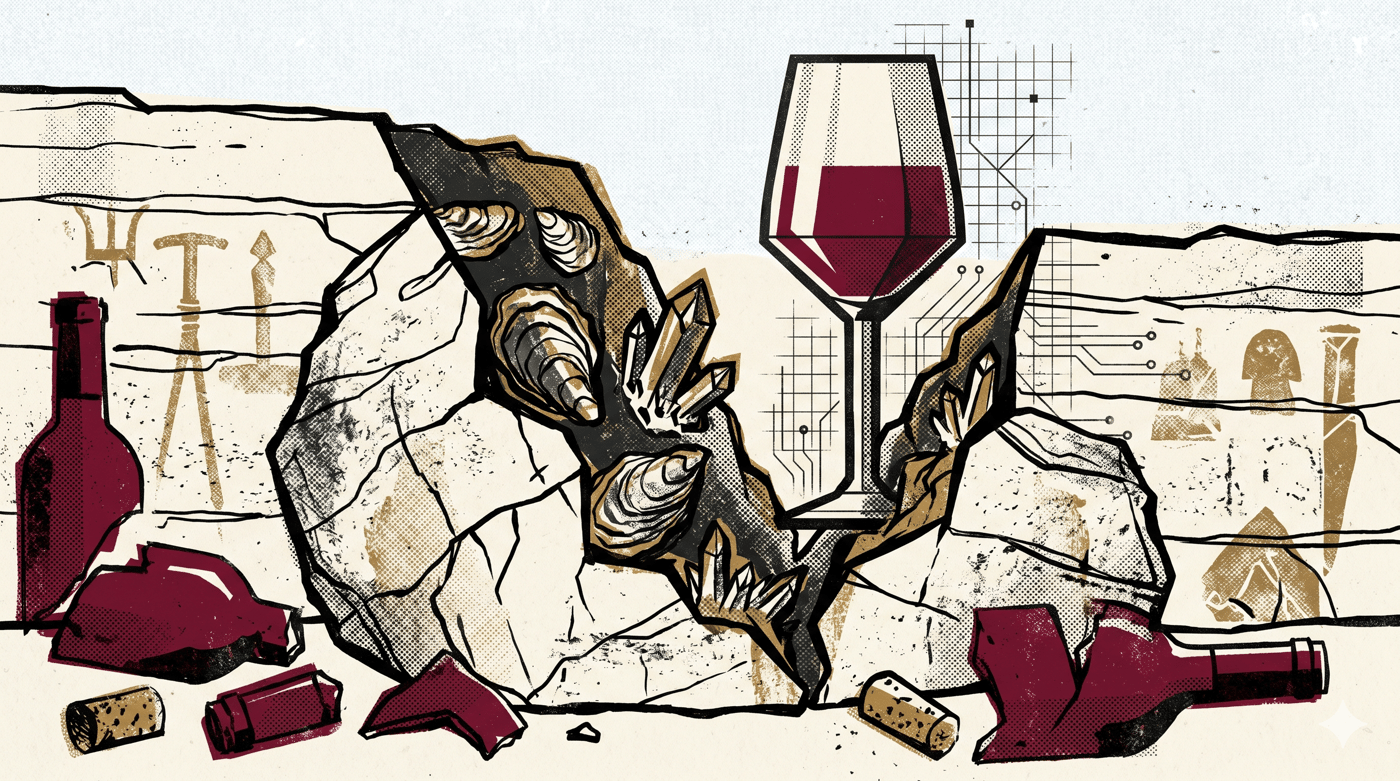
The soil is Kimmeridgian limestone, a Jurassic-era chalk layer dense with fossilised oyster shells. That soil gives Chablis its unmistakable mineral character. Winemakers describe it as flint, chalk, wet stone. Taste it and you understand what they mean.
Chardonnay is the only permitted variety. No other grapes, no blends. Everything that Chablis produces is Chardonnay that leans into its environment rather than fighting it.
The quality hierarchy
There are four levels.
Petit Chablis is the entry level: lighter, simpler, early-drinking. Fine for what it is, but not where the interest lies.
Chablis is the base appellation. From a good producer it is already genuinely compelling: bright acidity, green-yellow fruit, that mineral undercurrent. Drink it young, within two to four years.
Premier Cru covers 40 individual lieux-dits grouped into 17 official premiers crus. Montée de Tonnerre, Montmains and Fourchaume are the ones most worth knowing. More complexity, more depth, more ageing potential. Five to eight years is normal.
Grand Cru is the top: seven climats on a single hillside north of the village, with Les Clos, Valmur and Blanchot among the most sought after. The most expensive and longest-lived Chablis. A grand cru needs a decade to really open; drink it earlier and you are missing half of what it has to say.
Flavour profile: what does Chablis taste like?
The first impression is always acidity. Not aggressive, but present like a backbone. Then citrus, green apple, sometimes a suggestion of white plum in warmer years. In the background: chalk, wet stone, iodine in the better bottles.
The texture is lean compared to Pouilly-Fuissé or a Meursault. That is deliberate. Chablis is built for precision, not generosity. Anyone looking for a broad, creamy Chardonnay is in the wrong place. Anyone looking for tension, sharpness and length is exactly where they should be.
Oak is a long-running argument here. Traditional producers like Raveneau and Dauvissat use small barrels, and handle them well enough that you barely notice. Modern producers work exclusively with stainless steel or large neutral vessels. Both approaches can produce excellent wine. What matters is whether the wine holds together, not what it touched.
Chablis versus other white Burgundies
The direct contrast is with the Mâconnais: warmer climate, riper grapes, broader texture. Chablis is at the opposite end of that spectrum.
Against Bourgogne Blanc: Bourgogne Blanc is the generic appellation with no geographic boundary guaranteeing quality. Chablis has a specific location, a specific soil, a specific climate. That difference is audible in the glass.
Against Pouilly-Fuissé: both are Burgundian Chardonnay, but they say different things. Pouilly-Fuissé is richer and more approachable. Chablis is tighter and more challenging. Which one you reach for depends on the evening.
Producers and what to buy
Domaine Raveneau is the absolute reference point. Difficult to find, not cheap, but every cliché about Chablis turns out to be true here. Buy if you get the opportunity.
Vincent Dauvissat sits next to Raveneau in reputation. Biodynamic, traditional, unhurried. His premiers crus are formidable.
William Fèvre is a larger producer with a consistently reliable range. More accessible than Raveneau and trustworthy across the appellation hierarchy.
Domaine Pinson and Domaine Laroche are solid mid-range producers: their premier cru bottles deliver year after year.
For an honest introduction on a modest budget: a basic Chablis from La Chablisienne, the local cooperative, gives an accurate picture of the appellation for under €12.
Serve cold, around 9 to 10°C. Any colder and the wine shuts down. And pair it with oysters if you get the chance. That Kimmeridgian soil full of fossilised oyster shells is not a coincidence.